

Public Fountains for Parks & Rec Departments: 2026 Guide

Parks and recreation departments buying public fountains need equipment built for nonstop outdoor use, ADA compliance, and years of service without a maintenance visit every month. Unlike an office or a gym, a park department juggles multi-site rollouts, freeze cycles, heavy dog traffic, and a capital budget that gets approved once a year — the fountain has to work the first time, because the second chance might not come until next fiscal year.
- Public fountains for parks and recreation departments need vandal-resistant stainless steel or concrete, ADA hi-lo access, and freeze-resistant valves in cold climates.
- The Elkay LK4420FRKGRY bi-level pedestal fountain covers standard park installs where freeze protection matters most in 2026.
- Add a pet station — the Willoughby WODF-3-HC-PET or an Elkay bi-level unit with a built-in pet bowl — wherever dog traffic is heavy.
- Budget for winterization and a maintenance plan before the fountain ships, not after the first hard freeze.
Why public fountains matter for parks and recreation departments
A park fountain sits outdoors in full weather exposure and takes heavier daily use than an office cooler ever will. It also faces vandalism that indoor units rarely see — kicked bases, forced valves, graffiti on stainless steel. Reviewing how to choose a commercial drinking fountain for parks before you write the spec sheet saves a rebid later.
Most parks departments run on annual capital plans. A fountain that fails mid-season often waits months for replacement funding because the money wasn't in this year's line item. That single fact changes how you should buy in 2026: durability and freeze protection aren't upgrades, they're the difference between a fountain that survives to the next budget cycle and one that doesn't.
ADA compliance is not optional on public property. Federal ADA Standards for Accessible Design require at least one fountain with a spout no higher than 36 inches and clear knee space underneath, and a standard-height unit where only one fountain serves a site. That's exactly why bi-level fountains dominate the public parks category — one product code satisfies both height requirements instead of two separate purchase orders.
How to spec public fountains for a parks and recreation department
Work through these steps before a single unit ships. Skipping the traffic count or the freeze check is the fastest way to end up replacing a fountain in year two instead of year ten.
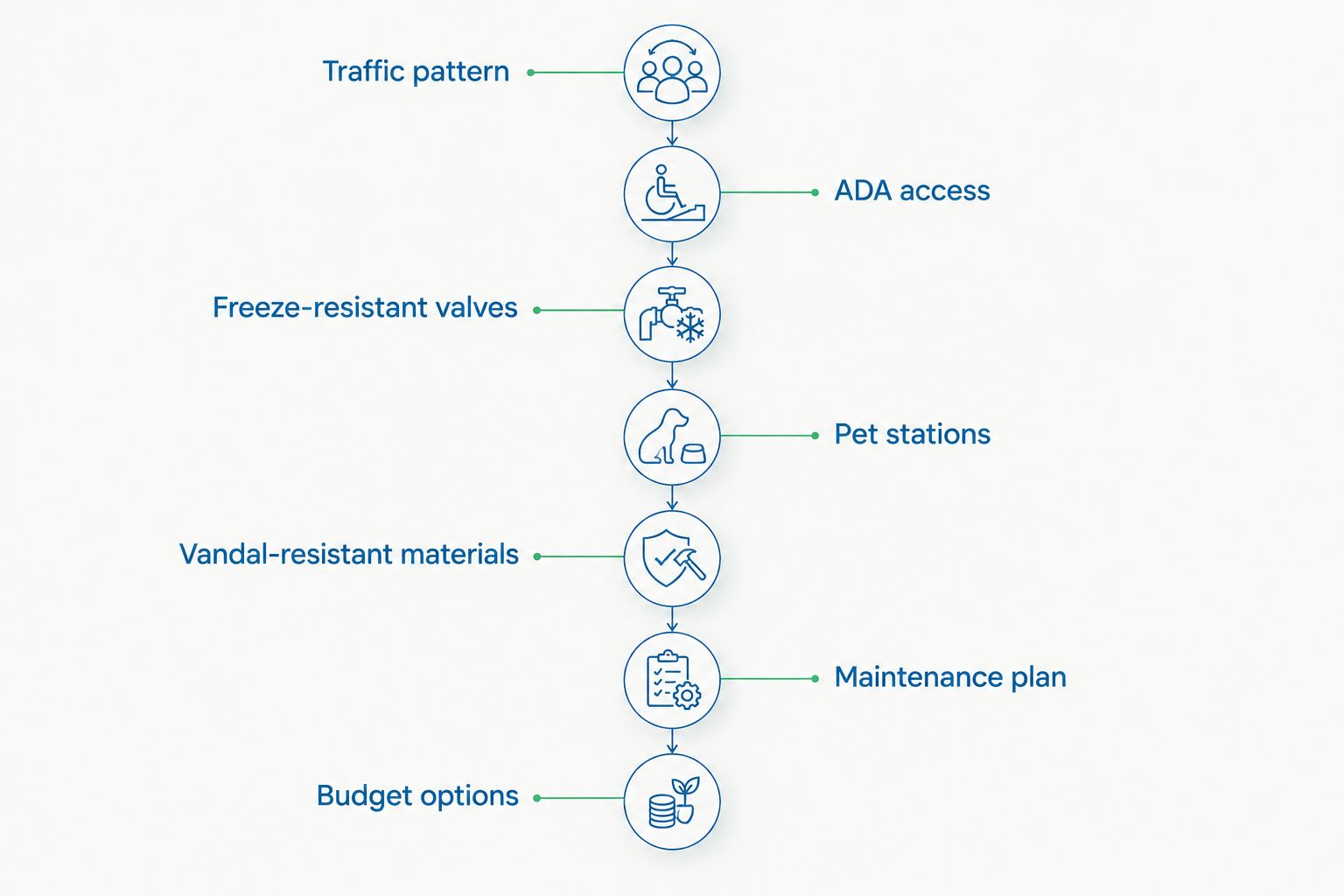
Match the fountain type to your traffic pattern
- Count daily foot traffic at each site before specifying anything
- Separate high-traffic hubs (ballfields, splash pads, playgrounds) from low-traffic trailheads
- Budget one fountain per major gathering point, not one per park
- Add a bottle filler head at high-traffic sites to cut plastic bottle litter
- Compare a bi-level pedestal fountain against a single pedestal unit for lower-traffic sites
Specify ADA-compliant access at every location
- Confirm a spout height of 36 inches or less with clear knee space on at least one unit per site
- Pair a standard-height fountain with the accessible unit if you're not installing a bi-level model
- Check approach clearance — a clear floor space in front of the fountain, not blocked by a bench or planter
- Favor a factory bi-level pedestal fountain that builds both heights into one casting instead of two separate fixtures
Choose freeze-resistant valves for your climate
- Check average frost depth for your service area with the local water utility
- Specify a freeze-resistant valve for any site that sees sub-32°F nights for more than a few weeks a year
- Add a manual shutoff and drain if you're winterizing outdoor lines seasonally instead of running them year-round
- Skip freeze-resistant hardware only in true no-freeze climates — it can't be retrofitted without replumbing later
Add pet stations where dog traffic is heavy
- Walk the park and note off-leash areas, trailheads, and dog park entrances
- Install a combined human and pet fountain like the Willoughby WODF-3-HC-PET at shared-use paths
- Reserve a standalone pet bowl fountain for dedicated dog parks only
- Route pet station drainage away from foot traffic to cut slip hazard around the base
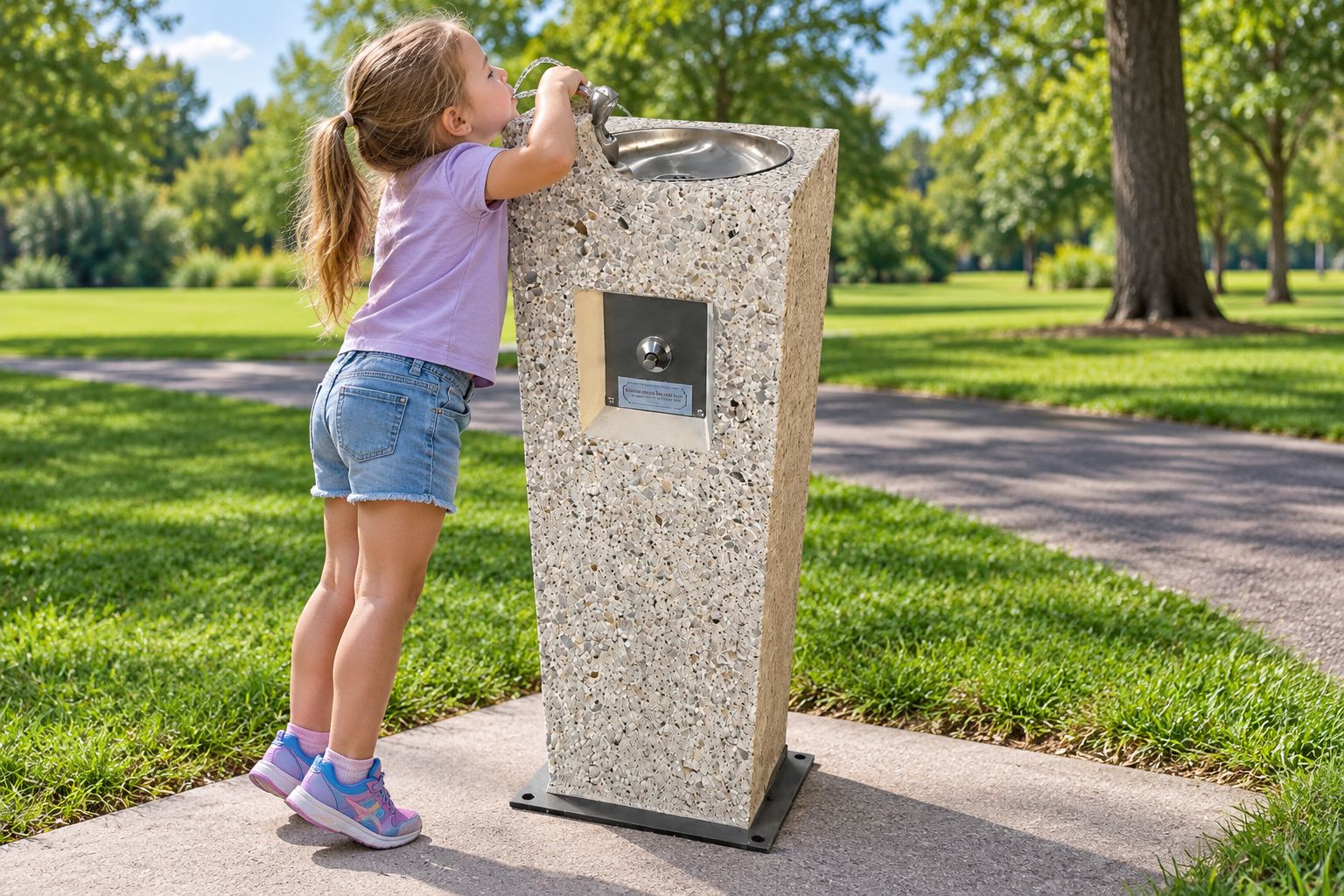
Confirm vandal-resistant materials and mounting
- Specify 300-series stainless steel or reinforced concrete over painted metal
- Choose bolt-down pedestal mounting rated for public sites, not surface-mount anchors meant for indoor use
- Route plumbing lines inside the pedestal instead of leaving them exposed below the bubbler
- Ask for tamper-resistant fasteners on any access panel
Set a maintenance and winterization plan before ordering
- Assign a crew or contractor to shut down and drain freeze-prone lines each fall
- Stock spare bubbler heads and push-button valves — these fail first under heavy public use
- Schedule a mid-season inspection for splash pad and ballfield fountains
- Log service calls by fountain so next year's replacement budget request has a paper trail
Get comparable options into next year's budget request
- Pull at least three fountain options at different price points before the capital plan is due
- List pet stations and bottle fillers as separate budget line items, not bundled add-ons
- Attach spec sheets showing ADA height and freeze rating for the reviewing board
- Request quotes early in the 2026 budget cycle so procurement isn't rushed at year-end


Quick comparison for parks and recreation departments
The Elkay LK4420FRKGRY bi-level pedestal fountain is the safest default for a standard park site in 2026 — it covers ADA height and freeze protection in one unit.
| Option | Best for | Key limitation |
|---|---|---|
| Elkay bi-level pedestal fountain, freeze-resistant | Standard park installs in freeze-prone climates | No built-in pet station |
| Willoughby WODF-3-HC-PET | Shared-use trails and off-leash areas needing human and pet access | Larger footprint than a single pedestal |
| Elkay bi-level fountain with pet station | Multi-use parks wanting one unit for people and dogs | Higher upfront unit cost than two separate fountains |
| Stern-Williams concrete pedestal fountain | Budget-limited departments prioritizing durability over extra features | No pet station or bottle filler built in |
Common mistakes parks and recreation departments make
- Specifying single-height fountains, then fielding an ADA complaint the following season
- Skipping freeze-resistant valves to save budget, then paying for emergency plumbing repairs mid-winter
- Buying painted metal instead of stainless steel or concrete and repainting it every year
- Forgetting pet stations, then dealing with dogs drinking from the fixture meant for people
- Treating every park as one fountain per site regardless of actual foot traffic
FAQ
What's the best public drinking fountain for a parks and recreation department in 2026?
A bi-level pedestal fountain like the Elkay LK4420FRKGRY is the safest default for most park sites because it meets ADA height requirements and adds freeze protection in one unit. Budget-limited departments can use a Stern-Williams concrete pedestal fountain instead.
Is a bi-level fountain required by ADA?
ADA doesn't name 'bi-level' specifically, but it requires a spout no higher than 36 inches with knee clearance plus a standard-height option at each location. A bi-level fountain is the simplest way to meet both requirements with a single product.
How do parks departments protect fountains from freezing?
Freeze-resistant valves and a seasonal shutoff and drain protect outdoor fountains through winter. Departments in true no-freeze climates can skip this hardware, but it can't be added later without replumbing the unit.
Do public fountains need pet stations?
Pet stations aren't required by code, but they're standard at dog parks, trailheads, and shared-use paths. Adding one keeps dogs off the fixture meant for people and cuts complaint calls.
What material holds up best for outdoor public fountains?
300-series stainless steel and reinforced concrete outlast painted metal in outdoor public settings. Both resist rust, dents, and repeated vandalism without repainting.
Can one drinking fountain serve an entire park?
It depends on foot traffic — one fountain per major gathering point (ballfield, playground, splash pad) is the standard approach, not one per park. Low-traffic trailheads can often share a single unit.
How often should a public drinking fountain get serviced?
Most departments run a mid-season inspection plus a fall winterization visit for freeze-prone sites. Logging service calls by fountain also builds the case for next year's replacement budget.
Where can parks and recreation departments buy commercial drinking fountains?
The Fountain Direct carries bi-level pedestal fountains, pet stations, and bottle fillers built for park sites, with freeze-resistant options for cold climates. Compare models by traffic level and climate before requesting a quote.
One last thing
The pet station is usually the first line item cut when a parks budget gets trimmed — and it's the cheapest way to stop dogs from drinking out of the fixture built for people. If the 2026 budget only stretches to one upgrade beyond the base fountain, put it there before the coating or the finish.