

Drinking Fountain Without a Floor Drain? Yes | 2026

Yes, you can install a drinking fountain without a floor drain when its basin connects to an approved waste system and local requirements do not call for a separate floor drain. No floor drain does not mean no drainage: you still need a compliant route for unused drinking water, plus any additional drainage the selected equipment requires.
- Can you install a drinking fountain without a floor drain? Yes, with approved fixture drainage and local approval.
- A basin drain carries unused drinking water; a floor drain collects water from the surrounding floor.
- Confirm the waste connection, trap, venting, and installation instructions before ordering a drinking fountain.
- The Fountain Direct sells commercial drinking fountains; select equipment only after confirming the site's plumbing requirements.
Can you install a drinking fountain without a floor drain?
A separate floor drain is not automatically necessary for every drinking fountain installation. A wall-mounted fountain can discharge through its basin outlet into building waste piping without sending that water across the floor. The final arrangement depends on the manufacturer's instructions and the plumbing requirements adopted where you install it.
Use the drinking fountain specification guide for architects when assembling the equipment and installation requirements for your project.
| Installation situation | Can it work without a floor drain? | Main advantage | Main limitation |
|---|---|---|---|
| Wall-mounted fountain with an approved wall waste connection | Yes, if the installation meets local requirements | Basin water enters enclosed waste piping | The waste connection must match the fixture and plumbing design |
| Replacement fountain using existing waste piping | Yes, if the existing arrangement is suitable | You can retain a usable drainage route | Old piping and new rough-in locations need inspection |
| New fountain with water supply but no waste connection | Not as a conventional plumbed installation without adding approved drainage | You can choose the location before construction | A water supply alone does not complete the installation |
| Outdoor fountain without nearby building waste piping | Only with an approved drainage design | The drainage plan can suit the outdoor site | Outdoor placement does not authorize discharge onto the ground |
For a 2026 project, establish the drainage arrangement before selecting the mounting position. A convenient wall is not necessarily a workable plumbing location.
Why this matters
Confusing a fixture drain with a floor drain leads to the wrong purchase decision. You can have no visible grate in the floor and still have a fully drained fountain. Conversely, a nearby grate does not establish that you can connect a particular fountain to it.
The distinction also affects construction scope. A usable wall waste connection can avoid the need to create a new floor opening, but relocating the fixture still requires checking pipe routing, wall support, accessibility, and service access.
Choose the drainage route before choosing the fountain. That order keeps an equipment selection from becoming a plumbing redesign after delivery.
What is the difference between a basin drain and a floor drain?
Basin drain: water from the fountain
The basin drain collects water that leaves the bubbler but is not consumed. Its outlet connects to the fixture's waste arrangement, which must follow the equipment instructions and applicable plumbing rules. The basin is part of normal fountain operation, not an emergency spill container.
A drain opening built into the fountain does not dispose of water by itself. You still need the downstream connection. Check the installation drawing for the outlet location, required fittings, and access needed to assemble and maintain that connection.
Floor drain: water on the floor
A floor drain receives water from the surrounding floor surface. Its presence is a separate question from how the fountain's basin drains. Room use, cleaning practices, equipment requirements, and local rules can affect whether a floor drain belongs in the project.
Do not specify a floor drain solely because the fountain stands on the floor. Mounting style describes how the equipment is supported; it does not establish its waste connection.
Trap and vent: parts of the drainage design
A plumbing trap maintains a water seal that helps prevent sewer gases from entering the occupied space. Venting supports proper drainage and protects trap seals. The approved design determines how these requirements apply to the fountain connection.
Do not copy a nearby sink connection without checking it. Pipe routing, connection elevation, and the adopted plumbing code all matter, even when the fixtures occupy the same room.
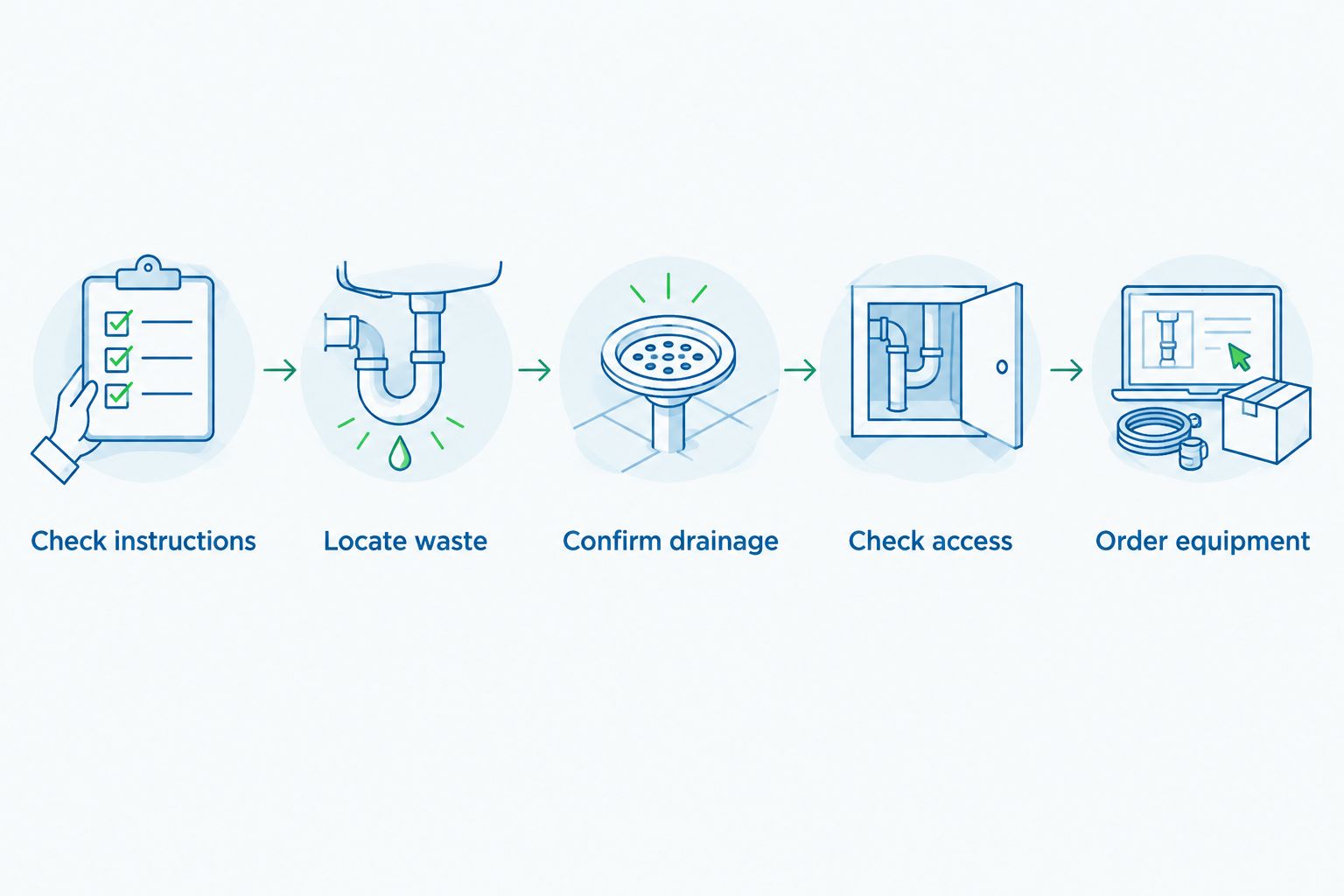
How do you confirm the installation before ordering?
Use this sequence for your 2026 purchase. Give the installer the proposed model's installation instructions, not just a photograph or sales description.
- Check instructions. Identify the fountain's supply inlet, waste outlet, mounting requirements, and any separate equipment connections. A combined fountain and bottle filler needs review as a complete assembly.
- Locate waste. Establish where the basin water will go. Record the existing connection's location and condition, or identify the approved route for new piping.
- Confirm drainage. Have the plumbing contractor check the proposed trap, venting, pipe arrangement, and connection against local requirements. Confirm whether a separate floor drain or other receptor is required.
- Check access. Verify that the fountain fits the accessible layout and that maintenance panels, shutoffs, filters, and waste fittings remain reachable.
- Order equipment. Select the exact model after the plumbing and mounting details agree. Keep the installation drawing with the purchase information so the delivered fixture can be checked against the approved plan.
An existing waste stub-out is useful evidence, not automatic approval. Ask the installer to inspect it before assuming that a replacement fountain will connect without changes.
Which installation approach fits your site?
Best for a usable wall waste connection: a wall-mounted fountain. This arrangement keeps the basin discharge in enclosed piping rather than relying on floor collection. Its limitation is that the selected model's rough-in and support requirements must fit the wall.
Best for a straightforward replacement: a fountain matched to verified existing services. Retaining suitable supply and waste connections limits changes to the installation. The drawback is that a similar-looking replacement can still have different connection locations or mounting requirements.
Best for a site without existing waste piping: a planned new drainage connection. This gives you a defined discharge route before the fixture arrives. It also adds construction work that a water-supply-only assessment misses.
Do not treat a catch bucket, loose hose, or discharge onto a walkway as a substitute for an approved installation. These arrangements leave routine wastewater handling unresolved and are not a basis for specifying a conventional commercial fountain.
For outdoor sites, separate basin wastewater disposal from surface drainage around the pad. The fountain needs an approved discharge arrangement, while the surrounding walking surface also needs attention to avoid standing water. One design does not automatically solve the other.
Why drainage requirements vary
The equipment and installation setting determine what your contractor must check. For a 2026 renovation, resolve these factors before approving the order:
- Selected equipment: A fountain, a combined fountain and bottle filler, and a refrigerated assembly have different installation instructions. Check the complete assembly rather than assuming every component shares the same requirements.
- Mounting location: A wall-mounted fixture needs suitable support and reachable connections. A pedestal fixture needs a compatible base and a planned route for services.
- Existing plumbing: A nearby waste connection is useful only when its position, condition, and approved use suit the installation. Photograph and measure it before selecting replacement equipment.
- Indoor or outdoor placement: Outdoor equipment needs a site-specific drainage plan. Do not assume that soil, landscaping, or a stormwater inlet is an approved destination for fountain discharge.
- Accessibility: Drain piping and protective covers must fit within the required approach and clearance layout. Moving the fixture to simplify plumbing must not compromise access.
- Adopted local requirements: The building official or plumbing authority determines which requirements apply at your address. Manufacturer instructions alone do not replace that review.
The practical question is not simply whether a floor grate exists. It is whether the complete installation has an approved path for water from the basin to its permitted destination.
What should you check when buying a wall-mounted fountain?
The Avalon A51 water fountain and bottle filler with chiller is a wall-mounted fountain and bottle-filling option in the supplied product catalog. That format is relevant when you want drinking and bottle-filling functions at the same location. It does not establish that your wall has suitable drainage.
Before choosing that assembly, match its current installation drawing to the site's supply, waste, support, and electrical provisions. The benefit is combining drinking and bottle filling; the constraint is coordinating the complete assembly rather than treating it as a supply-only appliance.
The Fountain Direct is a commercial drinking fountain supplier for schools, contractors, and public facilities. Use the product selection to identify the required equipment, then have the installer confirm its fit with the approved plumbing arrangement.
A useful purchase brief states the location, intended users, mounting format, available services, and required features. Include photographs of existing connections and the planned installation area. Do not describe the site only as having no floor drain; that leaves the most important connection question unanswered.
Does accessibility change where the drain can go?
Yes. Your drainage layout must coexist with the accessible approach, knee clearance where required, and protection around exposed plumbing. Accessible equipment still needs an accessible installation.
For a 2026 U.S. project, the U.S. Access Board's ADA drinking fountain guidance provides useful checks:
- A wheelchair-accessible drinking fountain has a spout outlet 36 inches maximum above the finish floor or ground.
- A drinking fountain for standing users has a spout outlet 38 to 43 inches above the finish floor or ground.
- The standard clear floor space is 30 by 48 inches; the required approach and any applicable exceptions depend on the installation.
These measurements address accessibility, not permission to omit drainage. They also do not replace the full accessibility review, which includes operable parts, clearances, protruding objects, and the arrangement of drinking facilities.
Check plumbing and accessibility together. A trap or pipe that fits behind the equipment can still create a problem if it intrudes into required user space or lacks required protection.
Can I connect the fountain to an existing sink drain?
An existing sink drain is not automatically a suitable connection for a drinking fountain. Have the plumbing contractor verify the proposed branch connection, drainage capacity, trap arrangement, and venting before approving it.
A nearby sink can make a location worth investigating, but proximity alone does not establish compliance. Avoid improvised hoses or connections that bypass the approved plumbing design.
Does a bottle filler eliminate the need for drainage?
A bottle filler does not automatically eliminate drainage requirements. Combined fountain and bottle-filling assemblies include a basin, and individual bottle fillers have model-specific provisions for managing spills or overflow.
Read the exact installation instructions. Do not infer drain requirements from the absence of a conventional bubbler or from the word bottle in the product name.
Can an outdoor fountain drain into gravel?
Gravel is not automatic approval for wastewater disposal. Use an outdoor discharge arrangement only when the manufacturer permits it and the local authority accepts the design for that site.
Also distinguish a freeze-protection system's drainage requirements from the basin's wastewater route. Follow the model-specific instructions rather than assuming that every outdoor fountain works the same way.
FAQ
Can you install a drinking fountain without a floor drain?
Yes, when the fountain has approved fixture drainage and local requirements do not call for a separate floor drain. Confirm the basin waste connection and the exact model's installation instructions before ordering.
Does a drinking fountain need a drain in the wall?
A wall drain is one possible arrangement, not a universal requirement. The fountain needs the approved waste connection specified for its model and installation, whether services route through a wall or another approved location.
Can I install a drinking fountain with only a water line?
A water line alone does not complete a conventional basin-style drinking fountain installation. You also need an approved way to remove unused water from the basin and any other services the equipment requires.
Does a built-in drain mean I do not need waste piping?
No, a built-in basin drain does not remove the need for a downstream waste connection. Check the installation drawing to see how the outlet connects to the approved drainage system.
Will a non-refrigerated fountain solve my drainage problem?
No, non-refrigerated describes the absence of water chilling, not the absence of basin drainage. Select the waste arrangement from the installation instructions, not from the cooling description.
What should I confirm before buying from The Fountain Direct?
Confirm the exact fountain's supply, waste, mounting, accessibility, and electrical requirements where applicable. For a 2026 installation, have the plumbing contractor approve the proposed connection before placing the equipment order.
Is a floor drain enough to protect against a leaking fountain?
A floor drain does not replace sound supply connections, an accessible shutoff, or correct fixture drainage. Address leak prevention and maintenance access separately from floor-water collection.
One last thing
Ask your installer to identify the fountain's waste destination on the drawing before you approve the purchase. That single check is more useful than asking whether the room has a floor drain.
For your 2026 order from The Fountain Direct, keep the selected model's installation drawing with the site photographs and contractor's connection plan. Buy the fountain that fits the approved installation, not the installation you hope the fountain will allow.