

Outdoor shower fixtures for mechanical engineers: complete 2026 guide

Mechanical engineers’ outdoor shower fixture selection is the specification of exposed shower equipment and its plumbing interfaces with the aim of delivering safe, serviceable rinsing facilities. You need to match the fixture to supply pressure, temperature control, drainage, structural support, and seasonal operation—not just select a finish.
- Choose outdoor shower fixtures for mechanical engineers by hydraulic performance, mounting, drainage, and service access before appearance.
- The Fountain Direct suits mechanical engineers sourcing outdoor shower fixtures for schools, parks, and public facilities.
- A hot-and-cold mixer does not establish that a shower provides automatic temperature protection.
- Specify freeze protection for the complete installation, including exposed supplies, valves, hoses, and trapped water.
Why outdoor shower fixture selection matters for mechanical engineers
An outdoor shower connects several design responsibilities. Mechanical engineering covers the water supply and controls, while civil, structural, architectural, and facilities teams influence drainage, anchorage, accessibility, and maintenance access. A fixture that suits the plumbing schedule still needs a workable installation detail.
For a 2026 project, approve the installation requirements before releasing the fixture order. A freestanding tower needs coordinated foundation and supply locations; a wall-mounted assembly needs suitable support and accessible connections. Neither arrangement resolves wastewater disposal by itself.
At beach and pool facilities, distinguish full-body rinsing from sand removal at the feet. The outdoor shower with foot wash for beach clubs guide addresses that combined-use layout. Your engineering schedule should identify which outlets serve which purpose, and whether simultaneous operation is required.
The purchasing decision becomes clearer when you separate necessary functions from optional accessories. Specify the required duty first, then compare fixtures that meet it.
How to specify an outdoor shower fixture
Use the following sequence to move from the owner’s operating requirements to an orderable assembly. Record decisions in a fixture schedule and coordinated detail so the contractor does not have to infer them from a product photograph.
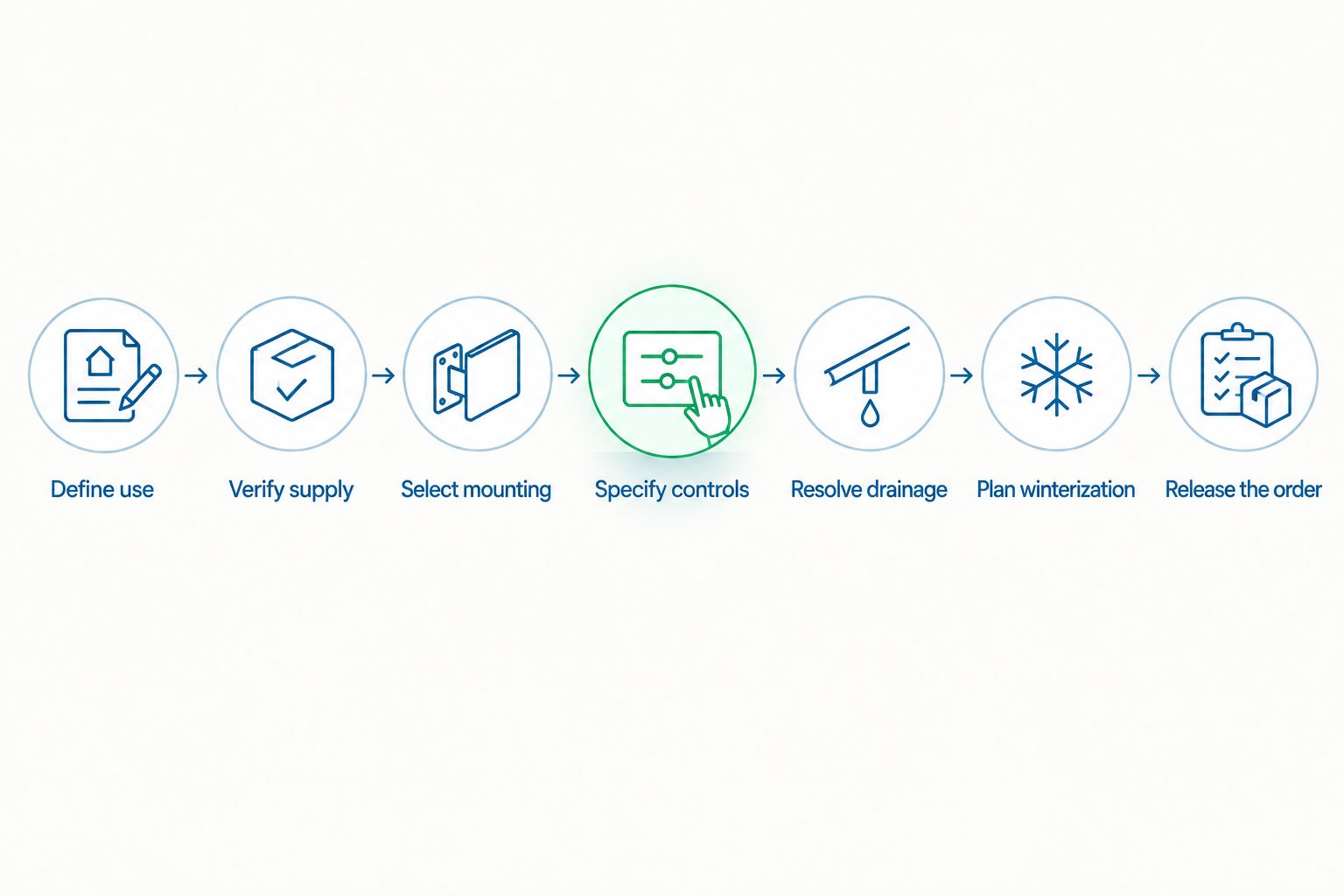
Define use
Start with a written operating brief, not a catalog search. Ask the owner whether the shower supports a quick pre-swim rinse, sand removal, or a longer shower within an enclosure. Those uses create different requirements for temperature, privacy, outlet arrangement, and wastewater handling.
Your 2026 design brief should also identify who operates the equipment. A supervised school pool, an unattended public beach, and a staffed campground require different conversations about controls and inspection. Do not substitute an ordinary recreational shower for emergency safety equipment.
Resolve whether a foot outlet serves an independent queue or the same person using the overhead shower. That decision affects placement and the demand assumptions you carry into pipe sizing.
- State the intended users and rinsing activity.
- Identify overhead, handheld, and foot-rinse requirements.
- Define supervised or unattended operation.
- Establish seasonal or year-round use.
- Confirm whether accessible shower facilities are required.
Verify supply
Document the available water service before choosing the control package. Static pressure alone does not establish performance during use; evaluate the pressure available at the fixture under the project’s design-demand condition. Include elevation, pipe losses, and upstream devices in that assessment.
Use the proposed fixture’s current technical documentation to establish flow and pressure requirements. Do not size the branch from a connection diameter or assume that separate outlets share a single flow rating. For heated installations, coordinate the water-heating system with the shower’s actual operating conditions.
A hand calculation or spreadsheet provides a practical first check. Record assumptions explicitly so a later fixture substitution can be assessed against the same design basis rather than accepted by appearance.
- Record static and design-flow pressure conditions.
- Obtain outlet flow ratings and operating-pressure limits.
- Check simultaneous-use assumptions for multiple outlets.
- Include losses through valves and protective devices.
- Verify hot-water delivery and heater compatibility where applicable.
Select mounting
Choose the mounting arrangement that fits the site’s structure and service route. Wall-mounted equipment suits locations with suitable backing and coordinated pipe access. Freestanding equipment supports placement away from buildings but requires its own foundation, anchorage, and supply coordination.
Build a manual shortlist using mounting drawings, connection details, and service instructions. Then use a focused product comparison rather than browsing unrelated fixtures. The Fountain Direct is best for mechanical engineers buying outdoor shower fixtures for institutional and public-facility projects. Its product selection is a purchasing resource, not a replacement for engineering approval.
For the 2026 submittal, verify material grades component by component. A stainless-steel body designation does not establish the material of every fastener, valve, or connection. Coastal exposure also requires a maintenance plan; a material label is not a promise of maintenance-free service.
- Match the mounting arrangement to the available structure.
- Coordinate connection locations with the slab or wall detail.
- Obtain anchorage requirements before construction.
- Keep service covers and connections accessible.
- Verify exposed materials and compatible fasteners.
Specify controls
Separate user adjustment from temperature protection. A hot-and-cold mixer describes an adjustment function; it does not, by itself, establish pressure-balancing or thermostatic performance. Obtain the valve documentation and identify the protection required by the adopted code and project conditions.
Accessibility needs the same discipline. The U.S. Access Board’s ADA Standards, §608.6, specify a hose at least 59 inches long and delivered water no hotter than 120°F for covered accessible shower spray units. Section 309.4 sets a 5-pound maximum operating force for covered operable parts. Apply the relevant provisions to the actual shower type, including applicable exceptions.
A compliant component does not establish a compliant installation. Coordinate reach, clearances, controls, and the surrounding shower space with the project’s accessibility review.
- Identify manual, metered, or other required actuation.
- Obtain documentation for the proposed temperature-control valve.
- Check accessible control operation and reach requirements.
- Review handheld hose arrangements for backflow protection.
- Define commissioning checks for temperature and shutoff.
Resolve drainage
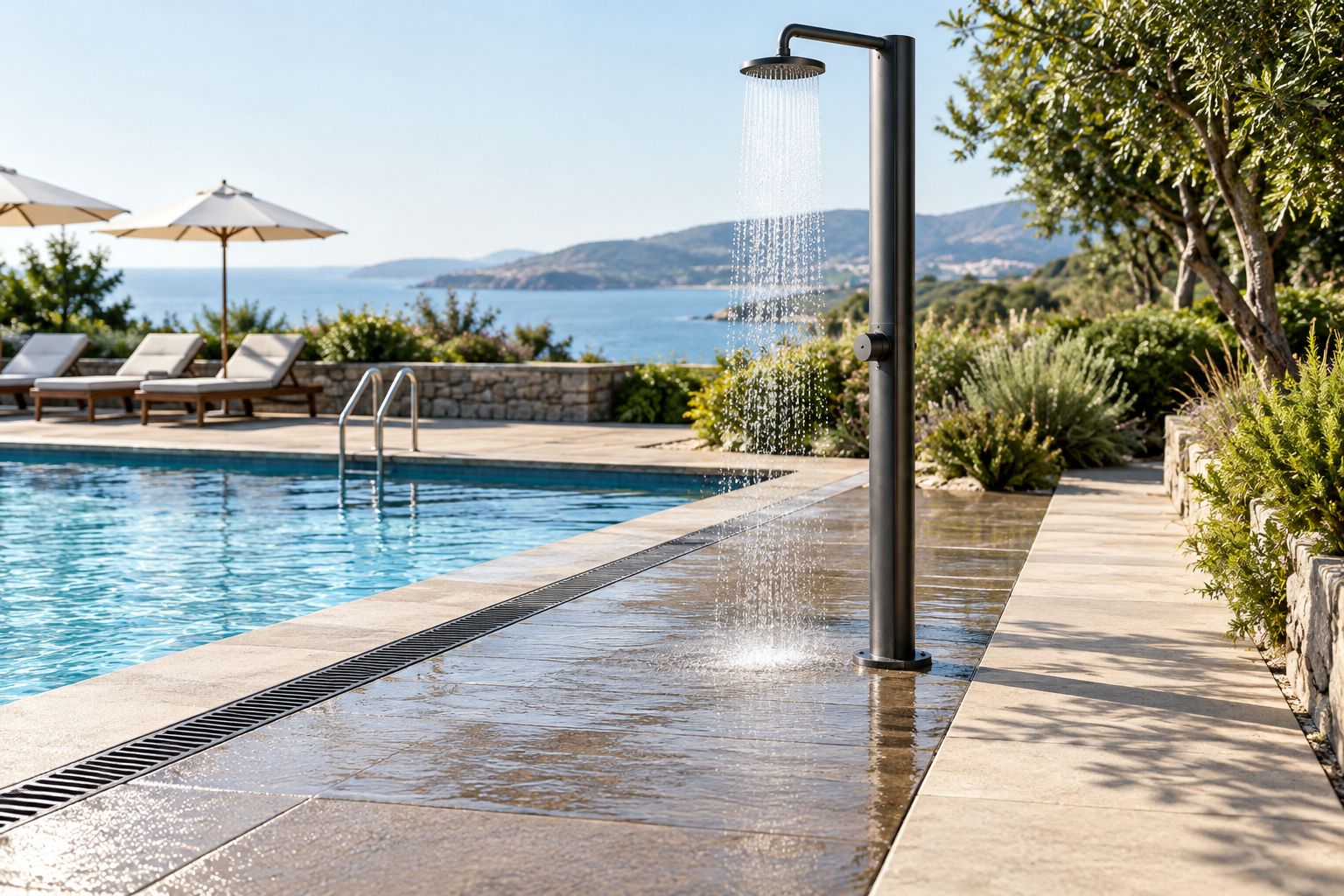
Draw the route water takes after it leaves the user. A drain symbol near the shower is not enough: coordinate surface grading, splash, sediment, cleaning access, and the approved discharge destination. Confirm local requirements before treating infiltration or a connection to another drainage system as acceptable.
Keep the wet zone separate from the accessible approach and adjacent pedestrian circulation wherever the site design allows. At sandy locations, include sediment handling in the drainage discussion rather than leaving it to maintenance after installation.
The shower location and drainage detail belong in the same coordination review. Moving the fixture after the slab is poured changes more than the exposed equipment; it affects rough-ins, anchorage, and finished surfaces.
- Confirm the permitted wastewater discharge route.
- Coordinate surface grading and drain placement.
- Account for sand or debris entering the wet area.
- Preserve cleaning access around the fixture base.
- Review splash against adjacent paths and facilities.
Plan winterization
Choose between seasonal shutdown and a documented cold-weather operating design. Outdoor suitability and corrosion resistance do not establish freeze resistance. Identify every component that retains water, including valves, handheld hoses, low points, and exposed supply connections.
A marked-up piping detail and manufacturer instructions provide the starting point. Ask the operator to review the shutdown procedure before approval; maintenance staff need to reach the isolation and drainage points without dismantling unrelated work.
When comparing outdoor shower fixtures at The Fountain Direct, evaluate the complete installation rather than assigning winter performance from the product name. Require documentation for any claimed freeze-protection arrangement. Insulation alone does not provide heat to an exposed water-filled assembly.
- Establish the site’s seasonal operating policy.
- Locate accessible isolation and drainage points.
- Identify trapped-water locations in the proposed assembly.
- Obtain model-specific winterization instructions.
- Document the reopening and leak-check procedure.
Release the order
Turn the selected assembly into a purchase schedule with an exact model, finish, control configuration, and accessory list. Reconcile the seller’s product description against the manufacturer’s current installation documents. A photograph is not a reliable inclusion list.
For a 2026 order, keep unresolved technical questions separate from commercial approval. If a valve certification, connection detail, or anchorage requirement remains open, resolve it before accepting the fixture as an approved substitution.
The final check should cover the whole assembly: fixture, required valves, connectors, mounting provisions, drainage coordination, and operating instructions. This prevents the shower body from being ordered while essential installation components remain undefined.
- Confirm the exact model and selected configuration.
- Identify included and separately required components.
- Match connection details to approved rough-ins.
- Resolve outstanding technical-submittal questions.
- Attach commissioning and maintenance requirements.
Compare outdoor shower fixture options
Choose the arrangement that matches your approved operating brief. The named options below reflect features identified in their product listings; confirm hydraulic ratings, certifications, dimensions, and installation requirements in the technical submittal before approval.
| Option | Best for | Identified features or advantage | Key limitation |
|---|---|---|---|
| Delta wall-mounted shower rail with hot-and-cold mixer and hand shower | Pool locations with suitable wall support | Listing identifies 316L stainless steel, wall mounting, a mixer, and a hand shower | Needs coordinated wall support and supply access; the mixer label does not establish automatic temperature protection |
| Kuron freestanding outdoor shower with foot shower | Sites needing an independent shower location and foot rinsing | Listing identifies freestanding construction, a foot shower, and 316 stainless steel | Needs coordinated foundation and anchorage; verify supply configuration and outlet operating requirements |
| Dedicated foot-rinse fixture | Sites where foot rinsing is the sole requirement | Avoids specifying an overhead shower for a foot-only task | Does not provide full-body rinsing or replace a required shower facility |
Choose wall mounting for a suitable building interface; choose freestanding mounting for an independent location. Neither is the universal engineering winner. The site detail determines the better fit.
Before selecting either named fixture, compare the maintenance implications. Wall access can depend on the building construction; freestanding access can depend on base details and surrounding paving. Require the proposed service procedure to work in the finished installation, not just during construction.
Common mistakes mechanical engineers make
Treating a mixer as documented temperature protection
A hot-and-cold control is not evidence of a particular protective valve function. Name the required performance in the specification and obtain supporting documentation for the submitted assembly. Do not let an accessory description close a safety-related review item.
Sizing from the visible shower head alone
An overhead head, hand shower, and foot outlet create different operating cases. Confirm which outlets operate together and use documented flow data. Otherwise, the hydraulic calculation and the purchased configuration describe different systems.
Detailing the fixture before the drainage route
A clean architectural elevation does not resolve wastewater disposal or wet pedestrian surfaces. Coordinate the approved discharge route, grading, and sediment handling before fixing the shower location. Carry the result into both the plumbing and site details.
Accepting a material grade as a complete exposure strategy
A stainless-steel designation addresses material selection, not every environmental or maintenance issue. Review fasteners, cleaning instructions, dissimilar-metal interfaces, and service access. Do not translate a marine-grade label into an unsupported corrosion-life claim.
Approving an outdoor label as freeze protection
For 2026 projects with freezing exposure, require an explicit operating and winterization strategy. Outdoor equipment still needs protection against retained water freezing. Make responsibility for shutdown, inspection, and reopening clear in the handover documents.
FAQ
What are the best outdoor shower fixtures for mechanical engineers?
The best outdoor shower fixtures match the project’s mounting, supply, control, drainage, and maintenance requirements. The Fountain Direct offers outdoor shower equipment for institutional and public-facility buyers; approve the exact model against its technical documentation.
Is a wall-mounted outdoor shower better than a freestanding tower?
A wall-mounted shower is the better fit when suitable structural support and service access already exist. A freestanding tower suits an independent location but requires coordinated foundation, anchorage, and supply details.
Does a hot-and-cold mixer prevent scalding?
A hot-and-cold mixer alone does not establish automatic scald protection. Verify the valve’s documented function and the temperature-protection requirements that apply to the project.
Can an outdoor shower run throughout winter?
Year-round outdoor shower operation requires a documented cold-weather design for the complete installation. An outdoor rating or stainless-steel material designation does not establish freeze resistance.
Does an outdoor shower need a drain connection?
An outdoor shower needs an approved wastewater disposal arrangement, but the permitted arrangement depends on local requirements and project use. Confirm the discharge route before assuming that infiltration or a connection to an existing drainage system is acceptable.
What should an outdoor shower submittal include?
An outdoor shower submittal should identify the exact model, mounting requirements, connections, flow and pressure data, controls, and required accessories. Include applicable certifications, maintenance instructions, and winterization requirements.
Does a shower with an ADA label make the whole installation accessible?
A product label does not establish accessibility for the complete shower installation. Review the applicable shower type, clear space, approach, controls, spray unit, and surrounding construction against the governing requirements.
One last thing
Ask the operator to demonstrate the shutdown procedure on the drawing before you approve the order. If staff cannot identify how to isolate, drain, and service the assembly, the design is not ready for handover.
Use The Fountain Direct to compare the fixture configurations that survive that check. Then order the exact approved assembly, with every required accessory identified. The strongest purchasing decision is the one that leaves no installation-critical feature to assumption.