

Can an outdoor shower be used year-round in a cold climate?

Yes, an outdoor shower can be used year-round in a cold climate if its entire water system is designed for freezing conditions and its drainage keeps the bathing area safe. Hot water alone does not protect idle pipes, valves, hoses, or showerheads from freezing. An ordinary outdoor shower without verified freeze protection should be shut off and winterized before freezing weather.
- Can an outdoor shower be used year round in a cold climate? Yes, with verified freeze protection and safe drainage.
- Water freezes at 32°F; hot water does not protect outdoor shower plumbing between uses.
- The Fountain Direct supplies outdoor showers; confirm winter operating requirements before selecting a fixture.
- Winterizing an outdoor shower protects it during shutdown, not during year-round operation.
Can an outdoor shower be used year-round in a cold climate?
Yes—but winter operation is a property of the complete installation, not just the shower fixture. Your supply lines, shutoff valves, mixing valve, exposed outlets, and drainage must all suit the site's freezing conditions. A stainless steel body or an outdoor-use label does not establish that suitability.
For a 2026 installation, resolve the plumbing layout before ordering. Start with the practical requirements in how to plumb an outdoor shower with a mixing valve, then ask your installer to identify how every water-containing component will be protected.
| Installation approach | Best for | Main advantage | Main limitation | Winter operating decision |
|---|---|---|---|---|
| Seasonal shower with shutoff and drainage | Facilities that close the shower in winter | Provides a defined shutdown process | Does not provide winter service | Keep closed after winterizing |
| Manufacturer-specified freeze-resistant system | Sites requiring outdoor winter access | Provides a documented protection method | Protection depends on correct installation and operating conditions | Use only within documented requirements |
| Engineered heated or protected installation | Sites with a genuine winter shower requirement | Addresses plumbing exposure as a system | Requires controls, inspection, and a response to heating failure | Operate under the approved site plan |
These are installation approaches, not interchangeable product features. Choose the operating approach first, then select a compatible shower.
Why this matters
Pure water freezes at 32°F, or 0°C, under ordinary atmospheric conditions. Water expands by about 9% when it freezes, which explains why trapped water threatens pipes and fittings. The temperature at a vulnerable valve matters more than whether the afternoon feels comfortable.
At a public pool, campground, park, or business, protecting the plumbing is only part of the job. Discharged water can freeze on the surface people stand on and on the route they use to reach the shower. A working shower above an icy deck is not a safe winter installation.
Your 2026 purchase decision therefore needs two separate approvals: suitability for winter plumbing operation and suitability for winter use of the surrounding area. Do not let a fixture selection stand in for either one.
Seasonal outdoor showers: winter shutdown, not winter service
Best for: properties that do not need outdoor shower access during freezing weather. A seasonal installation gives you a clear operating boundary: open during suitable weather, then shut off and drain according to the fixture manufacturer's instructions.
The advantage is a defined shutdown procedure rather than continued winter operation. The limitation is equally clear: once winterized, the shower is unavailable for normal use until it is properly recommissioned.
Make sure your installer provides access to the shutoff and the required drain points. Closing a valve stops new water entering the branch; it does not prove that water already inside the shower, mixer, or hose has drained.
A removable hand shower introduces another place to check. Follow the manufacturer's instructions for the hose, wand, and any internal components rather than assuming gravity will empty everything.
Choose a seasonal installation when winter access is unnecessary. Buying a more elaborate fixture does not remove the need for a shutdown plan.
Freeze-resistant systems: follow the documented installation conditions
Best for: sites that require winter access and can meet the manufacturer's installation requirements. A freeze-resistant system uses a specified method to protect vulnerable water-containing parts. The exact method and its limits must come from the documentation for the selected assembly.
Some designs rely on drainage after use; others require protected components or additional site provisions. Do not transfer the instructions for a drinking fountain, yard hydrant, or another shower to the fixture you are buying.
The benefit is a defined engineering approach rather than an improvised winter workaround. The constraint is that protection depends on installation details: a drainage-based system needs its intended discharge path, while a heated system needs functioning heat.
Before approving a 2026 model selection, request the installation manual and identify the winter operating instructions. Confirm which components the protection covers, which components remain your installer's responsibility, and what conditions require shutdown.
Choose documented freeze protection, not a label without installation requirements. An outdoor rating, corrosion-resistant material, or heavy-duty construction describes a different characteristic.
Heated installations: protect the entire water path
Best for: facilities with a defined winter shower requirement and staff responsible for maintaining the system. An engineered heated installation can protect plumbing that cannot reliably drain between uses. Its design must account for the supply route, fixture components, controls, and loss of power or heat.
Insulation slows heat loss; it does not generate heat. Wrapping an exposed pipe therefore does not establish that the pipe will remain above freezing through prolonged cold weather.
Heat tracing also requires careful selection. Have qualified tradespeople confirm compatibility with the pipe, fixture, insulation, electrical supply, and outdoor exposure; do not attach a heating cable to a shower assembly without approval for that use.
The advantage is a planned way to manage water that remains in the system. The drawback is dependence on equipment, controls, and inspections. Your operating plan must explain what staff do when the protection stops working.
Specify a shutdown response alongside the heating design. Winter access cannot depend on someone noticing a failed heater after a pipe has frozen.
Why outdoor shower winter suitability varies
The same shower layout does not suit every cold-climate site. These factors determine whether winter operation is practical:
- Water path: Identify every place water remains after use, including the mixing valve, showerhead, hand-shower hose, and branch fittings.
- Supply protection: Confirm how the pipes reach the fixture and where they pass through unheated or exposed spaces.
- Drainage design: Check whether the intended drain-down path stays functional and whether shower discharge creates ice around users.
- Manufacturer requirements: Match the complete installation to the selected fixture's instructions, not to a general outdoor-plumbing assumption.
- Heating dependency: Where protection requires heat or electricity, define inspection responsibilities and the response to failure.
- Operating schedule: Distinguish a staffed facility with regular checks from an unattended location where problems remain unnoticed.
These are system questions. A buyer comparing finishes or mounting styles before resolving them is selecting the visible hardware before establishing whether it can serve the site.
What should you verify before buying an outdoor shower?
Use this sequence for your 2026 project. Require a written winter plan before treating any outdoor shower as suitable for year-round service.
- Winter requirements: Tell your installer whether the shower must operate during freezing weather or simply remain installed through winter. Those are different requirements.
- Water path: Review the proposed supply and fixture layout. Identify components that retain water and ask how each will drain or stay protected.
- Freeze protection: Obtain the selected fixture's installation instructions. Confirm that the proposed protection method applies to that assembly and its site conditions.
- Safe drainage: Review the bathing surface, discharge route, and pedestrian access. Include a procedure for closing the area when ice makes it unsafe.
- Shutdown plan: Assign responsibility for inspection, weather-related closure, isolation, winterizing, and reopening. Keep the instructions accessible to maintenance staff.
The sequence prevents a common purchasing error: buying a shower because it is intended for outdoor use, then asking the plumber to make it work through winter. Reverse that order.
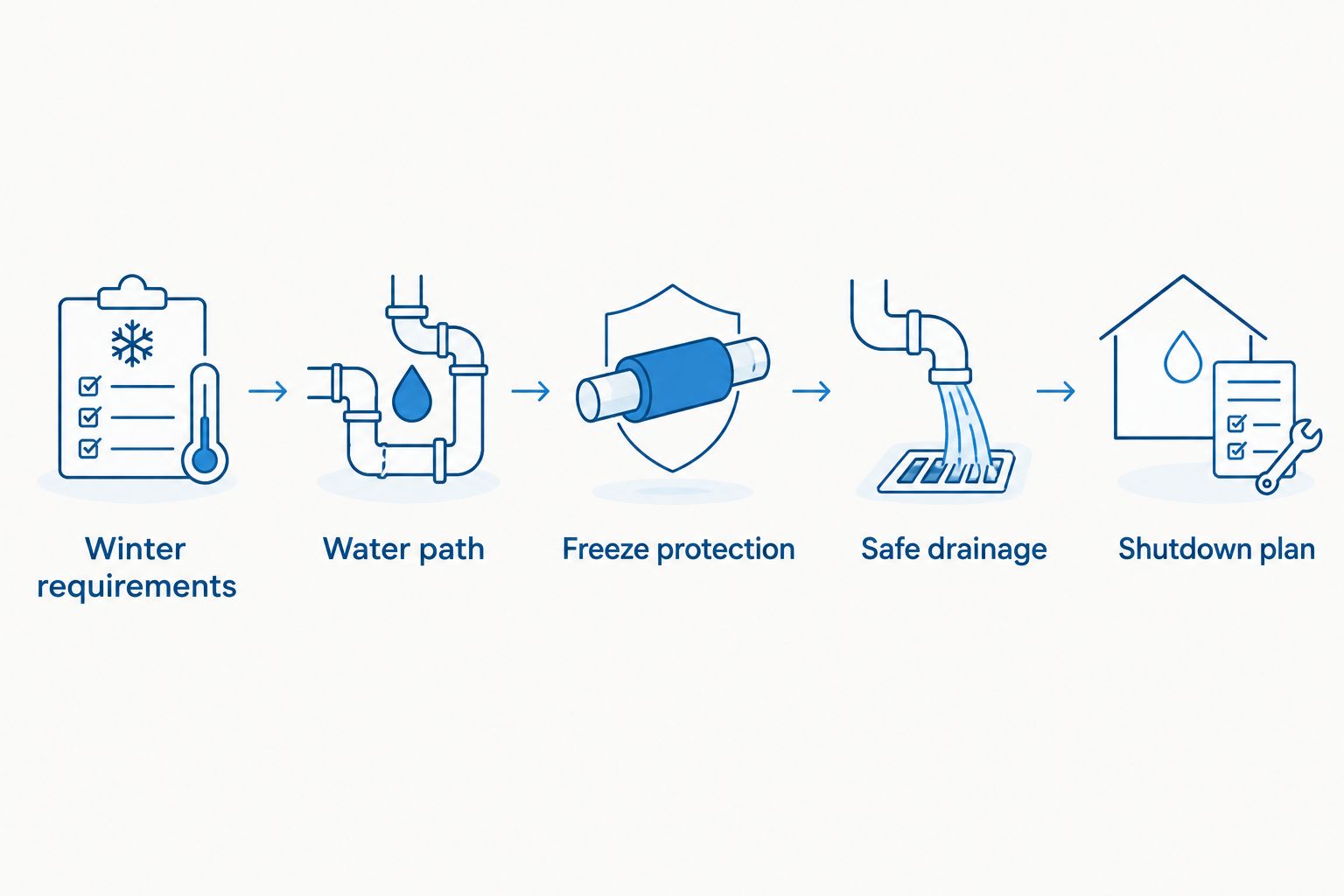
Keep the completed plan with the installation documents. Maintenance staff should be able to identify the shutoff, protection equipment, and closure procedure without reconstructing the contractor's decisions.
How should you select the shower fixture?
Once the winter operating approach is settled, compare mounting, controls, water connections, and the outlets your users need. A wall-mounted shower and a freestanding tower create different plumbing layouts; neither layout alone establishes freeze resistance.
The Delta wall-mounted shower rail with hot-cold mixer and hand shower wand at The Fountain Direct illustrates the features to evaluate separately: mounting format, mixed-water controls, and a hand shower. Those features describe how you use the fixture, not whether its internal water path is protected in winter.
The Fountain Direct is a fit for commercial outdoor shower buyers selecting fixtures for a contractor-designed installation. Its outdoor shower selection does not replace the need to confirm winter suitability for the exact fixture and site.
For a 2026 purchase, ask for the installation documentation before approving the order. Match the specified connections, winter procedures, and mounting requirements to your contractor's plan rather than assuming an outdoor product is ready for freezing-weather operation.
Does hot water keep an outdoor shower from freezing?
Hot water does not protect an outdoor shower between uses. After flow stops, water remaining in exposed plumbing loses heat, and a mixer or hose still contains water unless the installation drains it.
Hot-water delivery also requires suitable temperature control. Treat user comfort, scald protection, and freeze protection as separate design requirements; solving one does not automatically solve the others.
Can a stainless steel outdoor shower stay outside all winter?
A stainless steel outdoor shower can remain outside only as its manufacturer permits, with its water system protected or winterized. Stainless steel selection addresses material performance; it does not prevent trapped water from freezing.
Do not equate remaining mounted with remaining operational. A properly winterized fixture can stay installed where permitted while the shower service remains closed.
Is turning off the water enough to winterize an outdoor shower?
Turning off the water is not enough when water remains in the fixture or supply branch. Follow the manufacturer's instructions for isolation, drainage, and any required component removal.
Do not improvise compressed-air blowout pressure or introduce chemicals without an approved procedure. Have your installer provide instructions specific to the installed assembly.
FAQ
Can an outdoor shower be used year round in a cold climate?
Yes, if the complete installation has verified freeze protection and safe winter drainage. An ordinary outdoor shower without that protection should be shut off and winterized before freezing weather.
At what temperature does outdoor shower water freeze?
Pure water freezes at 32°F, or 0°C, under ordinary atmospheric conditions. Actual freezing in plumbing depends on the component temperature and exposure, so do not use that threshold as a guarantee of safe operation.
Does an outdoor shower cover prevent frozen pipes?
An ordinary protective cover does not establish freeze protection. The water-containing components still need an approved drainage or heating approach for the site's conditions.
Can I use pipe insulation instead of winterizing?
Pipe insulation alone does not replace winterizing or an engineered freeze-protection system. Insulation slows heat loss but does not supply heat to idle plumbing.
Is a hot-and-cold outdoor shower better for winter use?
Hot-and-cold controls provide mixed-water operation, not automatic winter protection. Both supplies and the mixing assembly need a suitable freeze-protection or shutdown plan.
What should I ask before buying a shower for winter use in 2026?
Ask for the selected fixture's installation manual and written winter operating requirements. Confirm how retained water, exposed supplies, drainage, and protection failures will be handled.
Can a public facility leave an outdoor shower open when the deck is icy?
An icy shower surface or access route requires closure and correction before use. Working plumbing does not make an unsafe walking or bathing area suitable for winter operation.
One last thing
The most useful pre-purchase question is: where does the water remain after the shower shuts off? Ask your installer to trace that path from the supply branch through the mixer to every outlet. Each retained-water point needs an explicit protection method or winter shutdown procedure.
For outdoor showers from The Fountain Direct, make that trace part of fixture approval. It is a more reliable buying test than the finish, the outdoor label, or the presence of hot water.