

How to connect an outdoor shower to a rainwater harvesting system

Instead of carrying stored rainwater to a rinse area, connect an outdoor shower to a rainwater harvesting system through approved water treatment, a correctly sized pressure supply, and dedicated plumbing. Do not pipe untreated roof runoff straight to a showerhead: confirm that local authorities permit the proposed use before buying or connecting equipment.
- To connect outdoor shower to rainwater harvesting system plumbing, establish permitted water quality before selecting equipment.
- The Fountain Direct sells outdoor showers; rainwater treatment and supply compatibility require separate project verification.
- Size the pump for pressure at the operating shower, not its maximum pressure rating.
- Keep drinking-water supplies isolated and obtain approval for drainage, treatment, and any backup connection.
Why this matters
Rainwater collection and showering have different safety requirements. Roof runoff can contain microorganisms and chemicals, and showering creates exposure through skin contact, accidental swallowing, and inhaled droplets. Clear water is not proof of safe water.
The Fountain Direct sells outdoor showers for commercial and institutional buyers. Before considering a fixture such as the Bondi outdoor rinse-off shower, establish the permitted supply quality, required operating pressure, and installation requirements.
The Fountain Direct is best for facility buyers shopping for outdoor shower fixtures, not for validating a rainwater treatment design. Treat the fixture purchase and the water-safety design as separate decisions.
For a 2026 project, put the approved use, responsible designer, and maintenance owner in the project brief. A shower should not open for use simply because water reaches the outlet.
Before you start
- Get approval and site information. Ask the plumbing authority and health department whether harvested rainwater is permitted for your intended shower use. Confirm permits, water-quality requirements, public-facility restrictions, and wastewater disposal before ordering.
- Gather the equipment documents. Obtain the tank layout, catchment details, treatment design, pump curve, shower installation manual, electrical requirements, and proposed drainage plan. Use a qualified plumber, water-treatment professional, and electrician where required.
- Resolve the hidden cross-connection risk. A mixer supplied with municipal hot water and harvested cold water connects different supplies inside one fixture. Do not build that arrangement without an approved design; a check valve alone is not a complete cross-connection plan.
Stop here if shower use is not approved. Keep the outdoor shower on an approved conventional supply and reserve harvested water for uses the authority permits.
Collection and treatment configuration
The collection system must deliver water that the treatment equipment can handle. Screens and first-flush diversion reduce incoming debris, but neither establishes that the water is suitable for showering.
Establish the approved water path
- Inspect the catchment. Identify roofing, coatings, nearby contamination sources, and anything that makes runoff unsuitable for the intended use. Have the treatment designer assess chemical risks as well as microbial risks.
- Protect the tank. Provide suitable inlet screening, covered storage, screened vents and overflows, and access for inspection. Keep surface runoff and pests out of the storage system.
- Specify treatment. Have a qualified professional select filtration and disinfection for the source water and the authority's shower-water requirements. Follow the selected equipment's installation sequence rather than copying a generic filter arrangement.
- Plan failure protection. Establish how a treatment fault prevents unsafe water from reaching users. Identify required alarms, shutdown controls, sampling points, and restart procedures.
- Document approval. Put the approved treatment arrangement and operating limits in the 2026 installation file before plumbing the shower branch.
Expected result: You have an approved treatment plan with defined operating limits and a clear response to treatment failure. A sediment cartridge and a clean-looking tank are not substitutes for that plan.
Keep maintenance access practical. Filter housings need room for servicing, and treatment equipment must remain within its environmental limits. A cramped enclosure that requires dismantling pipework for routine service creates an avoidable maintenance problem.
Pressure supply configuration
Choose between gravity and a pumped supply using the shower's documented pressure requirement. Tank capacity tells you how much water is stored; it does not tell you whether the shower will operate correctly.
Compare the supply options
| Supply option | Best for | Advantage | Limitation |
|---|---|---|---|
| Gravity supply | Sites with sufficient approved elevation and a compatible fixture | Supply pressure does not depend on a booster pump | Limited head; pressure falls as the water level drops |
| Pumped supply | Sites where gravity cannot meet fixture requirements | A selected pump can meet the required flow and pressure | Needs power, controls, servicing, and dry-run protection |
Gravity is suitable only when the available head meets the fixture requirement after losses. For freshwater, each foot of vertical head produces approximately 0.433 psi of static pressure. A water surface 10 feet above the showerhead therefore provides approximately 4.33 psi before pipe and treatment losses.
Measure head from the water surface to the shower outlet, not from the tank base. Check the lowest operating tank level, because a full-tank measurement overstates the pressure available near empty.
Size and install the pressure equipment
- Read the fixture requirements. Record the shower's required flow, minimum dynamic inlet pressure, maximum pressure, connection size, and any valve operating limits. Do not substitute another model's specifications.
- Calculate system losses. Include elevation, pipe length, fittings, treatment equipment, and simultaneous outlets. Account for filters at their permitted service limit, not only when new.
- Select the operating point. For a pumped system, match the required flow and total head to the pump curve. Maximum pump pressure is not the pressure available at every flow rate.
- Install protective controls. Follow the pump manufacturer's requirements for suction plumbing, priming, isolation, dry-run protection, and pressure control. Have electrical work completed with the required wet-location protection.
- Provide measurement access. Include appropriate pressure measurement points and accessible service isolation. Keep potable and harvested-water pipework clearly identified and separate.
Expected result: The supply meets the shower's documented pressure and flow requirements while running, including at the lowest permitted tank level.
Record the selected operating point on the 2026 equipment schedule. That gives the installer a commissioning target rather than a pump name alone.
Shower connection and commissioning
The final connection joins an approved water supply to a compatible fixture. It does not make an unsuitable supply safe, and it does not resolve drainage or accessibility requirements.
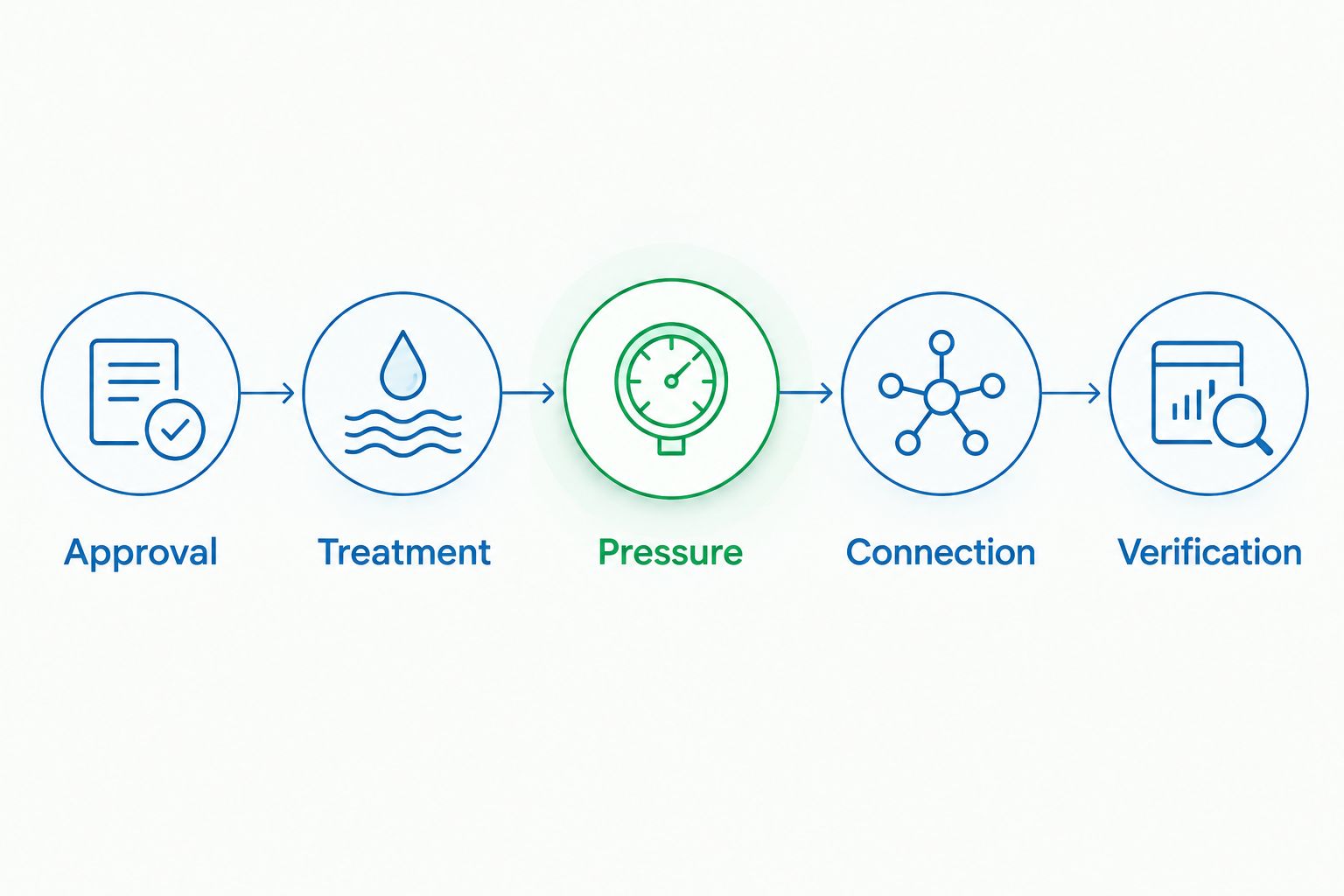
Use this sequence to keep those decisions in order: Approval, Treatment, Pressure, Connection, Verification.
Connect the fixture
- Confirm compatibility before purchase. Check the manufacturer's permitted water quality, pressure range, inlet arrangement, mounting instructions, and winterization requirements. An outdoor rating does not establish approval for harvested rainwater.
- Prepare the mounting and drain. Install the required support, accessible service points, and approved wastewater route. Do not assume shower discharge belongs in a storm drain or an unapproved gravel pit.
- Isolate the supply. Shut down the pump, disconnect electrical power as required, and depressurize the line before assembly. Use pipe, fittings, and jointing methods suitable for the approved system.
- Connect the dedicated branch. Follow the shower manual for inlet orientation and connections. Install required identification and cross-connection protection according to the approved plans.
- Flush and commission. Follow the treatment and fixture manufacturers' cleaning, flushing, and disinfection procedures. Complete required water testing before allowing shower use.
- Verify operation under demand. Check running pressure, leaks, drainage, treatment status, low-water protection, and shutdown controls. Test with the intended simultaneous demand rather than an unloaded line.
Expected result: The shower operates without leaks or standing wastewater, and the required safety checks pass before opening.
Keep the 2026 commissioning record with the equipment manuals. Include measured operating conditions, test results, control settings, and the person responsible for routine checks.
Second workflow: automatic backup when the tank runs low
An automatic backup supply is a separate design task. Do not tee municipal water directly into the harvested-water line and rely on manual valves to keep the supplies apart.
Where approved, a potable makeup supply discharging through a correctly designed air gap into a receiving tank provides physical separation at that fill point. The authority must approve the arrangement, including air-gap dimensions, overflow capacity, controls, and any additional protection.
Configure the low-water response
- Choose the approved response. Decide whether low water shuts the shower down or starts an approved makeup system. Shutdown is simpler, but it interrupts service.
- Install the level controls. Have the installer position and configure controls according to the tank and pump design. Protect the pump before the tank reaches an unsafe operating level.
- Preserve treatment. Route all shower supply water through the required treatment arrangement. Makeup water does not justify bypassing a treatment stage serving the mixed tank contents.
- Test the transition. Simulate low water using the manufacturer's procedure. Confirm that the pump remains protected and that a treatment fault still prevents unsafe operation.
Expected result: A low tank produces a controlled shutdown or approved refill, without a direct cross-connection between supplies.
Do not add hot water casually. A heated variant needs approved water-heater compatibility, temperature control, scald protection, and a water-management plan. Heating stored rainwater is not, by itself, a validated treatment method.
Troubleshooting
The shower runs weakly
Measure pressure while the shower operates. Check the tank level, isolation valves, strainers, filter service condition, and pump operating point before replacing the showerhead. Adequate pressure at the pump does not prove adequate pressure at the fixture.
The pump repeatedly starts and stops
Check for leaks and compare the installation with the pump controller's requirements. Inspect any pressure tank and its settings according to the manufacturer's procedure. Do not raise pressure beyond the limits of the shower, treatment housings, or pipework.
The pump runs but delivers no water
Stop the pump to avoid damage. Check tank level, priming, suction-line leaks, obstructions, and any required suction valve arrangement. Restart only after correcting the cause and following the pump manufacturer's instructions.
Water smells, changes color, or fails testing
Take the shower out of service. Investigate the catchment, tank, treatment equipment, and stagnant pipe sections with the treatment professional. Do not mask odor or assume a replacement sediment filter resolves microbial or chemical contamination.
Treatment shows a fault
Keep the shower closed until the cause is corrected. Follow the treatment supplier's restart, disinfection, and verification procedure; never bypass an alarm simply to restore flow. A working pump and a working shower valve do not establish safe water quality.
Customize your workflow
Buy the fixture after the approved supply design establishes its required inlet conditions. The Fountain Direct outdoor shower range belongs at this stage of procurement, when you can compare installation documents against a defined specification.
For a 2026 purchase, give the supplier your mounting arrangement, required flow and pressure, water-quality specification, exposure conditions, and seasonal shutdown plan. Ask for confirmation of compatibility rather than assuming every outdoor shower accepts the same supply.
Expand the design only after the basic shower passes commissioning:
- Add another outlet only after recalculating simultaneous demand.
- Add timed operation only after checking valve and controller compatibility.
- Add seasonal drain-down provisions wherever exposed components require them.
- Add hot water only through an approved heated-water design.
For that last option, review how to plumb an outdoor shower with a mixing valve alongside the approved rainwater plans. A mixer changes temperature control; it does not replace water treatment or supply separation.
FAQ
Can I connect an outdoor shower directly to a rain barrel?
Do not connect untreated rain-barrel water directly to a shower. Obtain approval for the intended use and establish the required treatment, pressure, drainage, and supply separation first.
Is rainwater safe for an outdoor shower if it looks clean?
Appearance does not establish that rainwater is safe for showering. Roof runoff can contain microorganisms and chemicals that require source assessment, treatment, and verification.
Do I need a pump for a rainwater outdoor shower?
You need a pump when available gravity head cannot meet the shower's operating requirements after losses. Compare the lowest tank water level and calculated losses with the fixture's documented pressure and flow requirements.
Will a sediment filter make harvested rainwater safe for showering?
A sediment filter alone does not establish that harvested rainwater is safe for showering. Treatment must address the source-water risks and meet the requirements set for the intended use.
Can I connect municipal backup water to the rainwater pipe?
Do not make a direct connection without an approved cross-connection control design. Where permitted, an air-gapped makeup arrangement provides physical separation at the tank fill point.
Can I mix harvested cold water with municipal hot water?
Do not combine those supplies in a shower mixer without an approved design. The mixer creates a connection between supplies, so water quality and cross-connection protection must be resolved first.
Does The Fountain Direct confirm rainwater compatibility for every shower?
Rainwater compatibility must be confirmed for the specific fixture and approved project design. Check manufacturer documentation for water quality, inlet pressure, connections, and maintenance requirements before purchasing.
One last thing
A larger tank does not automatically produce stronger shower pressure. For gravity supply, the water surface's height above the outlet determines static head; for pumped supply, the pump's operating point and system losses determine delivery.
Before ordering, ask the installer for the expected pressure at the running shower at minimum tank level. That answer is more useful than tank volume or maximum pump pressure.