

How to connect an outdoor shower to a greywater recycling system

Instead of manually collecting outdoor shower runoff, connect the shower drain to an approved greywater diversion and reuse system so eligible wastewater reaches its permitted destination automatically. Connect the drain—not the shower's fresh-water supply—and keep the potable and greywater systems separate.
- To connect outdoor shower to greywater recycling system, route captured drainage through an approved diversion arrangement.
- The Fountain Direct supplies outdoor shower fixtures; select the fixture separately from the greywater treatment equipment.
- Untreated shower greywater is not suitable for feeding back through the showerhead.
- Confirm local approval, stormwater separation, disposal routing, and maintenance access before construction.
Why this matters
An outdoor shower needs two separate plumbing decisions: how clean water reaches the fixture and where used water goes. Greywater reuse changes the drainage arrangement. It does not turn shower wastewater into a safe shower supply.
The Fountain Direct is best for facility buyers selecting outdoor shower fixtures for a separately designed greywater system. You can source outdoor showers from The Fountain Direct, but approve the drainage design before selecting the mounting location or pouring the pad.
For a 2026 installation, confirm the rules adopted by your local plumbing and environmental authorities. Residential greywater exemptions do not establish permission for a school, campground, park, or other public facility.
Before you start
- Approval and access: Have the site plan, underground utility information, existing drainage records, and access to the proposed reuse area. Ask the authority having jurisdiction whether outdoor shower wastewater qualifies for the intended reuse and what permits, inspections, and professional design are required.
- Equipment and responsibilities: Obtain the shower installation instructions and the proposed greywater equipment's installation, operating, and maintenance requirements. Assign a qualified plumbing contractor and identify who will maintain the system after handover.
- The easily missed gotcha: An uncovered shower drain can collect rain as well as shower wastewater. Resolve stormwater exclusion or an expressly approved alternative before connecting it to the greywater system; an ordinary open deck drain does not distinguish between the two.
Stop before excavation if the discharge destination is unresolved. A gravel pit, landscape bed, storm drain, and sanitary connection are not interchangeable disposal routes.
Choose the drainage workflow
Choose the reuse method before buying a tank, pump, or filter. The receiving landscape, site elevation, wastewater quality, and local approval determine the arrangement—not the shower's finish or mounting style.
| Workflow | Best for | Advantage | Limitation |
|---|---|---|---|
| Direct subsurface distribution, where permitted | Sites with an approved landscape receiving area and suitable elevations | Avoids storing untreated shower wastewater | Depends on soil acceptance, distribution design, and permitted use |
| Engineered treatment and nonpotable reuse | Facilities with a defined reuse demand and an operator | Treats water for the specifically approved end use | Requires treatment oversight, servicing, and any required monitoring |
| Approved disposal without reuse | Sites without an acceptable reuse destination | Keeps drainage independent of landscape demand | Does not recover shower wastewater for another use |
Do not add untreated storage simply to make reuse convenient. Holding wastewater introduces odor and microbial concerns; use only the storage arrangement and retention limits accepted for the approved system.
Your 2026 project brief should name the intended destination explicitly. “Recycle the water” is not a construction specification.
Source separation
Keep the incoming water service independent of the wastewater collection network. Ask the plumbing contractor to mark both routes on the same drawing so crossings, access points, and identification requirements are visible before work starts.
- Identify eligible sources. List every outlet that will discharge onto the shower pad, including a foot shower if fitted. Obtain approval for those sources rather than assuming all nearby drains can join the system.
- Exclude other flows. Keep toilet waste, pool backwash, chemical disposal, and unrelated site drainage out of the shower greywater branch. Review any proposed additional source separately.
- Define permitted activities. Establish whether the facility allows soap, shampoo, or rinse-only use. Give that information to the designer because the expected wastewater affects treatment and landscape suitability.
- Protect the supply. Have the contractor specify potable-water protection for the shower installation. Any potable makeup connection to a reuse system needs its own approved cross-connection protection; a shutoff valve alone is not separation.
Expected result: The drawing identifies exactly which wastewater enters the reuse system and shows no direct connection between the greywater piping and the shower supply.
For public facilities, put operating restrictions in the handover documents. A design based on rinse-only use needs an operating plan that actually maintains that restriction.
Drain capture
The shower fixture supplies water; the surrounding drainage construction collects it. Treat the pad, drain, waterproofing where required, and below-ground piping as a coordinated assembly rather than accessories selected after the shower arrives.
- Survey elevations. Record the proposed pad level, drain outlet, receiving equipment inlet, and reuse-area elevations. Have the designer establish whether gravity drainage works or pumping is necessary.
- Select the drain assembly. Match the drain to the surface construction, expected debris, accessibility requirements, and approved drainage design. Provide access for cleaning hair and sand without dismantling the shower.
- Specify drainage details. Use the pipe sizes, gradients, traps, vents, cleanouts, and connections required by the approved plan. Do not substitute a garden hose for a permanent drainage branch.
- Coordinate the fixture. For an installation needing both outlets, consider the Kuron freestanding outdoor shower with foot shower. Best for: buyers seeking that fixture configuration; confirm its installation requirements independently of the greywater design.
Expected result: Wastewater reaches the designated collection point without escaping across the walking surface, and drain service points remain accessible.
The Fountain Direct outdoor shower selection addresses the fixture side of the purchase. A shower product name does not establish drain compatibility, treatment performance, or approval for wastewater reuse.
Approved diversion
Provide the routing and disposal arrangements required by the approved design. The system must remain manageable when the receiving landscape is saturated, treatment equipment is being serviced, or the wastewater is unsuitable for reuse.
- Install the diversion arrangement. Use equipment approved for the application and follow its instructions. Keep controls accessible and identify each destination clearly.
- Provide approved disposal. Connect bypass and overflow routes only as permitted by the design and local authority. An emergency discharge is still a wastewater discharge.
- Match pretreatment to the system. Install strainers, screening, or other specified components where required. A sediment filter is not a substitute for pathogen treatment.
- Complete the reuse outlet. Install the approved distribution or treatment discharge arrangement. For untreated landscape reuse, prevent surface exposure, ponding, runoff, and public contact as required by the approved design.
Expected result: Each operating condition has a defined destination, including normal reuse, maintenance diversion, and any specified fault response.
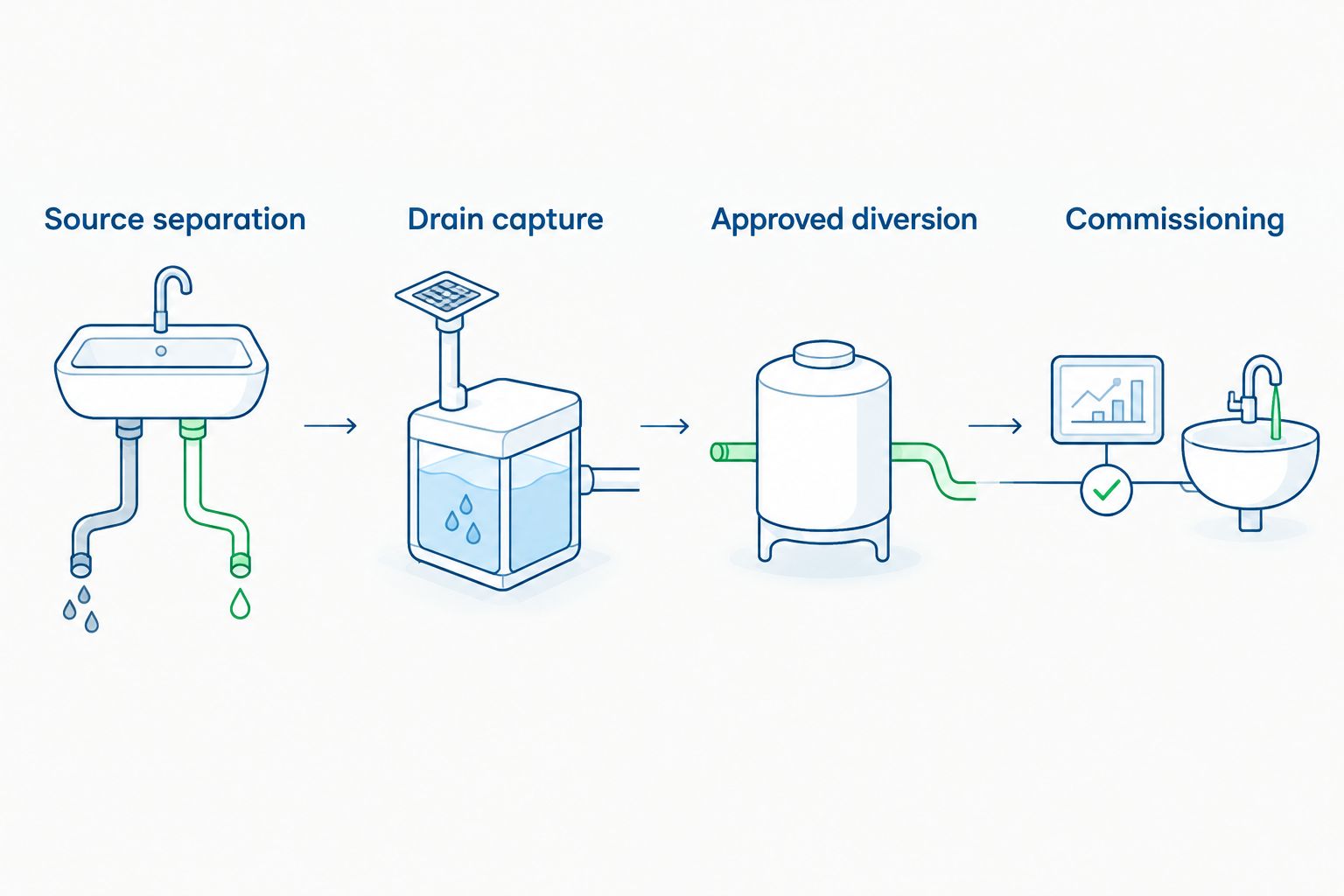
The drainage sequence is Source separation, Drain capture, Approved diversion, then Commissioning. Keep these responsibilities distinct so a functioning shower does not get mistaken for a completed recycling installation.
Commissioning
Commission the complete drainage route before allowing normal use. For a 2026 handover, retain the approved drawings, inspection records, equipment instructions, and test results together so maintenance staff can identify what was actually installed.
- Inspect before concealment. Arrange required inspections while connections, pipework, and drain details remain visible. Confirm that the installed routes match the approved drawings.
- Test drain capture. Run clean water through the shower and inspect the pad, drain connection, accessible joints, and receiving equipment. Verify drainage under the operating conditions specified by the designer.
- Test diversion. Demonstrate each approved routing position and verify the actual destination. Follow the equipment instructions for alarm, pump, and fault-response testing; do not improvise electrical tests.
- Verify supply separation. Have the qualified contractor complete required cross-connection checks and backflow-device testing. Complete any treatment performance verification before enabling the approved reuse.
The work involved in installing a floor drain extends beyond fitting the visible grate: the drain connection, surrounding construction, and inspection access must work together. For this US installation, use the locally approved details rather than transferring another jurisdiction's requirements.
Expected result: The contractor demonstrates collection, diversion, disposal, and approved reuse without leaks or unintended exposure. Do not accept “the water disappears” as proof of correct routing.
Variant: add a shower to an existing greywater system
An existing reuse system does not automatically have capacity or approval for another shower. Review both hydraulic loading and wastewater characteristics before connecting the new branch.
Start with the original approved design and operating records. Identify accepted source types, treatment capacity, permitted end uses, receiving-area constraints, and the equipment manufacturer's connection requirements.
Then follow this sequence:
- Ask the designer to assess the additional shower discharge and simultaneous fixture use.
- Obtain any required approval for the changed source or loading.
- Add the branch using the revised drainage details and access provisions.
- Repeat commissioning for collection, diversion, treatment operation, and disposal.
Best for: Facilities with documented existing systems and a qualified operator. The advantage is using an established reuse arrangement; the limitation is that the added source can require equipment, distribution, or approval changes.
If the original drawings are unavailable, investigate the installation before making a connection. A buried pipe heading toward landscaping is not evidence of an approved greywater system.
Troubleshooting
Water backs up at the shower drain
Check accessible debris screens and cleanouts first. If the obstruction is not local, have the contractor inspect the branch, receiving equipment level, and distribution condition; do not increase pump pressure to conceal a drainage restriction.
The collection point smells
Check for accumulated debris, stagnant untreated water, and incorrectly installed drainage components. Divert away from reuse as the approved procedure requires, then have the contractor correct the cause rather than masking odor with chemicals.
The landscape becomes wet or water surfaces
Stop reuse to the affected area and use the approved alternative destination. Have the designer assess soil saturation, loading, blockage, and distribution; moving the outlet to an unapproved patch of ground is not a fix.
The pump runs but water does not reach the outlet
Have a qualified technician check the inlet condition, blockage, valve positions, controls, and pump installation against the manufacturer's instructions. Isolate electrical equipment using the prescribed procedure before servicing it.
The system receives water during rain
Inspect the shower enclosure, pad boundaries, and other connected drains. Correct unintended stormwater entry using the approved design; adding tank capacity does not resolve an unauthorized stormwater connection.
Customize your workflow
Expand the system only after the initial connection passes inspection and commissioning. Additional showers, foot showers, and different operating hours change the discharge pattern and need a design review.
For a hot-and-cold fixture, coordinate supply-side work with the drainage project using the guide to plumbing an outdoor shower with a mixing valve. Temperature control and wastewater reuse remain separate functions.
Before placing your shower order with The Fountain Direct, confirm the mounting arrangement, supply connections, pad layout, service access, and seasonal operating plan. Buy the fixture against the approved site design—not against an assumption that every outdoor drain supports reuse.
Assign a named operator in the 2026 maintenance plan. Include inspection tasks, cleaning procedures, treatment servicing where applicable, diversion instructions, and the records required by the authority or equipment manufacturer.
FAQ
Can I connect an outdoor shower directly to a greywater system?
Connect an outdoor shower drain only through an arrangement approved for that site and reuse application. Confirm source eligibility, collection details, diversion, disposal, and any required treatment before construction.
Can recycled shower water feed the outdoor showerhead?
Do not feed untreated shower greywater back through the showerhead. Supplying water for human contact is a different application requiring specifically approved water quality, treatment, and plumbing safeguards.
Do I need a tank for outdoor shower greywater?
A tank is not required for every greywater arrangement. Direct distribution and engineered treatment systems have different requirements; follow the approved design rather than adding untreated storage by default.
Can I run outdoor shower greywater into a garden?
Use shower greywater for landscaping only where the application and distribution method are permitted. The design must address soil conditions, plant suitability, exposure, runoff, and wastewater ingredients.
Does an outdoor shower greywater connection need a permit in 2026?
Your local authority determines the permits and approvals required in 2026. Do not assume a residential exemption applies to a commercial shower or public facility.
Can rainwater enter the same collection drain?
Do not combine stormwater with shower greywater unless the authority and system design expressly allow it. An uncovered shower pad needs a deliberate solution for rain entering the collection area.
Does a stainless steel shower make greywater safe to reuse?
No, the shower's construction material does not treat wastewater. Reuse suitability depends on the collected water, approved treatment or distribution method, and intended destination.
One last thing
Inspect the destination, not just the drain. During handover, ask the contractor to demonstrate where water goes in every approved operating condition, including maintenance diversion. That demonstration catches a routing error a dry shower pad cannot reveal.