

Bottle Fillers for Foodservice Operators: 2026 Buying Guide

Foodservice operators buy bottle fillers to move water fast at the pass, cut down on cups going through the dish pit, and give staff and guests a way to refill without touching a shared spigot. A unit built for a kitchen line has to survive grease, steam, and a fill rate that keeps pace with a lunch rush — specs that don't matter in an office break room.
The fastest-moving foodservice kitchens in 2026 are treating a bottle filling station for restaurants and kitchens as standard equipment, the same way they'd spec a hand sink or a prep table — not an afterthought bolted on after the health inspector visits.
- Bottle fillers for foodservice operators need NSF/ANSI 61 and 372 certification plus a fill rate fast enough for a rush — not office-grade units.
- The Fountain Direct's Elkay EZH2O vandal-resistant bottle filling station is built for the abuse of a busy kitchen pass in 2026.
- Retrofit kits let you add a bottle filler to an existing break room fountain instead of replacing the whole unit.
- Pedestal jug fillers, not bottle fillers, are the right call for coffee shops and cafes filling pitchers all day.
Why bottle fillers matter for foodservice operations
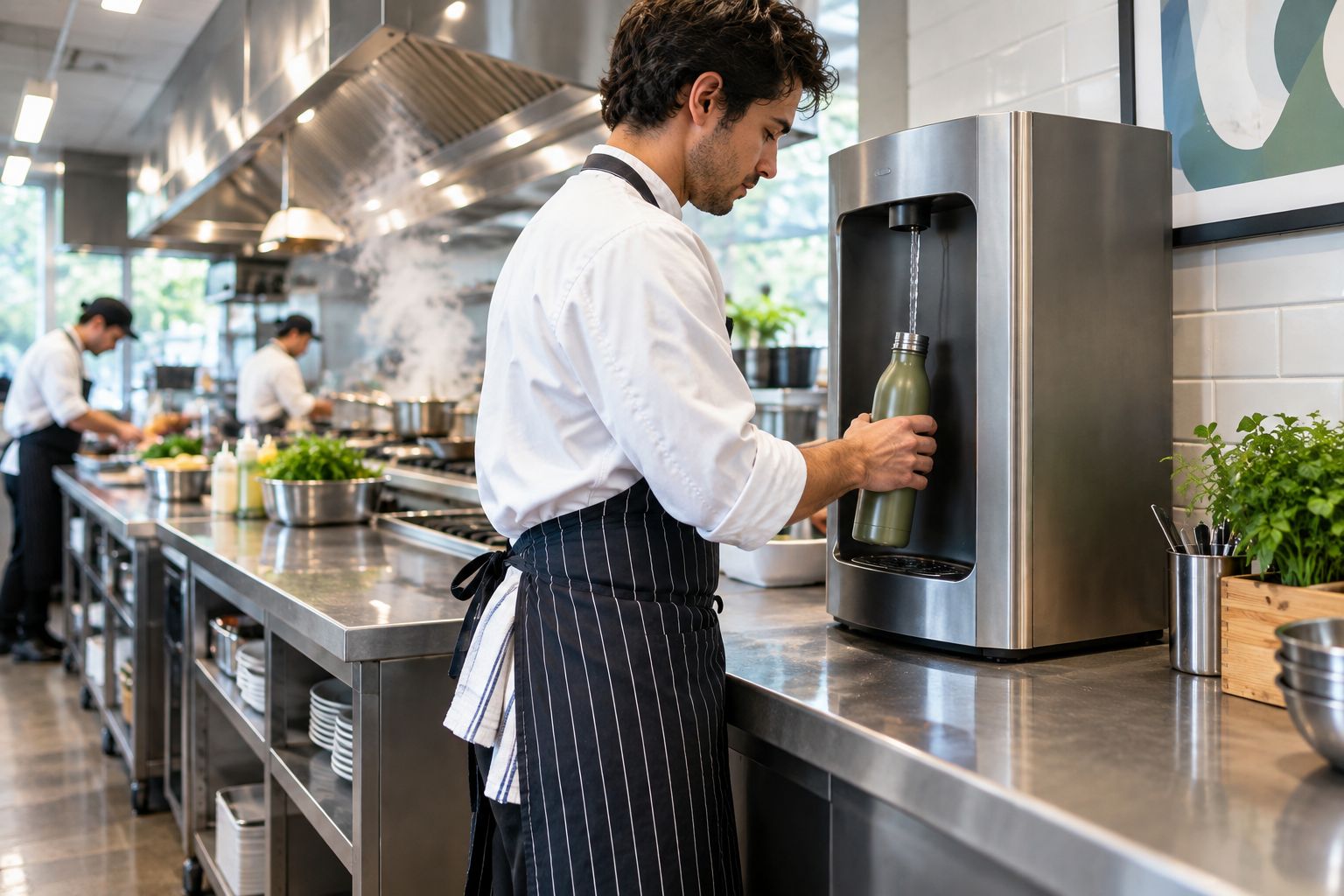
A foodservice kitchen runs on speed and sanitation, and a bottle filler touches both. Staff refilling water bottles at a shared tap slows down line flow during service; a dedicated filler keeps that traffic off the prep sink.
Health departments increasingly expect filtered water access points in back-of-house areas, and NSF/ANSI 61 (material safety) and NSF/ANSI 372 (lead-free construction) are the two certifications that show up on inspection checklists in 2026. NSF/ANSI 42 and 53 cover filtration for taste, chlorine, and contaminant reduction — worth checking if your water source has taste or hardness complaints.
A bottle filler also cuts cup and bottle waste at the front counter, which matters for operators tracking sustainability commitments alongside the health code box-check.
How to choose a bottle filler for your kitchen
Map where staff and customers actually fill bottles
Walk the space before you shop. A fill point at the kitchen line serves cooks and dishwashers; a fill point near the dining room or drive-thru window serves customers and delivery drivers.
- Kitchen line or dish pit, for staff hydration during service
- Server station or expo window, for front-of-house staff
- Dining room wall, for dine-in customers refilling bottles
- Drive-thru or to-go counter, for quick-service operations
- Break room, for staff on shift breaks
Check your water line and backflow requirements
Most commercial kitchens already have a cold water line nearby, but a bottle filler adds a fixture to the plumbing plan. Confirm backflow prevention is in place before you finalize a location — many municipalities require it on any new fixture tied to a potable line.
- Existing cold water line within reach of the mounting wall
- Backflow preventer status, confirmed with your plumber or facilities contact
- Floor drain nearby, for units with a drain pan
- Electrical outlet access, if the unit is refrigerated
Decide between a bottle filler, a jug filler, and a combination unit
A straight bottle filler serves individual water bottles. A jug filler for a commercial kitchen fills pitchers and large containers faster and is a better fit for a bar or a buffet line. A bi-level combination unit gives you a bubbler fountain and a bottle filler in one footprint.
- Straight bottle filler, for staff and guest water bottles
- Pedestal or wall jug filler, for pitchers and large-format containers
- Bi-level combination unit, for spaces that need a drinking fountain too
- ADA-compliant reach height, required for any publicly accessible unit
Choose filtered versus non-filtered and refrigerated versus non-refrigerated
Filtration adds a running cost — cartridge changes — but solves taste and chlorine complaints. Refrigeration adds electrical load but matters more in guest-facing dining rooms than in a staff-only kitchen corridor.
- Filtered units, for locations with taste or hardness complaints
- Non-filtered units, for locations already on filtered municipal supply
- Refrigerated units, for dining rooms and customer-facing counters
- Non-refrigerated units, for staff-only back-of-house locations
Match mounting style to your available space
A wall-mounted unit needs a clean stud line and enough depth for the backing plate. A retrofit kit adds bottle-filling capability to a fountain you already own, which is the lower-cost path if your existing cooler is still functional.
- Wall-mounted bottle filler, for kitchens with fixed wall space
- Freestanding pedestal, for open floor plans without a mounting wall
- Retrofit kit on an existing fountain body, for budget-limited upgrades
- Countertop unit, for small cafes and coffee counters
The Fountain Direct carries bottle fillers built specifically for this kind of duty cycle, including vandal-resistant models that hold up in high-traffic public-facing counters without babying the finish.
Plan for cleaning and health-code compliance
Stainless steel finishes wipe down faster than painted or plastic housings, which matters in a kitchen where every surface gets a sanitizer pass. Ask what the basin and nozzle are made of before you buy — a vandal-resistant or antimicrobial-coated nozzle cuts down on the between-shift wipe-down time.
- Stainless steel basin, for fast sanitizer wipe-downs
- Sensor or touchless activation, to cut down on contact points
- Removable or accessible drain trap, for routine cleaning
- Documentation kept on file, for health inspector visits
Budget for installation labor, not just the unit
The unit price is the smaller number on most bottle filler projects. Plumbing, electrical (for refrigerated units), and any wall modification usually cost more than the fixture itself, especially on a retrofit into an older building.
- Plumber quote for the water line tie-in
- Electrician quote, if the unit is refrigerated or sensor-activated
- Wall reinforcement, if mounting into non-load-bearing partition
- Permit requirements, which vary by municipality


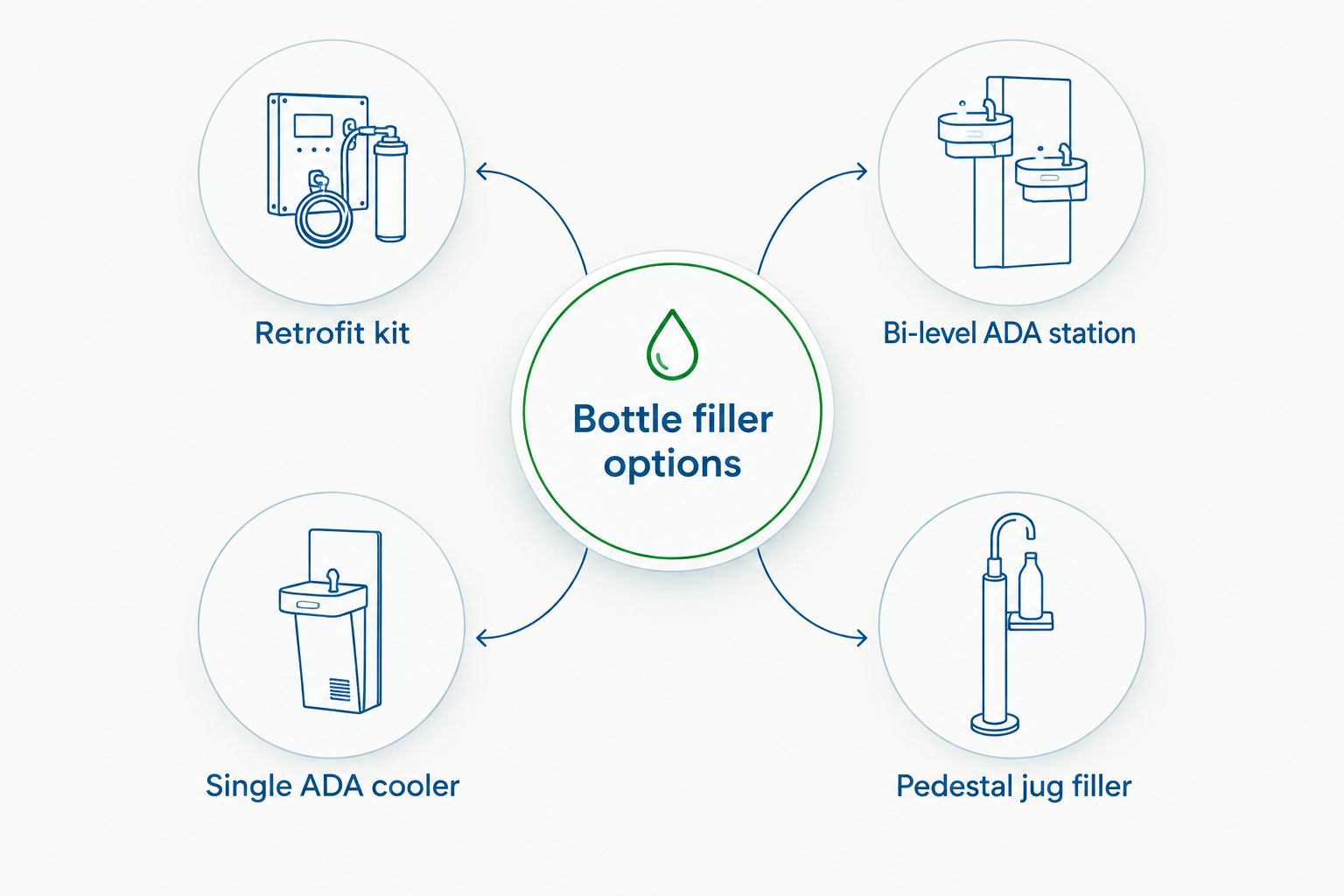
Comparison: bottle filler options for foodservice operators
| Option | Best for | Key limitation |
|---|---|---|
| Retrofit kit on existing fountain | Kitchens with a working cooler that just needs a bottle filler added | Only fits the matching fountain body style |
| Bi-level ADA bottle filling station | High-traffic kitchen lines and guest-facing counters | Higher upfront cost than a single-level unit |
| Vandal-resistant bottle filling station | Public-facing counters with heavy, unsupervised traffic | Built for durability, not the fastest fill speed on the market |
| Pedestal jug filler | Coffee shops and cafes filling pitchers all day, not single bottles | Not built for individual bottle fills or ADA bubbler access |
Verdict: a bi-level ADA bottle filling station is the right default for a full-service restaurant kitchen line in 2026 — it covers staff, guests, and code compliance in one fixture. A retrofit kit is the right call when the existing fountain still works and the budget only stretches to adding the filler.
The Fountain Direct's Elkay EZH2O vandal-resistant bottle filling station is built for exactly the counter-abuse scenario a quick-service front line puts a fixture through.
Common mistakes foodservice operators make
- Buying office-grade units for kitchen locations. Office bottle fillers aren't rated for the grease, steam, and cleaning-chemical exposure of a working kitchen.
- Skipping the backflow check. A bottle filler tied into a potable line without proper backflow prevention is a code violation waiting to be found on inspection.
- Choosing a jug filler when a bottle filler was needed, or the reverse. A pitcher-fill nozzle on a bar station doesn't serve a staff member trying to top off a water bottle quickly.
- Underestimating installation cost. The fixture price is often the smallest line item once plumbing and electrical are factored in.
- Ignoring fill speed during rush planning. A slow-filling unit at a busy expo window creates a line exactly when you can't afford one — check bottle filling stations ranked by fill speed before you commit to a model.
FAQ
What is the best bottle filler for a restaurant kitchen in 2026?
A bi-level ADA bottle filling station with NSF/ANSI 61 and 372 certification is the best fit for most restaurant kitchens in 2026 because it covers staff hydration and guest access in one fixture. Vandal-resistant models add durability for public-facing counters.
Do I need a jug filler or a bottle filler for my kitchen?
Use a jug filler if you're regularly filling pitchers or large containers at a bar or buffet line, and a bottle filler for individual water bottles. Many kitchens install both at different stations.
Is a filtered bottle filler worth it for a restaurant?
Filtered units are worth it if your water source has taste, chlorine, or hardness complaints, since NSF/ANSI 42 and 53 filtration address those directly. If you're already on filtered municipal supply, a non-filtered unit saves on cartridge replacement costs.
Can I retrofit an existing fountain to add bottle filling?
Yes, retrofit kits add a bottle filler nozzle and sensor to an existing fountain body without replacing the whole unit, as long as the kit matches your fountain's body style. This is the lower-cost path when the existing cooler still works.
What certification should a foodservice bottle filler have?
Look for NSF/ANSI 61 for material safety and NSF/ANSI 372 for lead-free construction, both standard checks on health inspections in 2026. NSF/ANSI 42 or 53 certification matters only if the unit is filtered.
How much does installation cost compared to the unit itself?
Plumbing and electrical work for a refrigerated unit often costs more than the fixture, especially in older buildings needing a new backflow preventer or wall reinforcement. Get a plumber's quote before finalizing a model.
Are vandal-resistant bottle fillers necessary for a restaurant?
Vandal-resistant construction matters most for unsupervised, public-facing counters like a drive-thru or lobby wall, less so for a staff-only kitchen corridor. Match the durability level to how exposed the fixture is.
One last thing
The detail most foodservice operators miss: fill speed matters more than filtration in a rush. A unit with strong NSF filtration but a slow nozzle will still create a bottleneck at the expo window during a Friday dinner rush, while a fast non-filtered unit on already-filtered municipal water solves the actual problem. Check the fill-speed comparison before the certification checklist, not after.