

Bottle Fillers for Plumbing Contractors: 2026 Guide

Bottle fillers for plumbing contractors are hydration fixtures — wall-mounted, floor-standing, or fountain-retrofit units — that get specified, roughed-in, and pressure-tested for schools, parks, gyms, and public buildings. Contractors buying these units care less about fill speed and more about rough-in dimensions, backflow requirements, and whether the fixture passes inspection on the first walkthrough. That's a different buying decision than the one a facilities manager makes, and it changes what actually matters on the spec sheet.
- Bottle fillers for plumbing contractors need verified rough-in, backflow protection and vandal resistance before filtration specs matter.
- Retrofit kits mount fastest on an existing fountain body; floor-standing bottle fillers need a dedicated drain and extra rough-in time.
- NSF-rated filtration is the standard spec on schools and parks jobs in 2026, not an upsell.
- Outdoor bottle fillers in freeze-prone regions need winterization or a freeze-resistant body — insulation wrap alone doesn't hold.
Why bottle fillers matter for plumbing contractors
Facility managers now ask for a bottle filler on nearly every fountain replacement bid in 2026 — schools, parks departments, and gyms treat a bare bubbler as a callback waiting to happen. That shifts the job from "swap a fountain" to "run a filtered, ADA-compliant fixture that passes inspection and doesn't come back as a warranty claim six months later."
For contractors, the variables that decide whether a bid wins or loses aren't marketing terms like fast-fill or app-connected. They're rough-in dimensions, drain placement, backflow prevention, and whether the unit is rated for outdoor freeze cycles. Get the fixture selection wrong at the quoting stage and you're re-measuring the job after the walkthrough. The guide on installing a bottle filling station outdoors covers site prep in detail; this guide covers what to check before the unit is even ordered.
Verify the existing rough-in and supply line before you quote
Most bottle filler jobs are retrofits, not new construction, so the existing rough-in decides which units are even candidates for the bid. A quote built on assumed dimensions is the fastest way to eat a change order.
- Measure the existing supply line diameter and confirm it matches the new fixture's inlet fitting.
- Locate the shutoff valve and confirm it's reachable without cutting into a finished wall.
- Check drain size and slope before quoting a floor-standing unit — undersized drains back up under continuous public use.
- Note wall stud spacing on retrofit jobs; bottle fillers run heavier than the fountain body they replace.
- Confirm there's a dedicated electrical run available if the client wants a refrigerated unit.
Confirm ADA clearances and mounting height on the drawing
ADA compliance isn't optional on public and institutional work, and it's cheaper to catch on paper than after the unit is mounted.
- Set the accessible spout height at or below the 36-inch ADA maximum on a bi-level fixture.
- Leave 27 inches of knee clearance at the accessible spout per ADA Standards for Accessible Design.
- Confirm 30 by 48 inches of clear floor space in front of the unit.
- Check that operable controls need no more than 5 pounds of force and no tight grasping.
- Verify the bottle-filler spout clears the accessible fountain's basin, not just the wall plane behind it.
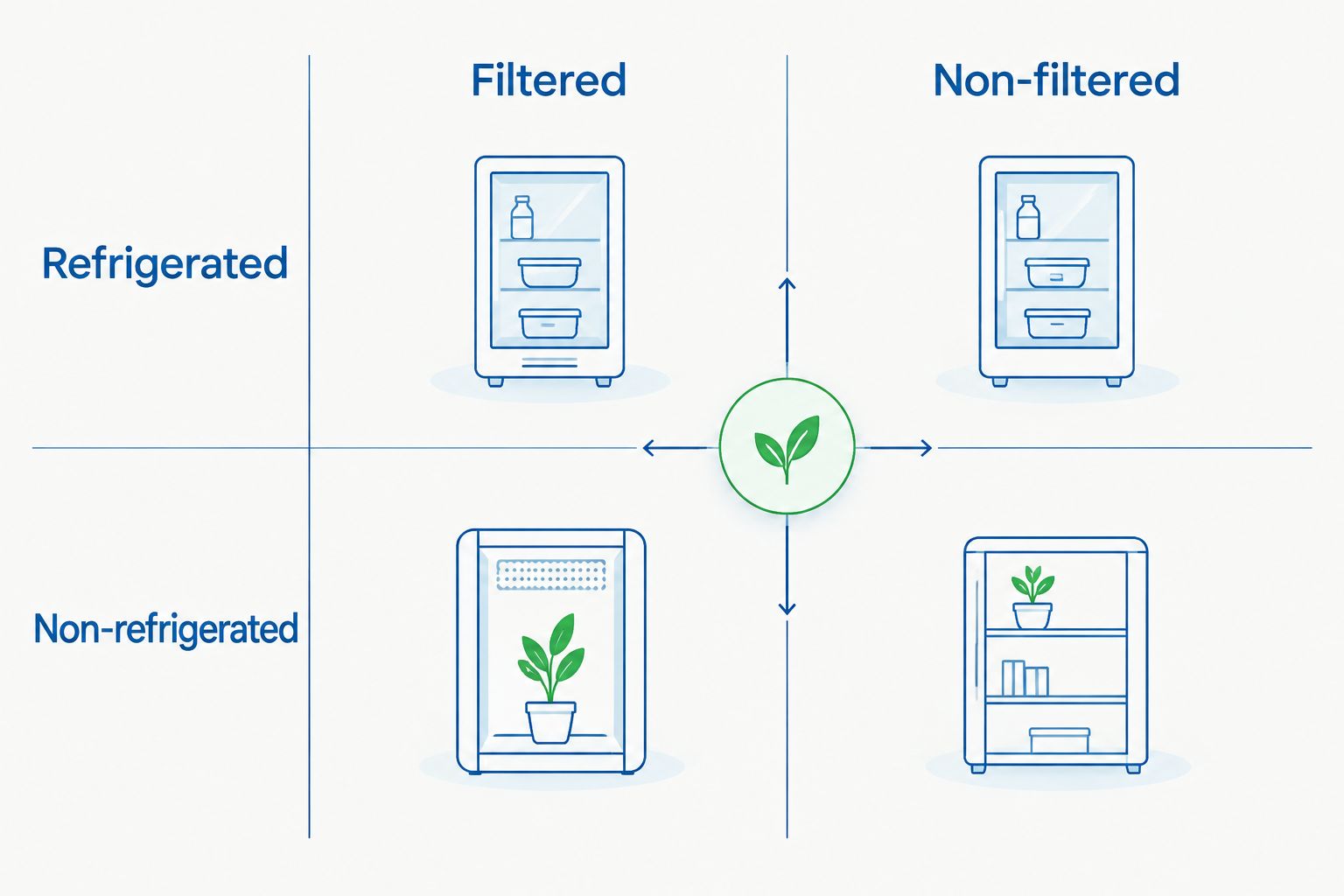
Choose filtered vs. non-filtered and refrigerated vs. non-refrigerated
This is the spec decision that drives most of the price spread on a bottle filler job, and it's the one owners ask contractors to explain.
- Spec NSF/ANSI 53 filtration when the site's water report shows lead or PFAS above local limits.
- Skip filtration only on jobs with a documented clean water report and a facilities team that actually changes filters on schedule — most public jobs don't have one.
- Choose refrigerated units for gyms, athletic facilities, and any site where cold water is part of the pitch to the owner.
- Choose non-refrigerated for outdoor park and trail installs, where a compressor is one more freeze-failure point.
- Confirm cartridge availability before you commit — a filtered unit with a hard-to-source filter becomes the client's maintenance headache, and eventually yours.
Spec vandal-resistant construction for outdoor and unsupervised sites
A fixture that looks identical to the filtered version on paper can fail in six months if it's built for a lobby instead of a park.
- Spec stainless steel bodies with concealed fasteners for any unsupervised outdoor or transit-adjacent site.
- Choose push-button or mechanical activation over exposed sensors in high-vandalism locations — sensors are the first thing that gets pried loose.
- Confirm the bubbler and bottle-filler spout are recessed, not protruding, on playground and park jobs.
- Ask whether the site has supervision during operating hours; unsupervised sites justify the vandal-resistant upcharge, supervised lobbies usually don't need it.
The Fountain Direct's catalog includes several bottle filler configurations built around exactly this contractor decision — how much vandal resistance and filtration a given site actually needs versus what it's tempting to over-spec.


Plan backflow prevention and shutoff placement
A bottle filler is a cross-connection point, and inspectors check it every time.
- Install a backflow preventer on every bottle filler connection — most state plumbing codes require it.
- Test the backflow assembly at commissioning and log the result for the inspector's file.
- Place the shutoff valve upstream of the backflow device, not buried behind the fixture where it's unreachable.
- Confirm with local code officials whether a vacuum breaker satisfies the requirement or a full reduced-pressure assembly is mandatory on that job.
Install and pressure-test the fixture
This is where a good spec turns into a fixture that actually works on day one.
- Dry-fit the unit before final connections to confirm the rough-in matches its actual footprint.
- Pressure-test the supply line before closing any wall or backfilling any trench.
- Run a full fill cycle and check the drain for backup before calling the job done.
- Photograph the rough-in and the finished install for the warranty file — bottle fillers draw more service calls over their life than standard fountains, and a paper trail settles disputes fast.
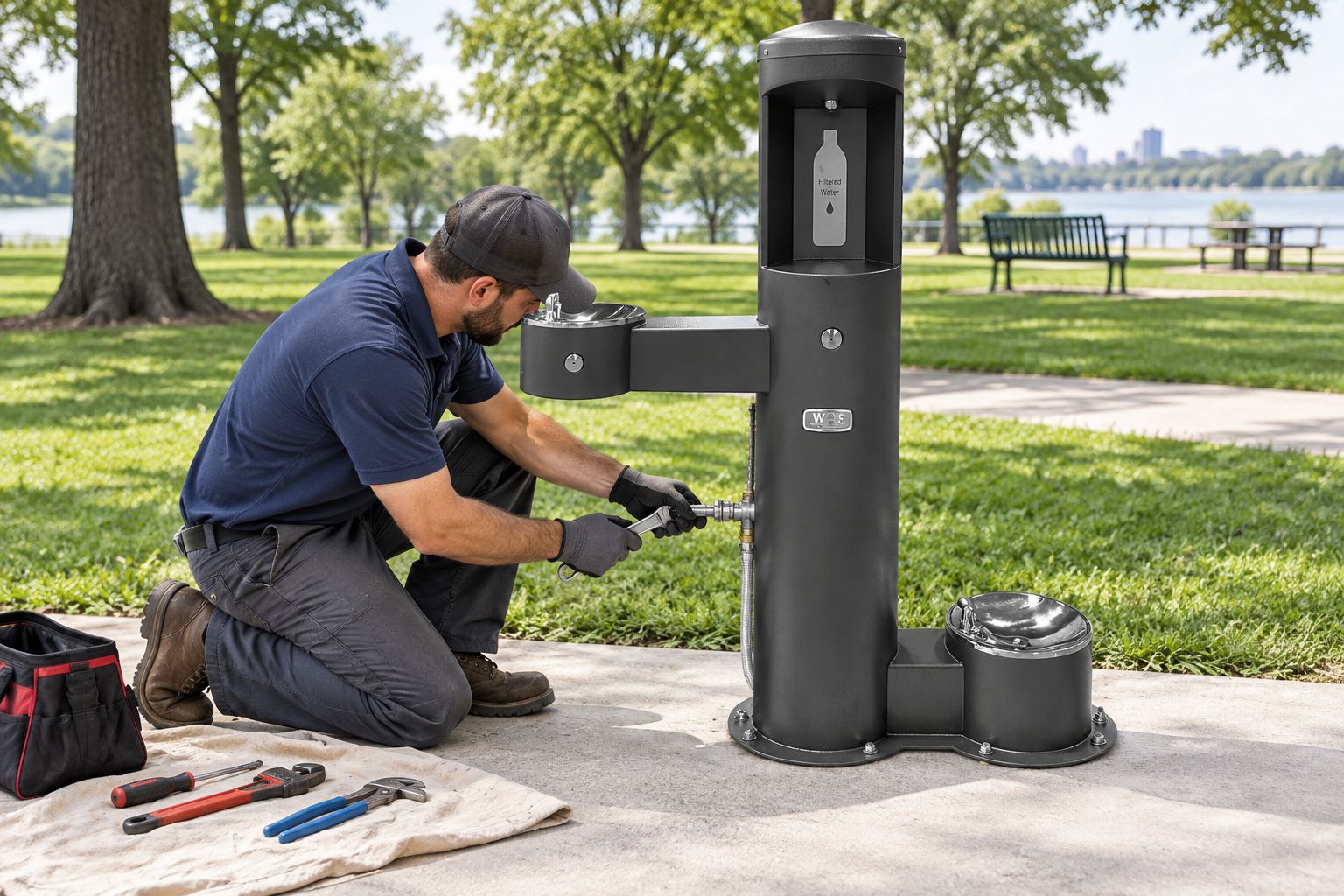
Winterize outdoor installs in freeze-prone climates
A bottle filler that isn't rated for winter is a burst pipe waiting for the first cold front.
- Install a freeze-resistant body or a self-draining supply line on any outdoor unit in a freeze-prone region.
- Shut off and drain outdoor bottle fillers before the first hard freeze if the unit isn't rated for winter use.
- Confirm insulation on any exposed supply line running through an unheated space.
- Hand the client the winterizing a bottle filling station checklist so their maintenance team handles shutdown correctly every fall, not just the first one.
Bottle filler options for plumbing contractor jobs
Most contractor bids land on one of four fixture types. Pick based on the rough-in you already verified, not the fixture that looks best on a spec sheet.
| Option | Best for | Key limitation |
|---|---|---|
| Mechanical retrofit bottle filler (Elkay EZH2O) | Budget retrofits onto an existing fountain body | Mechanical push-activation only, no filtration |
| Vandal-resistant bottle filling station with UV filtration | High-traffic public and park sites | Needs a refrigeration circuit and a higher upfront cost |
| Floor-standing filtered, refrigerated bottle filler (Enhanced EZH2O) | Standalone installs with no fountain to retrofit | Needs dedicated floor space and a floor drain |
| Single ADA bottle filler, refrigerated (Elkay LZ8WSBPRO) | Tight retrofit spots in corridors or break rooms | Single-user bubbler, no bi-level fountain |
The vandal-resistant, UV-filtered bi-level station is the right call for any unsupervised public site in 2026 — it's the only option here built to take repeat abuse without a service call every quarter.
Common mistakes plumbing contractors make on bottle filler jobs
- Quoting from the old fountain's footprint instead of measuring the actual bottle filler's deeper cabinet — bi-level and filtered units run bigger than a standard bubbler.
- Skipping the backflow test at commissioning and leaving it for the inspector to catch, which turns a same-day job into a return trip.
- Specifying a refrigerated unit on an outdoor job without checking for a dedicated circuit, then discovering the panel is full during rough-in.
- Installing a non-freeze-rated unit outdoors in a climate that gets hard frost, then fielding the burst-pipe call in January.
- Assuming filtration is optional on public jobs — most schools and parks departments now bake NSF-rated filtration into the spec before bids go out.
FAQ
What's the best bottle filler for a plumbing contractor doing a school retrofit?
A vandal-resistant, filtered bi-level bottle filler is the standard spec for schools in 2026 because it covers ADA height requirements and unsupervised-hallway durability in one fixture. A mechanical retrofit unit works if the budget won't cover a full filtered system.
Do bottle fillers need a backflow preventer?
Yes — a bottle filler is a cross-connection to the potable water supply, and most state plumbing codes require a backflow preventer on the line. Test the assembly at commissioning and keep the result on file for the inspector.
Is a filtered bottle filler better than a non-filtered one?
Filtered units are the better choice on any public job where the water report shows lead or PFAS above local limits, which covers most school and park sites in 2026. Non-filtered units make sense only where the water source is documented clean and filters would go unchanged anyway.
How much clearance does an ADA bottle filler need?
ADA Standards for Accessible Design call for a maximum 36-inch spout height, 27 inches of knee clearance, and 30 by 48 inches of clear floor space in front of the unit. Confirm these on the drawing before mounting, not after.
Can an outdoor bottle filler survive winter without extra work?
Only if it's built freeze-resistant or self-draining — a standard refrigerated unit left outdoors through a hard freeze risks a burst supply line. Shut off and drain non-rated units before the first freeze each year.
What's the difference between a retrofit kit and a floor-standing bottle filler?
A retrofit kit mounts onto an existing fountain body and installs fastest since the rough-in is already there. A floor-standing unit needs its own drain and more floor space but doesn't depend on the condition of an old fixture.
Do plumbing contractors need to test filtered bottle fillers before handoff?
Run a full fill cycle and check the drain for backup before calling the job complete, and pressure-test the supply line before closing any wall. Photograph the finished install for the warranty file.
Are vandal-resistant bottle fillers worth the extra cost?
On any unsupervised outdoor or public site, yes — push-button or mechanical activation and concealed fasteners hold up where exposed sensors get pried loose within months. Supervised lobbies and offices usually don't need the upcharge.
One last thing
Every bottle filler installed in a public building needs NSF/ANSI 61 certification for lead-free wetted material — that's been federal law since the Reduction of Lead in Drinking Water Act took effect in 2014, not a nice-to-have spec line. Check the certification on the cut sheet before you order, because swapping a non-compliant unit after install costs more than catching it at the quote.