

How to Purchase Order Commercial Fountain Online
Learn how to purchase order commercial fountain online with the right specs, ADA compliance, freight terms, and pricing for schools and facilities.

A commercial fountain order usually gets delayed for one reason - the product was chosen before the job requirements were fully defined. If you need to purchase order a commercial fountain online, the fastest path is not starting with brand names or price alone. It starts with use case, code requirements, installation conditions, and who will maintain the unit after it is installed.
That matters whether you are outfitting a school hallway, a public park, a transit facility, a gym, or a beachside rinse station. In each case, the right fountain is less about appearance and more about traffic volume, durability, compliance, freeze exposure, and how much abuse the fixture will take over time.
How to purchase a commercial fountain online without costly mistakes
Online purchasing can save time, especially when your team already has approved vendors, fixed project deadlines, and limited staff bandwidth. But commercial hydration equipment is not a casual buy. A wall-mounted indoor drinking fountain, an ADA bi-level bottle filler, and an outdoor pedestal fountain all solve different problems.
The best online orders begin with four questions. Where will the fountain be installed? Who will use it? What codes or accessibility requirements apply? And what kind of plumbing and drainage are already on site?
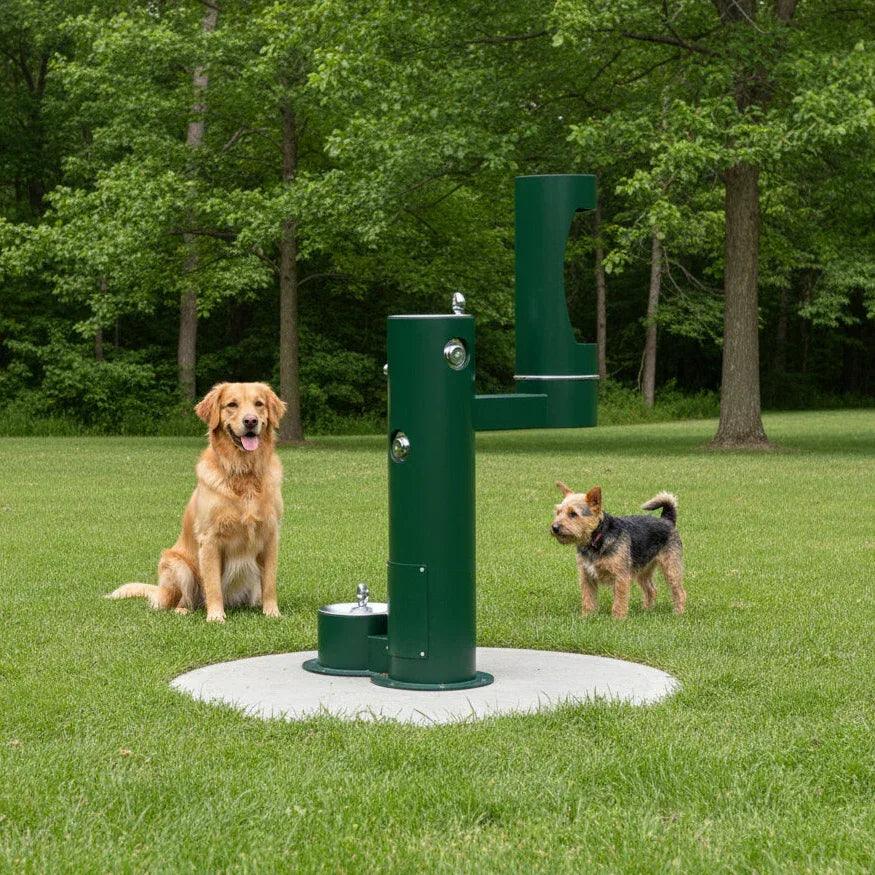
A school operations director might need a vandal-resistant bottle filler that can handle heavy daily traffic and reduce maintenance calls. A parks department may need a freeze-resistant outdoor drinking fountain with a pet station and bottle filler for year-round public access. A resort or beach property may need outdoor showers that can withstand salt air, sand, and constant use while still looking clean and professional.
If those questions are not settled first, the order can look correct on paper and still create field issues during install.
Start with the environment, not the catalog
Commercial buyers often search by product type first, but environment is a better filter. Indoor and outdoor fountains are built for very different conditions, and even outdoor units vary widely.
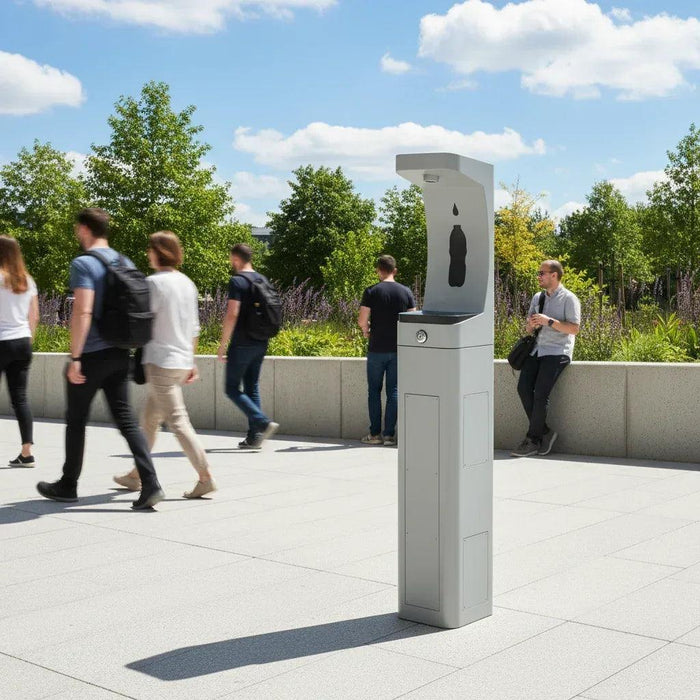
For indoor applications, common decision points include wall-mounted versus free-standing, chilled versus non-refrigerated, bottle filler integration, hands-free activation, and ADA/barrier-free access. In office buildings and schools, bottle filling stations are often the practical choice because they support hygiene goals and reduce disposable bottle waste. In lower-traffic back-of-house areas, a standard wall-hung fountain may be enough.
For outdoor applications, the decision tree changes. You need to think about sun exposure, freeze risk, corrosion resistance, vandal resistance, and whether the fixture will be used by people, pets, or both. A decorative-looking unit may not hold up in a public park. A basic outdoor fountain may also fail early in freeze-thaw climates if it was not designed for winter conditions.
That same principle applies to outdoor showers. Heavy-duty pool showers, beach rinse stations, and resort shower columns are not interchangeable with light residential-style units. Commercial buyers need fixtures built for repeated use, easier cleanup, and long-term durability in public settings.
The specs that matter before you issue a PO
If your purchasing process requires a formal purchase order, get the technical details aligned before procurement enters the order. That sounds obvious, but many avoidable delays happen because one missing spec forces a clarification cycle.
Mounting style is the first checkpoint. Wall-mounted units save floor space and are common indoors. Pedestal and free-standing units are more common outdoors and in open public areas. Then verify rough-in requirements, waste location, supply connections, and electrical needs if the fountain includes chilling or sensor-based bottle filling.
Next, confirm accessibility. For many public and institutional projects, ADA compliance is not optional. Mounting height, reach range, spout location, and control operation all matter. A product that is durable and affordable still may not be the right fit if it does not meet project accessibility needs.
Material and finish also deserve more attention than they usually get. Stainless steel is often preferred for commercial interiors because it is durable, easy to clean, and familiar to maintenance teams. For outdoor fountains and showers, corrosion resistance and weather performance become more important, especially in coastal or high-humidity settings.
Finally, consider maintenance reality. Filter replacement access, push-button durability, cartridge service, winterization requirements, and replacement part availability all affect long-term ownership cost. A lower upfront price can turn into a poor value if the unit is difficult to service or downtime becomes frequent.
Purchase a commercial fountain online for schools, parks, and facilities
The phrase sounds simple, but the buying path is different depending on the facility.
In schools, traffic volume and hygiene drive the decision. Bottle fillers with touchless activation are often the strongest fit for hallways, gyms, and cafeterias. District buyers usually need dependable lead times, ADA-compliant options, and units that stand up to student use without constant service calls.
In parks and recreation settings, outdoor durability comes first. Freeze-resistant models, pet-friendly combinations, and vandal-resistant construction tend to matter more than chilled water. If the site is unsupervised for part of the day, build quality is not a nice-to-have. It is the product.
In office, retail, and fitness spaces, appearance and user experience may carry more weight. A modern bottle filling station can support employee wellness and customer convenience, but it still needs to align with plumbing conditions and daily usage levels. For gyms and high-traffic business environments, hands-free filling and easy cleaning usually justify the upgrade.
For hospitality properties, especially resorts and pool areas, the conversation often expands beyond drinking fountains. Outdoor showers become part of the same planning process because guests expect practical rinse-off access near pools, beaches, and recreation zones. Here, finish, durability, and environmental exposure all have to work together.

Price matters, but freight and warranty matter too
Commercial buyers are right to focus on the budget. But online procurement is not just about unit cost. Freight, return terms, and warranty support can change the real cost of a purchase.
Large hydration fixtures often ship by freight, not parcel. That means packaging quality, delivery coordination, and inspection at receipt all matter. A low advertised price is less compelling if freight fees appear later or if replacement handling is difficult when a unit arrives damaged.
The same goes for warranty coverage and brand authorization. Established manufacturers such as Elkay, Halsey Taylor, Haws, Willoughby, Stern-Williams, and others are widely specified because buyers know what they are getting. That helps with submittals, replacement parts, and long-term confidence. Trusted by 800+ customers, The Fountain Direct focuses on that kind of procurement clarity with price match support, free freight on most orders, and U.S.-based guidance for commercial buyers.
That said, it still depends on your project timeline. If the site needs equipment quickly, availability may matter more than saving a small amount on unit price. If you are ordering well ahead of a scheduled install, you may have more flexibility to choose a configuration that better matches the end use.
When online ordering is the right move
Online ordering always works best when the buyer has a clear application, knows the installation constraints, and wants fast comparison across compliant commercial options. It is especially efficient for repeat buyers such as contractors, facility teams, and municipal purchasers who already understand the approval process on their side.
It is also a strong fit when you need to compare indoor drinking fountains, outdoor drinking fountains, bottle fillers, and outdoor showers by actual job requirements rather than generic product descriptions. The goal is not to browse endlessly. The goal is to narrow to a product that fits the site, the code, the budget, and the maintenance plan.
Where buyers get into trouble is assuming all commercial fountains are basically the same. They are not. A vandal-resistant outdoor pedestal unit, an ADA indoor bottle filler, and a freeze-proof pet fountain may all serve public hydration, but they are built for very different operating conditions.
That is why the right supplier matters. You want product guidance that reflects real commercial use, not just a broad catalog with thin descriptions.
A better way to move from quote to install
If you are preparing to purchase a commercial fountain online, treat the order like a project package. Confirm the environment, user type, ADA needs, mounting style, finish, and maintenance expectations before the PO is issued. Then verify freight terms, lead times, warranty coverage, and return policies so there are no surprises after approval.
That extra diligence usually saves more time than it costs. It keeps the fixture aligned with the site, helps your team avoid change orders, and gives end users a fountain or shower that actually performs the way the space requires.
Clean water access is a basic expectation in public and commercial environments. The right equipment makes that access easier to deliver, easier to maintain, and easier to trust long after the install is finished.