

Outdoor Showers for Property Managers: 2026 Buying Guide

Property managers buying outdoor showers for apartment complexes, HOA pools, and shared amenity decks need fixtures built for continuous public use, not the residential unit sold for one backyard. The right pick cuts rust warranty calls, slip risk on wet concrete, and after-hours plumbing emergencies down to almost nothing in 2026.
- Outdoor showers for property managers need 316-grade stainless, freeze resistance, and code compliance for the pool deck they serve.
- The Wesley freestanding outdoor shower tower fits open decks with no wall access; wall-mounted units need an existing stub-out.
- Add a mixer valve anywhere residents shower right after a cold pool exit — cold shock is the top service complaint.
- ADA-compliant models like the Milan Silver pool shower are required wherever the pool itself is ADA-accessible.
- Skip plastic components on coastal or high-chlorine properties — salt air and chlorine both accelerate corrosion on non-marine-grade parts.
Why outdoor showers matter for property managers in 2026
A freestanding outdoor shower tower solves the complaint every property manager hears from residents: pool water, sand, and sunscreen tracked through hallways and stairwells. Apartment and HOA pools sit under state and local health codes that typically require an accessible fixture near the water line, and a corroded or broken shower shows up as a liability flag on every insurance walkthrough.
Capital budgets for amenity equipment run annual or biennial at most properties. A shower installed in 2026 has to run without a service call until the next capital cycle, which means material and valve choice matter more than which unit looks nicest in a catalog photo.
Match the shower type to your property's foot traffic
A 40-unit apartment pool and a 300-unit HOA aquatic center do not need the same fixture. Traffic volume decides whether you need one shower or four, and whether a basic rinse unit is enough or you need a full mixer setup.
- Freestanding towers for open pool decks with no adjacent wall
- Wall-mounted units for buildings with an existing exterior wall near the pool
- Combination units with an integrated foot rinse spout for sandy or chlorinated feet
- Multi-head towers for properties running two or more pools off one budget line
- Compact push-button models for tight courtyards where deck space is limited
Decide between freestanding and wall-mounted installs
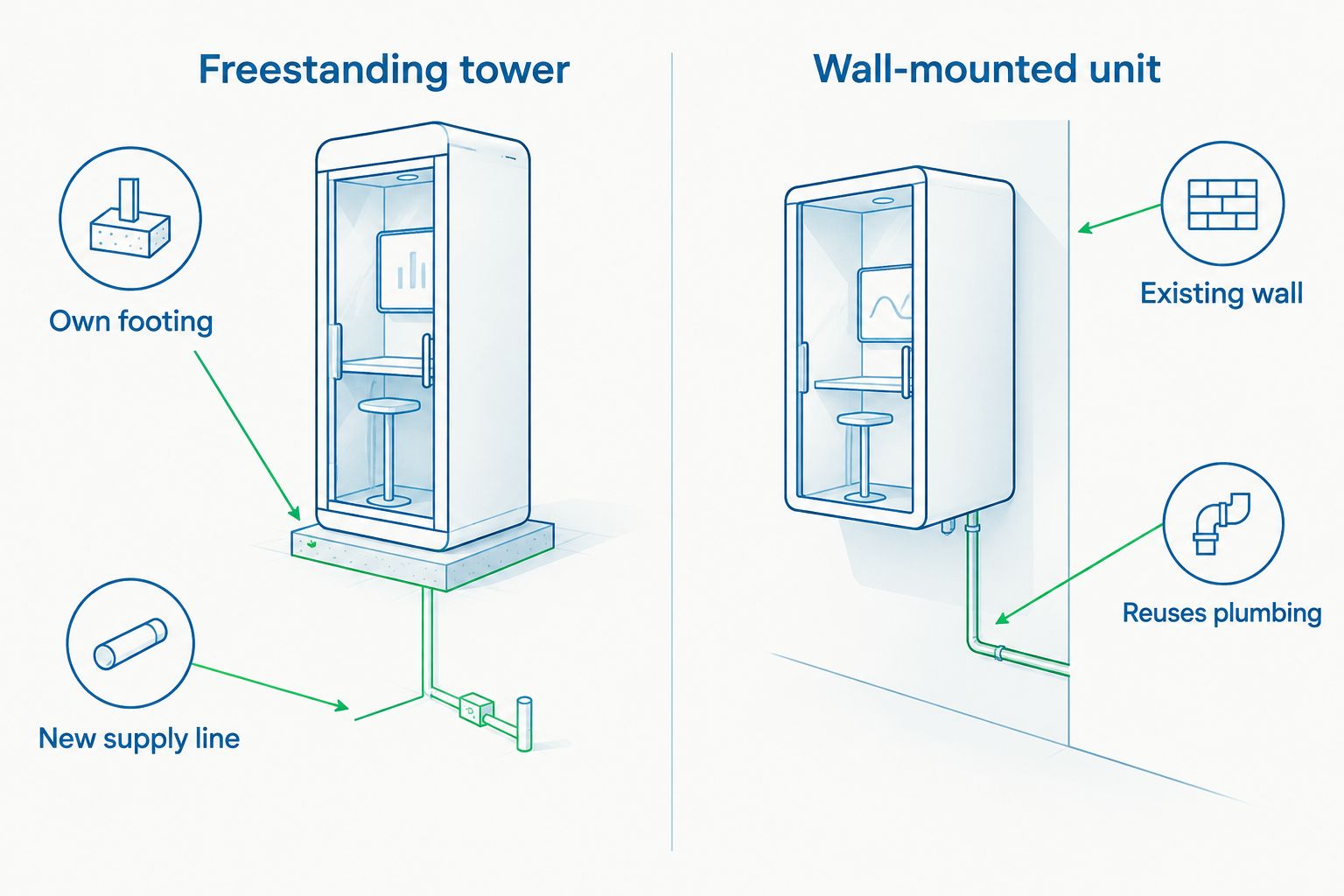
This is the first fork in the spec sheet, and it decides your plumbing cost more than any other choice on the list.
- Freestanding towers stand on their own footing, away from any wall
- Wall-mounted units tie into an existing exterior wall and stub-out
- Freestanding installs need a new supply line trenched to the deck
- Wall-mounted installs reuse plumbing already run to the pool equipment room
- Combination units add a foot rinse spout at the base for sandy decks
Add a mixer valve wherever cold-water shock is a complaint
Most property managers skip the mixer valve on the first purchase, then add it after residents complain about jumping into 55-degree water straight off a pool deck. A wall-mounted shower with a hot/cold mixer valve solves this on the first install instead of a retrofit.
- Self-closing mixer valves that shut off automatically, cutting water waste
- Hand-shower wands for rinsing sand or dirt off feet and legs
- Hot/cold mixer rails for properties in cooler climates or shoulder seasons
- Push-button timed flow for high-traffic decks that need turnover speed
- Lever handles over knobs for residents with limited hand strength
Specify marine-grade stainless for coastal or high-chlorine sites
Salt air and pool chlorine both eat through standard chrome and painted brass faster than most property managers expect. Marine-grade stainless is the material spec that keeps a shower out of the next capital repair list.
- 316-grade stainless for direct coastal exposure or year-round chlorinated pools
- Powder-coated brass only for inland properties with low chlorine dosing
- Stainless mounting hardware, not just a stainless shower head
- Sealed internal valves that keep chlorinated water off moving parts
- Satin or brushed finishes that hide water spotting better than polished chrome
Build in ADA compliance where the pool itself is accessible
If the pool has an ADA-accessible entry point, the shower serving it typically needs to meet the same standard. This is a code requirement in most jurisdictions, not an optional upgrade, and it gets checked during property inspections and insurance renewals.
- An ADA-compliant pool shower with reach and clearance built to the 2010 ADA Standards for Accessible Design
- A hand-held wand as the primary control, not a fixed overhead-only head
- Lever-style controls instead of round knobs that are hard to grip wet
- A slip-resistant mat or texture zone at the base of the unit
- Clear floor space around the shower matching your accessible-route plan
Control water waste with self-closing valves or a timer
Unmetered outdoor showers run all day if a resident forgets to shut one off, and that shows up on the water bill by August. Property managers running multiple properties usually standardize on one control type across the portfolio to simplify parts inventory.
- Self-closing push-button valves that shut off automatically after a set flow
- Coin- or key-operated timers for amenity areas billed separately
- Foot-pedal activation for hands-free use with sandy or soapy hands
- Metered flow restrictors that cap gallons per activation without shutting off early
- Standard lever valves only for low-traffic, staff-monitored areas
Plan for freeze protection before winter
Any property in a freeze-prone climate needs a shower that drains completely or gets winterized on a schedule, or the first hard freeze cracks the supply line.
- Freeze-resistant valve bodies rated for below-freezing exposure
- A shutoff and drain point below the frost line for full winterization
- Insulated supply lines on any run exposed above grade
- A written winterization date on the maintenance calendar every fall
- Backup shutoff access that doesn't require draining the whole pool equipment line
Confirm backflow prevention and local code sign-off
Most plumbing codes require backflow prevention on any outdoor fixture tied into a potable water supply, and outdoor showers are no exception. Skipping this step is one of the most common reasons a property fails a plumbing inspection after a shower install.
- A backflow preventer sized to the shower's supply line, not the building main
- Annual testing scheduled with whoever handles the property's other backflow devices
- Permit sign-off from the local plumbing authority before the concrete pour
- Documentation kept with the property's capital improvement records
- A licensed plumber for the final connection, even on a straightforward wall-mount


Quick comparison of outdoor shower options for property managers
| Option | Best for | Key limitation |
|---|---|---|
| Freestanding tower (Wesley) | Open pool decks with no wall access | Needs its own footing and dedicated supply line |
| Wall-mounted 2-in-1 (Delta) | Buildings with a wall and stub-out near the pool | Only works where wall plumbing already exists |
| ADA-compliant unit (Milan) | Properties with an ADA-accessible pool | Handheld wand hose needs periodic replacement |
| Basic rinse-off shower (Bondi) | Budget-limited properties needing a simple rinse | No mixer valve — cold water only |
The Fountain Direct carries all four categories, and the right one comes down to what's already on your wall, not which unit looks best in a brochure.
Common mistakes property managers make
- Buying a residential shower kit rated for one backyard, not continuous public traffic
- Skipping the mixer valve, then fielding cold-shock complaints the first warm weekend
- Forgetting backflow prevention required by local plumbing code before the next inspection cycle
- Choosing painted or low-grade steel near saltwater or high-chlorine pools, then replacing it well before the next capital cycle
- Missing ADA accessible-route requirements after a pool deck resurfacing changes the clearance
FAQ
What's the best outdoor shower for an apartment complex pool?
A freestanding stainless tower works for most apartment pool decks with no wall access, while a wall-mounted 2-in-1 unit fits buildings with existing plumbing on an adjacent wall. The Fountain Direct stocks both configurations for property managers buying in 2026.
Do outdoor showers need a mixer valve?
A mixer valve isn't required by code in most jurisdictions, but it's the fix for the most common resident complaint: cold shock right after a pool exit. Properties in cooler climates or with year-round pool use should specify one on the first install.
Is a freestanding or wall-mounted outdoor shower better for property managers?
Wall-mounted units cost less to plumb if a wall and stub-out already exist near the pool. Freestanding towers work anywhere on an open deck but need a new supply line trenched to the footing.
Are outdoor showers required to be ADA compliant?
Yes, wherever the pool itself is required to be ADA-accessible under the 2010 ADA Standards for Accessible Design. That typically means reach and clearance requirements apply to the shower serving that access point too.
How do property managers winterize an outdoor shower?
Shut off the supply, drain the line below the frost line, and confirm the valve body is rated freeze-resistant before the first hard freeze. Properties in freeze-prone climates should put this on the fall maintenance calendar every year.
Do outdoor showers need a backflow preventer?
Most local plumbing codes require backflow prevention on any outdoor fixture tied into a potable water line, and outdoor showers fall under that rule. Skipping it is a common reason installs fail plumbing inspection.
What material lasts longest on a coastal or chlorine-heavy property?
316-grade marine stainless steel resists salt air and chlorine corrosion far better than standard chrome or painted brass. Properties near the coast or running high chlorine dosing should specify it on every outdoor fixture, not just the shower head.
How often should an HOA replace an outdoor pool shower?
There's no fixed replacement schedule — it depends on material grade, water chemistry, and traffic volume. Marine-grade stainless units on a documented maintenance plan typically outlast painted or plastic units by a wide margin.
One last thing
The part that fails first on a high-traffic property install usually isn't the shower head — it's the mixer valve, because it gets bumped by carts, mowers, and pool furniture more than any other component. Mount it where equipment can't clip it, not just wherever the plumbing run happens to land, and it will outlast the rest of the fixture by years.