

Indoor Drinking Fountains for Gym Franchises: 2026 Guide

Gym franchise operators shopping for indoor drinking fountains for gym franchises need a different spec sheet than an office building buyer: hands-free activation, bottle-filling speed, and one model that installs the same way in every club on the roster. A locker room fountain that isn't touchless, isn't ADA-compliant, or can't be sourced identically for the next five locations creates a maintenance problem that compounds with every new club opening in 2026.
- Indoor drinking fountains for gym franchises should be touchless, ADA-compliant, and standardized across every club location.
- Elkay VRCTL8WSK and Haws 1211SFH both pair bottle filling with hands-free activation for high-traffic gyms.
- ADA rules cap accessible spout height at 36 inches — a Hi-Lo pair meets this without running a second fountain line.
- Non-filtered units save on install cost but push filtration onto a separate cartridge members will notice.
Why indoor drinking fountains matter for gym franchises
A single-location gym can get away with a general-purpose wall fountain. A franchise can't. Every new club has to pass the same ADA inspection, use the same wall rough-in, and run the same maintenance schedule — which means the fountain decision made for club #1 becomes the standard every regional manager inherits for the next ten builds.
Gym members also touch these units more than almost any other commercial fixture: pre-workout, mid-set, post-class, all day, every day. A push-button fountain in a 24-hour gym gets more cycles in a month than the same unit in a corporate lobby gets in a year, and sweat plus disinfectant wipes down surfaces faster than in most other commercial settings. That's why the water fountain with bottle filler for gyms question comes up so often from facilities teams managing more than one club.
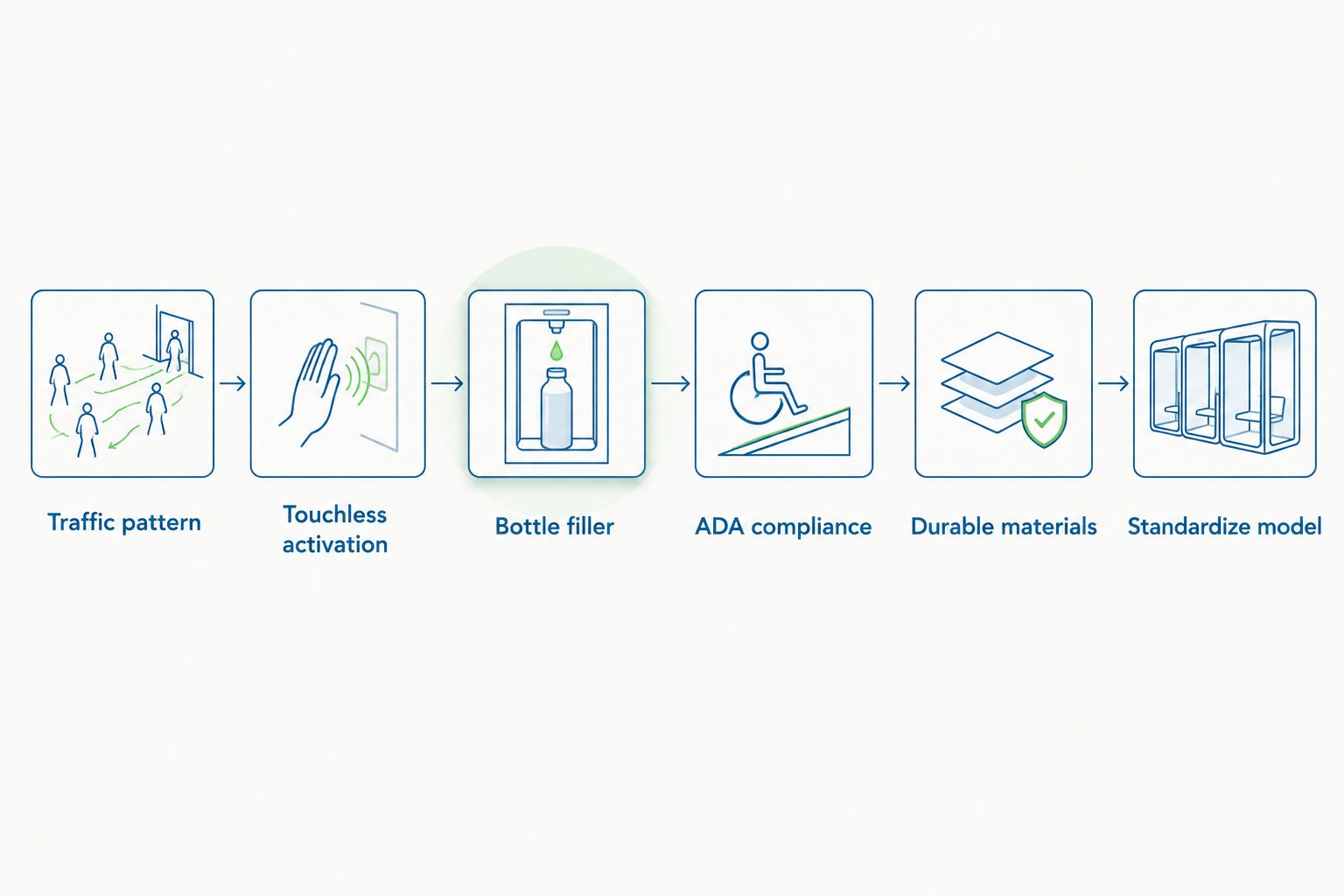
Step 1: Map your traffic pattern before you pick a model
Franchise clubs run on predictable peaks — early morning, lunch, and evening class blocks — and the fountain that handles a 24-hour anytime-access gym is not the same fountain a boutique studio with three classes a day needs.
- Count stations per square foot near the cardio floor, free weights, and locker rooms separately
- Flag any 24-hour locations for higher-duty-cycle units
- Note whether classes cluster demand into 15-minute windows
- Check if locker rooms need a second, lower-traffic unit instead of one central fountain
Step 2: Require touchless or motion activation
Hands-free activation isn't a luxury add-on in a gym in 2026 — it's the baseline members expect after years of hearing about touchpoint hygiene. Franchises that still spec manual push-button units are fielding more member complaints about it than they used to.
- Motion-sensor bottle fillers over manual push-bars wherever the budget allows
- Foot-pedal options for locker rooms where hands are often wet or gloved
- One activation type across all locations, not a mix of sensor and manual
- Sensors rated for humid, high-splash environments near showers
See the full breakdown in the guide to the hands-free drinking fountain for gyms before you finalize a spec sheet.
Step 3: Add a bottle filler, not just a bubbler
A bubbler-only fountain is the wrong call for a gym in 2026. Members bring bottles; the fixture should be built to fill them fast, not just offer a stream to drink from directly.
- Look for a fill rate rated for reusable bottles, not sip-only bubblers
- Confirm the filler head clears a 32-ounce bottle without tilting
- Prioritize a laminar flow stream that doesn't splash the counter
- Choose bi-level units so the bottle filler and the bubbler serve different heights at once
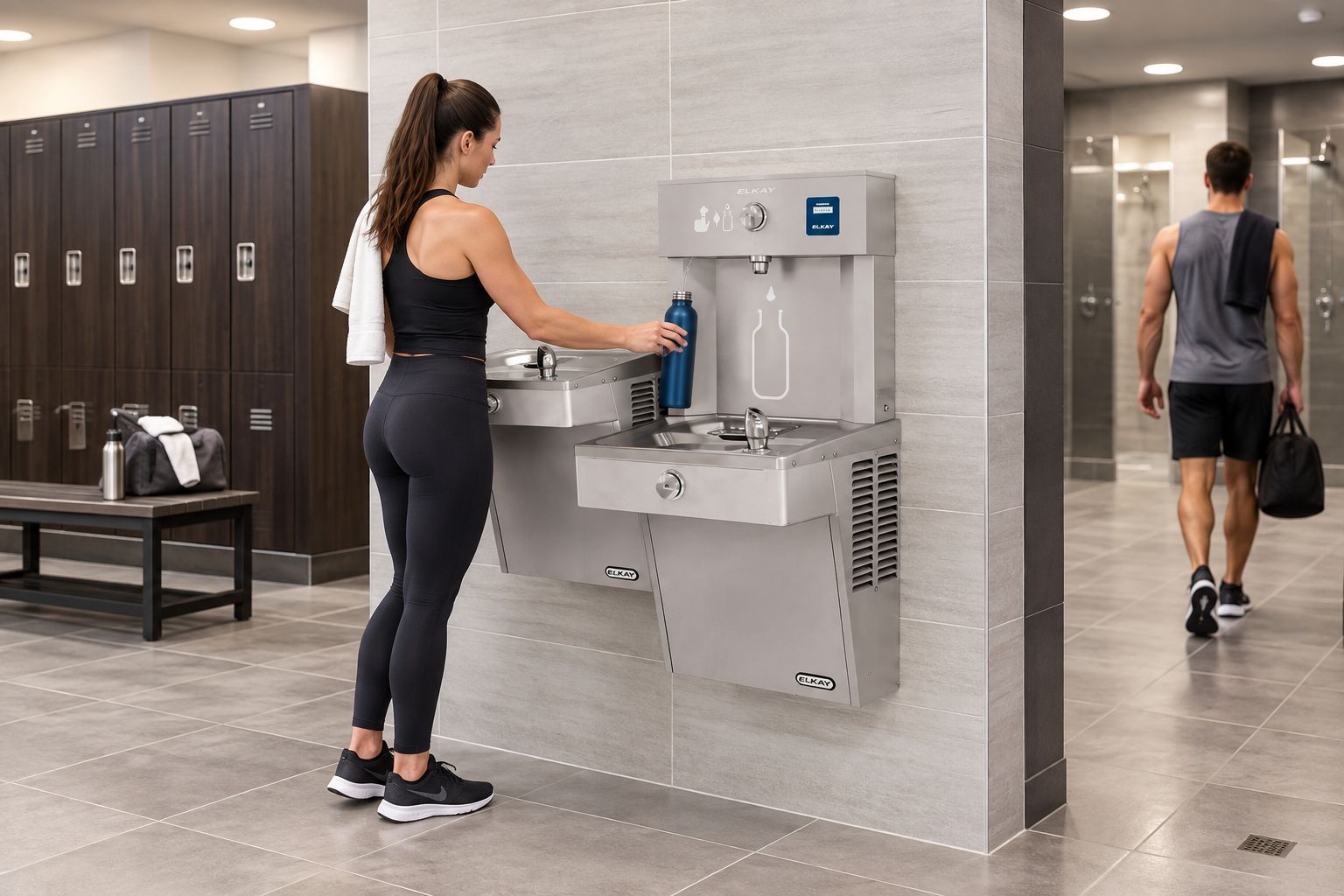
The vandal-resistant bottle filling station line covers this exact use case: bi-level, mechanical activation, built to survive gym-floor abuse.
Step 4: Meet ADA at every club, not just the flagship
ADA Standards for Accessible Design cap the spout height on a wheelchair-accessible fountain at 36 inches, with knee and toe clearance underneath for a forward approach. A Hi-Lo pair — one high-spout unit and one accessible-height unit — satisfies this in a single footprint instead of forcing a second fountain run.
- Confirm spout height sits at or under 36 inches on the accessible unit
- Verify knee clearance depth meets the forward-reach requirement
- Use the same Hi-Lo model at every location so inspections go the same way every time
- Keep a copy of the ADA compliance documentation on file per club, not just per chain
Step 5: Pick materials that survive sweat, cleaning chemicals, and gym traffic
Gyms clean surfaces with disinfectant more often than almost any other commercial space, and that chemical exposure eats cheap coatings fast.
- Stainless steel bodies over painted metal for chemical resistance
- Vandal-resistant construction for unsupervised 24-hour locations
- Sealed electronics on any sensor-activated unit near shower spray
- Powder-coat only on interior, low-splash locations — never near locker room showers
Step 6: Standardize the model across every location
The single biggest cost driver for a multi-location fountain program isn't the unit price — it's carrying five different models across ten clubs and stocking five different parts kits.
- Pick one primary model for new builds and one for retrofits
- Standardize the filter cartridge SKU across all filtered units
- Keep one install spec sheet your GC uses at every new club
- Train facilities staff on one troubleshooting process, not five
“A fountain that isn't touchless and doesn't fill bottles doesn't belong in a 2026 gym build-out.”
Step 7: Budget for filtration and a maintenance schedule
Filtered units need scheduled cartridge changes, and skipping that schedule is the fastest way to turn a premium fixture into a member complaint.
- Set a filter-change calendar tied to gallon count, not just a date
- Log service visits per club so franchise-wide patterns show up early
- Stock spare filter cartridges at the regional level, not per club
- Flag any non-filtered unit that members might assume is filtered
Comparison: indoor fountain options for gym franchises
| Option | Best for | Activation | Key limitation |
|---|---|---|---|
| Elkay VRCTL8WSK | High-abuse entryways and locker rooms | Push-bar plus mechanical bottle filler | Non-filtered — plan a separate filter cartridge if members expect filtered water |
| Haws 1211SFH | Cardio floors needing fully touchless fill | Motion-activated, filtered | Needs a dedicated electrical run for the sensor |
| Haws 1212SF | Franchises standardizing on one Hi-Lo unit | Sensor-activated, filtered | Hi-Lo footprint takes more wall space than a single-height unit |
| Elkay LZOOTL8WSLK | Locations wanting dual hands-free bottle filler plus ADA cooler | Dual hands-free activation, filtered | Requires a refrigeration line — budget install time accordingly |
Verdict: the Haws 1211SFH wins for cardio floors that need a fully touchless refill point, and the Elkay VRCTL8WSK wins for high-abuse locker room entries where vandal resistance matters more than filtration.


Common mistakes gym franchises make
- Buying single-height units to save wall space. This fails ADA at the next inspection and forces a retrofit later, which costs more than doing it right the first time.
- Mixing manual and sensor-activated fountains across locations. Facilities staff end up troubleshooting two different systems, and members notice the inconsistency between clubs.
- Skipping the bottle filler on retrofit locations. Members already expect one in 2026; a bubbler-only fountain reads as an outdated club.
- Ignoring filter cartridge logistics until after install. A non-filtered unit installed without a plan turns into a member complaint about water taste within weeks.
- Treating each new club as a one-off purchase. Franchises that standardize save on training, parts, and troubleshooting time across every location, not just the first one.
FAQ
What's the best indoor drinking fountain for a gym franchise?
A bi-level, hands-free unit with a bottle filler, such as the Haws 1211SFH or Elkay VRCTL8WSK, covers both ADA compliance and high-traffic durability. Pick one model and standardize it across every club in the chain.
Do gym drinking fountains need to be ADA compliant?
Yes — ADA Standards for Accessible Design cap the accessible spout height at 36 inches with required knee clearance underneath. A Hi-Lo pair meets this without needing two separate fountain runs.
Is a touchless drinking fountain worth it for a gym?
Yes for high-traffic clubs — motion or foot-pedal activation cuts touchpoints on a fixture members use dozens of times a day. It costs more to wire in but reduces member complaints about hygiene.
How often do gym bottle filler filters need to be changed?
Filter change intervals are tied to gallon throughput, not a fixed calendar date. High-traffic gym locations hit that gallon count faster than an office, so track usage per location rather than using one chain-wide schedule.
Should every gym location use the same fountain model?
Standardizing on one primary model across all clubs cuts parts inventory, simplifies staff training, and keeps ADA inspections consistent. Mixed models across a franchise create more maintenance overhead than the unit savings are worth.
What's the difference between a bubbler and a bottle filler?
A bubbler produces a stream for drinking directly from the fixture; a bottle filler is a separate spout built to fill a reusable bottle without splashing. Most gyms in 2026 need both on the same unit.
Can non-filtered drinking fountains work in a gym?
Non-filtered units work where municipal water quality is already good and members aren't expecting filtered taste. Filtered units are the safer default when a gym markets itself on wellness or premium amenities.
One last thing
The franchise decision that saves the most money over five years isn't the fountain model — it's the filter cartridge SKU. Pick one filtered unit that uses the same cartridge across every club, and the maintenance program scales without a facilities manager tracking five different part numbers.