

Connect Drinking Fountain to Chilled Water Loop Safely (2026)

Instead of troubleshooting warm fountain water after installation, design the potable-water cooling path before connecting the drinking fountain. Never pipe a closed HVAC chilled-water loop directly into a drinking fountain: keep HVAC water separate from drinking water, and use a cooling arrangement approved for potable-water service.
- To connect a drinking fountain to a chilled water loop, keep HVAC water isolated from the potable supply.
- The Fountain Direct is best for facility buyers comparing refrigerated fountains with non-refrigerated units that need separate cooling.
- Check the fountain’s installation instructions and the cooling design before ordering fittings or opening a water line.
- Commission the potable supply, drain and drinking outlet before putting the fountain into service.
Why this matters
A building’s chilled-water loop commonly serves heating, ventilation and air-conditioning equipment. Its water is not a drinking-water supply. A drinking fountain needs a separate potable path, even when that path is cooled by equipment connected to the building’s chilled-water system. For a 2026 project, establish that boundary on the plumbing drawings before anyone orders a fountain or cuts into a pipe.
If you are selecting the fixture as well as planning the connection, start with the drinking fountain specification guide for architects. The fountain’s inlet, mounting arrangement, drain and accessibility requirements affect the work around the cooling equipment. A suitable fountain does not, by itself, make a proposed chilled-water connection safe.
Before you start
- Get the right drawings and people involved. Have the fountain’s installation instructions, the cooling equipment’s documentation, the building’s plumbing and mechanical drawings, and a qualified plumbing contractor. Have the system designer confirm how potable water will be cooled.
- Confirm the actual water path. Identify the potable supply, any closed HVAC loop, the proposed potable-side cooling equipment and the fountain inlet. If the plan shows HVAC water entering the fountain, stop: that is not a connection to make.
- Check the non-obvious approval issue. A heat exchanger separates two fluid paths, but its presence alone does not approve the assembly for drinking-water use. Confirm the specified potable-side components, cross-connection protection and maintenance arrangement with the designer and local authority before installation.
Identify the cooling arrangement
In 2026, the first installation decision is whether the fountain cools its own potable water or receives water cooled elsewhere. These are different plumbing scopes. Do not treat a non-refrigerated fountain as a substitute for a refrigerated model without an approved external cooling design.
| Arrangement | Best for | Advantage | Limitation |
|---|---|---|---|
| Elkay LVRCTL8WSPRO refrigerated bi-level cooler and bottle filler | A project specifying a refrigerated fountain and bottle filler | Refrigeration is identified in the product listing | Its listed refrigeration does not establish compatibility with a building chilled-water loop |
| Avalon A51-OFNC wall-mounted drinking fountain | A project whose designer has separately specified the water temperature and supply arrangement | The listing identifies a built-in drain and front push button | The listing does not establish that it chills water or accepts a particular external cooling connection |
| Existing compatible fountain with separately designed potable-water cooling | A retrofit where the fixture can remain in place | Preserves the fixture when its condition and documentation support reuse | Requires a confirmed cooling design and a check of the existing supply and drain |
Best for a straightforward fixture selection: The Fountain Direct’s refrigerated drinking-fountain listing gives buyers a defined cooling feature to evaluate. Best for a central cooling design: select the fountain only after the designer confirms its permitted inlet conditions and specifies the potable-side equipment. Neither choice authorizes a direct HVAC-loop connection.
Map the two water paths
- Trace the closed loop from the building cooling equipment to the proposed point of heat transfer. Mark it as separate from every drinking-water pipe on the working drawings.
- Trace the potable side from the approved supply through any specified cooling equipment to the fountain inlet. Include the isolation valves and service points called for in the approved design.
- Check the separation method against the cooling equipment documentation and the requirements set by the designer and local authority. Resolve an unapproved or unclear connection before work begins.
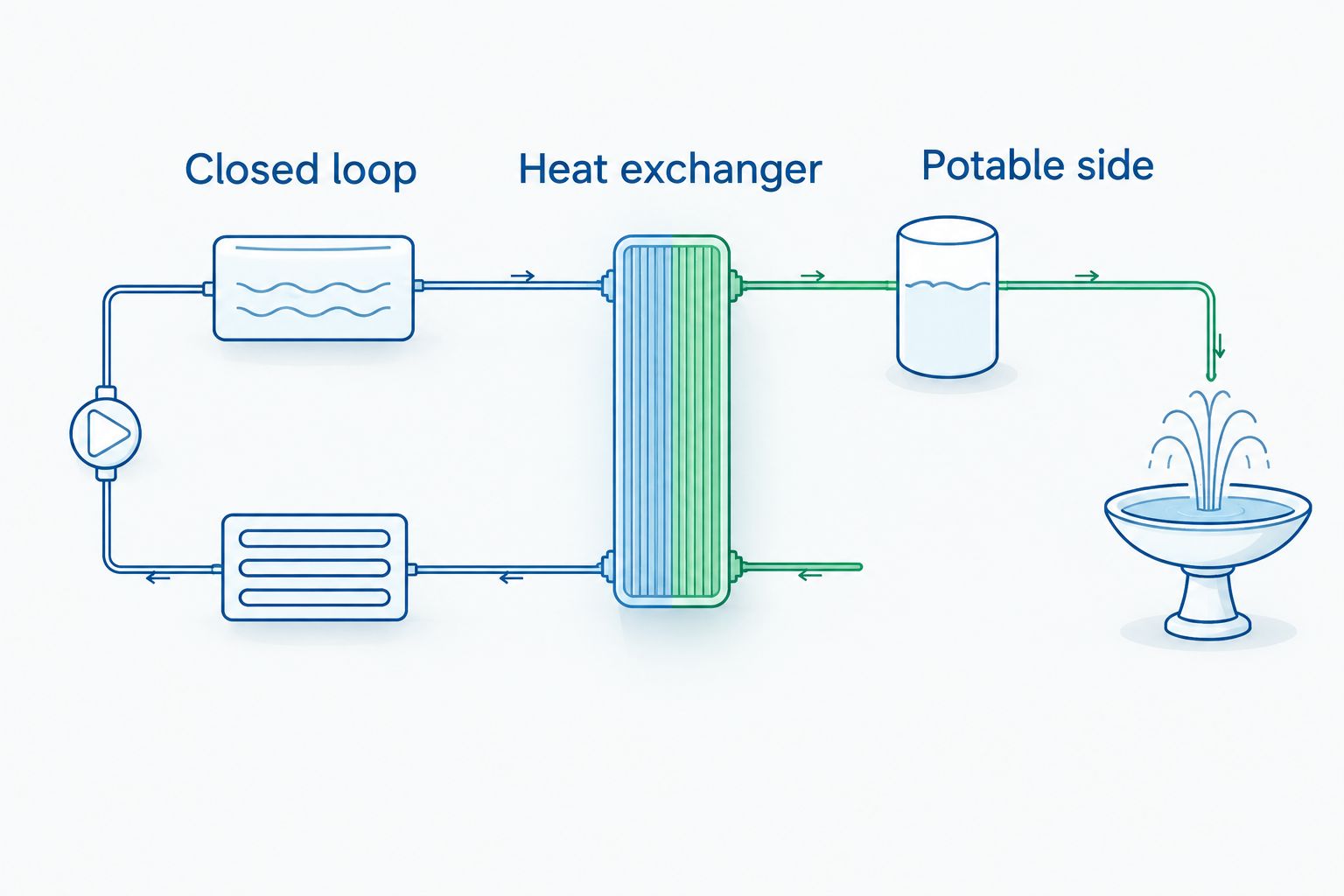
Expected result: The drawings show a continuous potable path to the fountain and no direct fluid connection from the HVAC loop to the drinking outlet. The heat-transfer boundary is identifiable to the installer and the person who will maintain it.
A heat exchanger transfers cooling without treating the two streams as one water supply. The approved design must also address what happens if equipment fails; do not assume that drawing two separate lines settles cross-connection requirements.
Verify the fountain and cooling equipment
- Read the fountain installation instructions for its approved supply connection, inlet conditions, mounting method and drain requirements. Use the model documentation, not a fitting that merely appears to match.
- Check the potable-side cooling equipment for its intended water service and the components specified by the designer. Confirm how it will be isolated and serviced without opening the HVAC loop to the drinking-water pipe.
- Confirm the site conditions with the plumbing contractor: access to the approved potable supply, room for the equipment, a suitable drain connection where required, and any electrical provision for the specified equipment.
- Resolve the fixture choice before ordering connections. If the fountain’s instructions do not permit the proposed supply arrangement, change the design or select a suitable fixture rather than adapting the inlet on site.
Expected result: The installer has a model-specific connection plan, and the cooling assembly has an approved potable-water path. In 2026, a product title or a photograph is not a substitute for those installation documents.
Connect and commission the potable side
- Isolate the potable supply serving the work area and follow the site’s required shutdown procedure. Keep the HVAC loop isolated from the drinking-water work.
- Install the specified potable-side connections in the sequence shown on the approved drawings and equipment instructions. Keep accessible service components accessible; do not bury an isolation point behind a finished wall without the required access.
- Connect the fountain inlet and drain using the fixture’s installation instructions and the approved plumbing plan. Do not use the drain as a water-supply route or connect a drinking outlet to a mechanical-system pipe.
- Flush, test and inspect the completed potable work under the applicable installation requirements. Check joints, drain operation, flow at the drinking outlet and cooling performance using the commissioning method specified for the installed equipment.
- Record the completed arrangement on the site documents so future maintenance staff can distinguish the potable pipe from the closed cooling loop.
Expected result: Water reaches the fountain through the approved potable route, the drain functions, and the installed cooling equipment performs as specified. Keep the fountain out of service until required testing and inspection are complete.
Variant: use a refrigerated fountain instead
You do not need to connect a drinking fountain to a building chilled-water loop simply because the facility already has one. For a new installation, a refrigerated fountain is another way to specify cooled drinking water. It still needs its own approved potable supply, drain and any utilities required by its instructions.
- Select a refrigerated fixture whose documented features fit the project, including the drinking outlets and accessibility arrangement. Confirm those requirements on the specific model before ordering.
- Plan the potable supply and drain around that fixture’s installation instructions. Remove the proposed connection to the building chilled-water loop from the fountain scope unless other specified equipment needs it.
- Commission the fixture using its documentation. Check drinking-water flow, drainage and refrigeration operation before opening it for use.
Expected result: The drinking fountain chills its supplied potable water as specified, without a direct connection to the building’s closed HVAC water. For a 2026 replacement project, compare the installation scope of both approaches before choosing the fixture.
The trade-off is clear: a refrigerated unit makes cooling a fixture-level specification, while a separately cooled potable supply adds equipment and coordination outside the fountain. A refrigerated listing does not remove the need to verify site utilities, and an external cooling design does not make every non-refrigerated fountain compatible.
Troubleshooting a new connection
- The fountain runs, but the water is warm. Confirm whether the installed fixture has refrigeration or relies on an external potable-water cooler. Check the specified cooling equipment and its commissioning results; do not move the inlet to an HVAC chilled-water pipe.
- The drawing calls a pipe chilled water but does not identify its use. Trace it with the mechanical and plumbing drawings. Treat an unverified pipe as unsuitable for the drinking-water inlet until the designer identifies the potable path.
- The cooling equipment is present, but its drinking-water approval is unclear. Stop the connection and obtain its documentation and the designer’s direction. A heat exchanger’s name alone does not confirm that the full assembly is suitable for this installation.
- Flow at the bubbler is poor after the connection. Check the approved supply path, isolation valves and the fountain’s model-specific adjustment instructions. Investigate a supply restriction before changing a fixture setting.
- Water appears below the fixture. Isolate the affected supply as required and inspect the inlet connections and drain separately. A dry supply joint does not rule out a drain leak when the bubbler is running.
Customize your workflow
For a building with several fountains, put each fixture and its cooling arrangement on the same schedule. Record the model, potable supply route, cooling method, isolation location and drain connection for each one. That gives the contractor a connection plan and gives maintenance staff a way to find the correct pipe later.
For a retrofit, begin with the existing fixture documentation and its condition. Confirm that the fountain can remain in service with the proposed potable-water supply before designing around it. If its inlet requirements cannot be verified, specify a replacement rather than presenting an improvised connection as an upgrade.
For a public facility planning work in 2026, include access and shutdown requirements in the installation scope. The cooling plan must work not only when first commissioned but also when a technician needs to isolate the potable side for maintenance. Have the designer document that service arrangement alongside the water paths.
FAQ
Can I connect a drinking fountain directly to an HVAC chilled-water loop?
No. A closed HVAC chilled-water loop is not the fountain’s potable-water supply. Keep the loop separate and use a drinking-water cooling arrangement approved for the installation.
How do I connect a drinking fountain to a chilled water loop safely?
Connect the fountain to an approved potable-water path, not directly to the closed loop. Have the designer specify and approve any equipment that transfers cooling between the separate systems.
Does a heat exchanger make chilled-loop water safe to drink?
No. A heat exchanger is a means of transferring heat between separate paths; it does not turn HVAC-loop water into drinking water. The entire potable-side arrangement needs review for the project.
Is a refrigerated drinking fountain better than an external chiller?
A refrigerated fountain is the simpler fixture specification when its documented features meet the project needs. An external potable-water cooling design is appropriate when the designer has specified the equipment and confirmed fixture compatibility.
Can I connect a non-refrigerated fountain to chilled potable water?
Only when the specific fountain’s installation instructions permit the proposed inlet conditions and the potable cooling arrangement is approved. A non-refrigerated product listing alone does not establish compatibility.
What should I check if a newly connected fountain dispenses warm water?
First identify whether the fountain has its own refrigeration or depends on separate cooling equipment. Then check that equipment’s commissioning results and the approved potable-water route.
Who should approve a drinking-fountain connection in 2026?
The project designer and the local authority should resolve the plumbing and cross-connection requirements, with a qualified contractor following the approved plans. Model-specific installation instructions govern the fixture connection.
One last thing
Label the water paths on the finished drawings before the wall closes. The immediate connection can look tidy while leaving the next technician unable to tell a potable supply from a mechanical cooling pipe. That distinction is the most important part of connecting a fountain near a chilled-water loop.