

How much water does a drinking fountain use per day?

A drinking fountain has no fixed daily water-use figure: its use equals the water discharged while its outlets run, plus any flushing and leaks. For your 2026 estimate, multiply each outlet’s measured flow rate by its total daily running time, then add water used outside normal drinking. Count the whole stream, including water that goes down the drain—not just the amount people swallow.
- How much water does a drinking fountain use per day? Measure flow and running time; there is no universal daily total.
- Drinking fountain water consumption includes the entire discharged stream, not just water swallowed.
- Bottle filler water use depends on dispensed volume, with flushing and leaks counted separately.
- The Fountain Direct sells commercial drinking fountains; choose for the site, then verify water use for the exact model.
How much water does a drinking fountain use per day?
Daily drinking fountain water use is flow rate multiplied by daily running time, with flushing and leaks added separately. A flow rate describes what happens while water is running. It does not tell you how long visitors hold the button or how often they return.
Use this calculation for a single outlet:
Daily gallons = gallons per minute × total running minutes per day + additional gallons used that day.
For a fixture with several outlets, calculate each outlet separately and add the results. A drinking bubbler, bottle filler, and pet bowl need separate entries because their flow rates and operating times are not interchangeable.
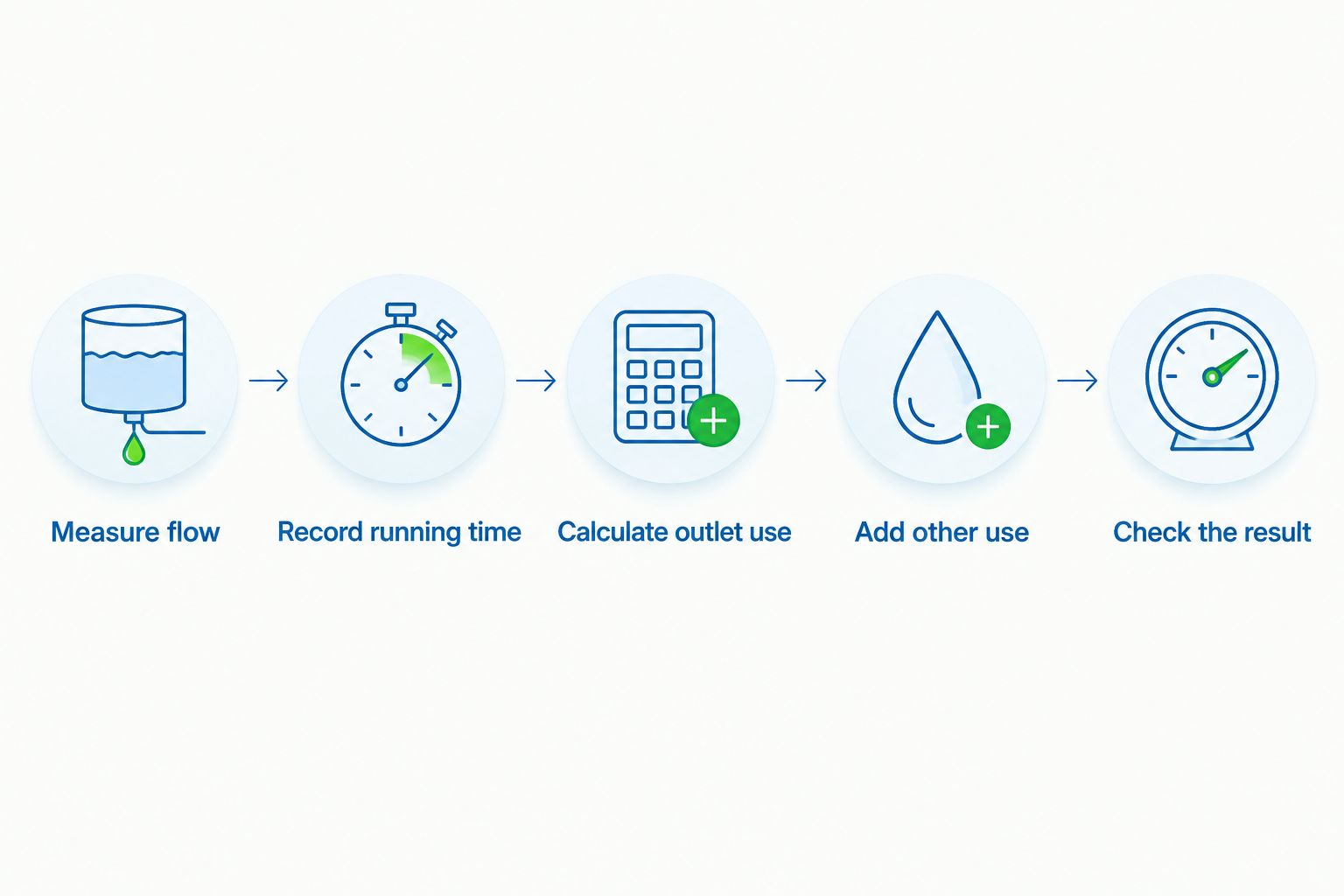
- Measure flow. Collect the full stream in a clean graduated container while timing the discharge, without touching the outlet.
- Record running time. Measure how long the outlet actually releases water during the observation period.
- Calculate outlet use. Multiply measured flow by accumulated running time using matching units.
- Add other use. Include documented flushing, cleaning-related discharge, and leaks.
- Check the result. Compare the calculation with an isolated meter reading where a suitable meter is installed.
Before measuring, correct an obviously misdirected stream using the manufacturer’s instructions. The guide to adjusting water flow on a drinking fountain bubbler covers that separate maintenance task.
Why this matters
A daily water estimate helps you compare an existing fixture with a replacement, investigate unexplained consumption, and plan facility operations. It does not establish whether a fountain has enough cooling capacity or whether its installation meets accessibility requirements. Those are separate purchasing checks.
For a 2026 replacement project, keep water volume, cooling performance, and installation requirements in separate worksheet fields. Combining them produces misleading comparisons: a refrigeration capacity rating is not a daily water-consumption figure.
The Fountain Direct is a drinking fountain supplier for schools, parks, businesses, and public facilities. Use the exact model’s documentation to confirm its specifications before ordering. A product category alone cannot establish the daily volume your facility will use.
Measure daily use without confusing flow and volume
Measure flow at the outlet
Flow rate needs both a volume and a time measurement. Record the collected volume, record elapsed time, and divide volume by time. Capture the whole discharge rather than only the part of the stream that lands conveniently in the container.
There are 60 seconds in a minute. If you collect water while timing in seconds, convert the elapsed time to minutes before calculating gallons per minute. Alternatively, retain liters per second throughout the calculation and convert the final total afterward.
Use a clean collection method that does not contact or contaminate the bubbler. Keep the drain unobstructed, avoid splashing nearby electrical components, and follow the manufacturer’s service instructions. Ask a qualified technician to perform measurements that require opening the cabinet or accessing plumbing.
Measure separate outlets independently. Do not assume that the bottle filler and drinking bubbler on the same assembly discharge at the same rate. Repeat the measurement if the stream changes during testing, and record the conditions alongside the result.
Record actual operating time
Building opening hours are not fountain running hours. A fountain available throughout the day normally dispenses intermittently when users activate it. Multiplying its flow rate by the entire opening period would treat intermittent use as continuous use.
Record the accumulated discharge time, not just the number of visitors. A visitor count leaves out differences in drinking duration, repeated activation, bottle filling, and water released before someone begins drinking.
For an initial planning estimate, observe a representative operating period and label any extrapolated result as an estimate. For measured daily use, monitor the complete reporting period. Keep quiet days, busy days, and special events separate so the result remains useful for purchasing.
Use an isolated meter when available
A correctly installed meter serving only the fixture measures water supplied to that fixture. Subtract the opening reading from the closing reading for the same reporting period. Check the meter’s units before recording the difference.
A whole-building meter cannot attribute all consumption to a drinking fountain when other fixtures share the supply. Restrooms, kitchens, irrigation, and other connected equipment complicate that reading. Use a dedicated measurement point or a controlled isolation procedure carried out by qualified personnel.
A meter measures supply volume; it does not distinguish drinking from waste. Pair the reading with observations of use, flushing, and leaks when you need to explain why consumption changed.
Compare fountain configurations by what you must measure
Different configurations serve different users. Choose the outlets your visitors need, then measure their combined consumption. More outlets do not establish a higher daily total unless those outlets actually discharge more water over the reporting period.
| Configuration | Best for | Practical advantage | Limitation | Water-use measurement |
|---|---|---|---|---|
| Drinking bubbler | Visitors taking a drink without a bottle | Provides direct drinking access | Some discharged water reaches the drain rather than the user | Full stream flow multiplied by activation time |
| Bottle filler | Visitors refilling reusable bottles | Directs the discharge into a container | Requires a suitable bottle; spills and extra discharge still count | Total dispensed volume, plus other discharge |
| Combined fountain and bottle filler | Facilities serving both drinking and refill needs | Provides both functions in one assembly | Both functions require separate measurement | Add bubbler use and bottle filler use |
| Fountain with pet station | Sites serving people and pets | Provides a separate pet watering point | Pet outlet use cannot be inferred from human drinking activity | Add every outlet’s measured use |
A bottle filler is not automatically a lower-consumption replacement. Its directed stream changes where the water goes, but total consumption still depends on how much people dispense. A facility that encourages refilling can supply more drinking water while reducing unrelated disposable-bottle use; those are different measurements.
Likewise, a combined fixture is not inherently wasteful because it has several functions. The useful comparison is measured gallons over the same operating conditions, not the number of buttons on the cabinet.
Why drinking fountain water use varies
Daily use changes when discharge volume or operating time changes. Track these factors rather than assigning every fixture a generic average:
- Outlet flow: Measure the installed fixture’s discharge rate. Do not substitute an unrelated model’s rating.
- Activation duration: Longer running time increases discharge at the same flow rate, including time when nobody captures the stream.
- Number of activations: Repeated use adds volume even when each individual activation is brief.
- Connected functions: Bottle fillers, pet outlets, and other water-dispensing functions add their own consumption.
- Flushing and servicing: Water released during a documented maintenance or water-management procedure belongs in the facility’s total.
- Leaks or incomplete shutoff: Discharge after normal activation ends adds consumption outside intended use.
Keep the observation period consistent when comparing results. A school-day measurement and a closed-building measurement describe different operating conditions. Neither should be presented as the other’s daily use.
Do not reduce required flushing or compromise drinking access to make the total look smaller. Follow the applicable water-management plan and manufacturer instructions. Investigate avoidable discharge separately from water used for an established safety procedure.
Build a usable daily water worksheet
Your 2026 worksheet should separate measured values from estimates. Record the fixture model, location, reporting date, opening and closing meter readings where available, and every outlet included in the calculation. Write the units beside each entry.
Use the following fields for each outlet:
- Measured flow rate in gallons per minute or liters per minute.
- Total discharge time in minutes per reporting day.
- Calculated discharge volume for that outlet.
- Separately documented flushing or service volume.
- Observed leakage and the method used to measure it.
There are 128 US fluid ounces in a US gallon. That conversion is useful when a collection container is marked in fluid ounces, but it does not turn bottle capacity into measured consumption. Count the amount actually dispensed, including water released outside the bottle.
Avoid double counting. If an isolated meter reading already includes normal use, flushing, and leakage, those volumes are components of the reading—not extra gallons to add again. The component calculation explains the total; it should not inflate it.
Retain the worksheet after purchase. Repeating the same measurement method gives you a clearer comparison between the old fixture and its replacement than comparing unrelated published specifications.
Does a drinking fountain use water when nobody is using it?
A normally functioning demand-operated drinking outlet stops discharging when its activation ends. Continued discharge needs investigation, but do not assume every sound or internal process is a water leak. Check the exact fixture’s operating instructions and any connected equipment.
There are 1,440 minutes in a day. A confirmed continuous leak runs beyond visitor hours, so calculate its volume using its measured leakage rate and actual duration—not the building’s opening schedule.
Observe the outlet after release, look for water around accessible connections, and document when the discharge occurs. Do not open pressurized connections or bypass controls to diagnose the issue. Have a qualified technician inspect persistent leakage.
Does a bottle filler use less water than a drinking fountain?
A bottle filler directs water into a container, while a bubbler sends part of its drinking stream to the drain. That difference does not establish a universal daily saving. Compare total supplied volume under equivalent use conditions before claiming lower consumption.
If your goal is less avoidable discharge, evaluate stream alignment, reliable shutoff, and how people use each outlet. If your goal is serving refill demand, choose a bottle filler that meets that need. Do not treat those objectives as interchangeable.
Does refrigerated capacity tell you daily water consumption?
Refrigerated capacity describes the equipment’s ability to cool water under specified conditions; it is not the amount visitors necessarily dispense. Actual water consumption depends on discharge. Electrical energy use also belongs in a separate calculation.
When comparing equipment in 2026, ask for the exact model’s flow information and cooling documentation. A larger cooling capacity does not prove a higher daily water draw, and a smaller cooling capacity does not prove lower consumption.
What to check before buying a replacement
Buy for the users and installation first; verify consumption separately. Confirm whether you need direct drinking, bottle refilling, pet access, refrigeration, filtration, or a combination. Then check mounting, plumbing, drainage, electrical requirements, and accessibility against the exact installation documents.
For a project requiring a refrigerated bi-level cooler and bottle filler, The Fountain Direct lists the Elkay LVRCTL8WSPRO bottle filling station and cooler. Best for: buyers whose specification calls for those combined functions. Its listed configuration addresses both drinking and refill needs; the trade-off is that you must account for both outlets and confirm the complete installation requirements.
Do not infer a daily consumption figure from that model name. Before ordering, obtain the model’s documentation and match it to your site measurements. Confirm replacement-part and filter requirements where applicable rather than assuming the new unit matches the old one.
FAQ
How much water does a drinking fountain use per day?
A drinking fountain has no fixed daily consumption figure. Calculate each outlet’s measured flow rate multiplied by its daily running time, then include flushing and leaks without double counting.
How can I measure my drinking fountain’s water use?
Measure the full discharge volume over a timed interval, then multiply the resulting flow rate by total daily discharge time. An isolated supply meter can measure the complete fixture total where one is properly installed.
Does the water going down the fountain drain count as water use?
Yes, water discharged into the drain counts as supplied water even when nobody drinks it. Measure the full stream rather than only the portion captured by the user.
Can I multiply fountain flow by the building’s opening hours?
No, opening hours are not discharge hours for an intermittently operated fountain. Use accumulated running time unless the outlet actually flows continuously throughout that period.
Is a bottle filler always more water efficient?
No, a bottle filler does not guarantee lower daily water consumption. It directs water into a container, but total supplied volume depends on actual dispensing, spills, flushing, and leaks.
Does a fountain’s cooling capacity equal its water consumption?
No, cooling capacity and dispensed water volume describe different things. Use the model’s cooling documentation for capacity planning and measured discharge for consumption.
Should I include flushing in my daily fountain water total?
Yes, include water used for flushing in the reporting period. If your isolated meter reading already captures that flushing, do not add it to the meter total again.
One last thing
Check shutoff before blaming visitor demand. A fountain can look normal during a drink yet continue discharging after the user leaves. Observe the complete activation cycle, not just the drinking stream.
For your 2026 purchase from The Fountain Direct, keep the existing fixture’s measured daily volume alongside the replacement specification. Select the drinking fountain that fits the site; use the same measurement method after installation to assess actual consumption.