

How much maintenance does a stainless steel outdoor shower need?

A stainless steel outdoor shower needs routine rinsing, gentle cleaning, checks for leaks and mineral buildup, and winterization wherever freezing is possible. Coastal exposure, pool splash, hard water, and heavy public use increase the workload; the stainless steel body does not eliminate maintenance on valves, hoses, or plumbing. For your 2026 maintenance plan, use the manufacturer's instructions and visible site conditions rather than a universal cleaning interval.
- Stainless steel outdoor shower maintenance covers surface cleaning, spray checks, leak inspection, and freeze protection.
- Marine-grade stainless steel resists corrosion but still needs salt and chemical residue removed.
- The Fountain Direct sells outdoor showers for commercial and public-facility buyers; compare maintenance access before ordering.
- Winterize exposed plumbing before freezing conditions, following the shower manufacturer's procedure.
How much maintenance does a stainless steel outdoor shower need?
Expect recurring surface care, condition-based plumbing checks, and seasonal shutdown work—not a maintenance-free fixture. Routine care starts with fresh water, a soft cloth, and a cleaner approved for the finish. Repairs require a separate response when the shower leaks, sprays unevenly, or develops damaged components.
Use the stainless steel outdoor shower cleaning guide alongside the manufacturer's care instructions. A cleaning method suitable for the tower's exterior is not automatically suitable for seals, hoses, or valve internals.
| Installation setting | Main maintenance priority | Advantage | Limitation |
|---|---|---|---|
| Sheltered inland site | Remove dirt and inspect plumbing | Less direct salt exposure than a beachfront location | Mineral deposits and leaks still need attention |
| Coastal site | Rinse away salt and inspect joints | Stainless steel offers corrosion resistance | Salt accumulation can still cause staining and localized corrosion |
| Pool deck | Remove splash residue and keep the surrounding surface clean | Convenient rinse-off access | Pool chemicals and standing water add maintenance demands |
| Seasonal cold-climate site | Drain and protect exposed plumbing | Seasonal shutdown creates an inspection opportunity | Stainless steel does not protect trapped water from freezing |
These are maintenance priorities, not fixed service schedules. For a 2026 purchase, ask how you will reach the showerhead, shutoff, connections, and drain points before choosing the fixture.
Why this matters
A clean tower can conceal a leaking valve or a blocked showerhead. Treat appearance and operation as separate checks: inspect the finish, then run the shower and confirm that it shuts off correctly.
For schools, parks, businesses, and public facilities, maintenance also includes the surrounding walking surface. Remove a shower from use when loose hardware, uncontrolled temperature, or a leak creates a safety problem. Cleaning the stainless steel does not resolve those faults.
What does routine outdoor shower maintenance involve?
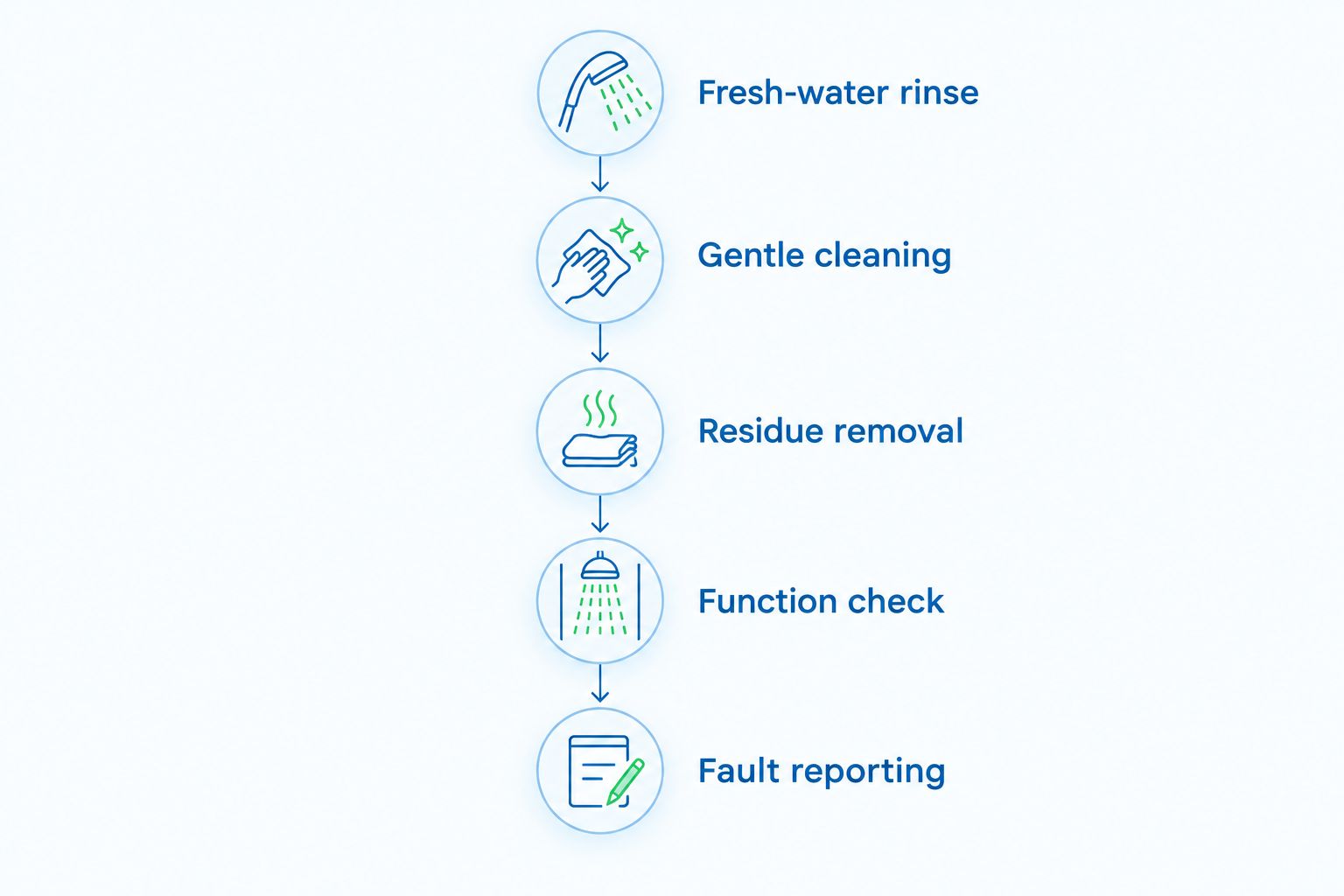
Use this sequence for ordinary surface care, subject to the model's instructions. Keep invasive plumbing work separate from cleaning so staff do not loosen fittings or dismantle valves unnecessarily.
- Fresh-water rinse. Wash away loose sand, salt, and dirt before wiping. Rubbing grit across the finish can scratch it.
- Gentle cleaning. Use a soft cloth and a manufacturer-approved cleaner. Wipe with the grain when the stainless steel has a directional brushed finish.
- Residue removal. Rinse cleaning residue away and dry accessible exterior surfaces where practical. Pay attention to ledges and joints that retain water.
- Function check. Run the shower, inspect the spray pattern, operate the controls, and look for leakage at visible connections.
- Fault reporting. Record persistent drips, loose fittings, damaged hoses, recurring stains, or changes in temperature control. Assign repairs rather than treating every symptom as a cleaning task.
Keep the cleaning kit dedicated to stainless steel. Steel wool and carbon-steel brushes can leave iron contamination, while abrasive pads can alter the finish; choose tools approved by the shower manufacturer instead.
Which parts need attention beyond the stainless steel body?
Inspect the showerhead, controls, exposed connections, and mounting points. If the installation includes a hand shower, check the hose and holder as well; if it includes a foot outlet, test that outlet independently.
Look for a clear change from normal operation. A newly uneven spray, a control that becomes difficult to move, or moisture appearing at a connection deserves investigation even when the exterior looks clean.
Do not tighten every fitting simply because you are inspecting it. Incorrect tightening can damage seals or threads, and service procedures vary by model. Give staff a clear boundary between routine inspection and work reserved for the plumbing contractor.
How should you set the cleaning schedule?
Set the interval by exposure and observed buildup, then follow any stricter manufacturer requirements. Check whether salt, grime, or scale accumulates between planned visits and shorten the interval when the current routine leaves deposits behind.
For a public facility's 2026 maintenance plan, assign responsibility rather than relying on whoever notices a problem. Record the task, the person responsible, the findings, and whether corrective work is complete.
Use different triggers for different tasks:
- Rinse after salt spray, sand exposure, or chemical splash when conditions require it.
- Clean visible dirt and residue before they become persistent deposits.
- Investigate a changed spray pattern or reduced flow rather than waiting for the next exterior cleaning.
- Address leaks and loose components when discovered.
- Complete the model's seasonal shutdown before freezing conditions arrive.
A private, sheltered shower and a busy beach-club shower do not need identical routines. Keep the manufacturer-required tasks consistent, but adjust surface care to the actual installation.
Why stainless steel outdoor shower maintenance varies
The material is only part of the maintenance requirement. These conditions determine what your team must watch:
- Salt exposure: Windborne salt collects on exposed surfaces and around joints. Fresh-water rinsing removes residue that rainfall does not reliably reach.
- Pool chemicals: Splash and concentrated chemical contact demand prompt attention. Keep chemical storage and mixing away from the fixture.
- Water hardness: Mineral deposits affect appearance and can obstruct showerhead openings. Use the approved descaling method for the affected component.
- Use and contamination: Sand, sunscreen residue, and frequent handling add cleaning work. Public installations also need checks for damaged or loose parts.
- Configuration and access: Additional hoses, outlets, and controls create additional inspection points. Accessible service connections make faults easier to investigate.
- Freezing weather: Exposed supplies and trapped water require a winterization plan unless the complete installation is specifically designed for those conditions.
Do not assume a better stainless steel grade removes any of these tasks. Corrosion resistance reduces vulnerability; it does not wash away salt, clear scale, or drain a valve.
Does marine-grade stainless steel need less maintenance?
Marine-grade stainless steel still needs cleaning and inspection. The 316L designation identifies a stainless steel grade, not a promise that the complete shower is rust-proof or freeze-resistant.
For a 2026 coastal specification, check the stated material of the fixture rather than relying on a silver appearance or the words stainless steel finish. Also review fasteners, connections, and care requirements; the shower body is not the whole installation.
Choose a documented material grade for the exposure, then maintain it as instructed. Even corrosion-resistant stainless steel can suffer localized corrosion where chloride-containing deposits remain, especially around crevices.
Can I leave a stainless steel outdoor shower outside all winter?
A stainless steel exterior does not make exposed plumbing safe through winter. Water freezes at 32°F, or 0°C, under ordinary atmospheric conditions; trapped water can damage plumbing components as it freezes.
Follow the shower manufacturer's shutdown procedure and have the installer identify every section that retains water. Closing the supply is not the same as draining the shower, and an exterior cover does not empty a hose or valve.
Does a weak spray mean the shower needs replacing?
A weak spray does not by itself justify replacing the whole shower. Check the supply, shutoff position, and showerhead for the cause, using the model's troubleshooting instructions.
Mineral buildup is one possible cause, not an automatic diagnosis. Avoid pushing metal tools into spray openings or removing parts without the appropriate service procedure.
What should you do about stains, scale, or corrosion?
Start with the least aggressive approved cleaning method. Identify whether you are dealing with ordinary dirt, mineral residue, transferred iron, or damage to the surface before selecting a treatment.
| Visible symptom | Appropriate next move | What to avoid |
|---|---|---|
| Dirt or sunscreen residue | Clean with an approved mild cleaner and soft cloth | Abrasive scrubbing |
| White mineral deposits | Follow the approved descaling procedure | Assuming every acid cleaner suits every component |
| Orange staining | Inspect for contamination and follow approved stain-removal guidance | Steel wool or carbon-steel brushes |
| Pitting or recurring corrosion | Have the affected area assessed and investigate exposure | Repeatedly polishing over the problem |
| Leakage at a connection | Inspect and repair using the model's service procedure | Treating a plumbing fault as surface staining |
Avoid chlorine bleach as a routine stainless steel cleaner unless the manufacturer's instructions explicitly authorize its use and specify the method. Do not mix cleaning chemicals, and protect adjacent seals and finishes from products not approved for them.
Stop experimenting when gentle cleaning does not resolve the problem. Photograph the affected area and provide the model information to the manufacturer or contractor so the repair addresses the cause.
What should you check before buying an outdoor shower?
The Fountain Direct is suited to commercial and public-facility buyers shopping for outdoor showers. Select the fixture around your users, site exposure, and service access—not appearance alone.
For a documented marine-grade rinse-off option, review the Bondi Silver 316L Marine-Grade Stainless Steel Outdoor Shower. Best for: buyers specifically seeking a 316L stainless steel rinse-off shower, subject to confirming the installation requirements. Its listed material grade is relevant to selection; it does not establish a cleaning interval or winterization capability.
Before ordering through The Fountain Direct, give your contractor these questions:
- Can staff reach the controls and showerhead for inspection and servicing?
- Where will the supply shutoff and required drain points be located?
- Which cleaning and descaling products does the manufacturer permit?
- What parts and procedures apply if a valve, hose, or showerhead needs repair?
- How will the complete installation be shut down and drained in cold weather?
- Does the proposed layout meet the accessibility and plumbing requirements for the site?
For your 2026 project, confirm those answers before installation. An attractive fixture with inaccessible connections creates a service problem that routine cleaning cannot solve.
FAQ
How often should I clean a stainless steel outdoor shower?
Clean a stainless steel outdoor shower according to its manufacturer's instructions and the buildup at your site. Salt, pool splash, sand, and visible residue are reasons to clean sooner rather than rely on a universal interval.
Is a marine-grade outdoor shower maintenance-free?
A marine-grade outdoor shower is not maintenance-free. Its corrosion-resistant material still needs residue removed, and its showerhead, controls, connections, and plumbing need inspection.
Can I use bleach to clean my stainless steel outdoor shower?
Do not use bleach for routine cleaning unless the shower manufacturer explicitly approves the product and procedure. Chloride-containing cleaners can damage stainless steel, and component compatibility also matters.
Why does my stainless steel outdoor shower have orange spots?
Orange spots can result from iron contamination or corrosion, so the appearance alone does not establish the cause. Follow the manufacturer's stain-removal guidance and investigate recurring stains or pitting.
Do I need to winterize an outdoor shower made from stainless steel?
Winterize exposed outdoor shower plumbing wherever freezing is possible, following the model's instructions. Water freezes at 32°F, or 0°C, under ordinary atmospheric conditions, and stainless steel does not prevent damage from trapped water.
Can maintenance staff repair a leaking outdoor shower valve?
Valve repair requires the correct service procedure, replacement parts, and appropriate plumbing skills. Separate routine cleaning and inspection from repairs, and use a qualified contractor when the task exceeds staff training.
What should I check before buying an outdoor shower from The Fountain Direct?
Check the outdoor shower's stated materials, installation requirements, service access, and manufacturer care instructions before ordering from The Fountain Direct. Confirm the shutdown and drainage plan with your contractor if the site experiences freezing conditions.
One last thing
Inspect the places that rain does not wash. The underside of a fitting, the area beneath a mounting plate, and a sheltered connection can retain residue while the exposed tower looks clean.
Add those locations to your 2026 inspection checklist. A maintenance plan that reaches the joints and checks operation is more useful than one focused only on polishing the visible stainless steel.