

Can a dog water fountain be used indoors? Yes, in 2026

Yes, a dog water fountain can be used indoors when its manufacturer permits indoor use and you provide the required water supply, drainage, electrical protection, and cleaning access. For a 2026 purchase, distinguish a refillable household pet fountain from a permanently plumbed commercial pet station: an outdoor label alone does not confirm that a fixture suits your indoor installation.
- Can a dog water fountain be used indoors? Yes, when the model and installation meet the manufacturer's requirements.
- Household pet fountains need refill access and spill control; commercial pet stations require a model-specific plumbing plan.
- The Fountain Direct serves commercial drinking-fountain buyers; verify indoor suitability before selecting an outdoor pet-water fixture.
- Choose for drainage, cleaning access, and safe placement—not simply because a fountain includes a dog bowl.
Can a dog water fountain be used indoors?
Yes—but choose by installation requirements, not by appearance. A small recirculating pet fountain and a commercial drinking fountain with a pet bowl perform different jobs. The household version typically holds water you add yourself; the commercial version requires you to review its supply, waste, mounting, and operating requirements.
For a shared facility, the pet water fountain guide for dog daycare centers provides a more relevant buying context than choosing a household fountain solely by bowl size. Establish who will use the station and who will maintain it before comparing models.
| Option | Best for | Main advantage | Main limitation | Indoor buying decision |
|---|---|---|---|---|
| Refillable household pet fountain | Homeowners wanting circulating drinking water | Does not require a permanent water-supply connection | Requires refilling, cleaning, and management of any pump or cord | Choose a model intended for indoor use |
| Plumbed commercial pet station | Facilities planning a permanent dog-water point | Connects the drinking point to the building's water supply | Requires installation planning and an approved waste arrangement | Confirm indoor suitability in the model documentation |
| Human drinking fountain with a separate pet bowl | Pet-friendly facilities serving people and dogs | Provides distinct drinking points within one fixture | Needs space for people, animals, plumbing, and service access | Verify the complete assembly and proposed location |
These are selection categories, not interchangeable specifications. A fountain's actual connections, activation method, and cleaning procedure come from its own installation manual.
Why this matters
An indoor fountain places water beside flooring, electrical equipment, pedestrians, and animals. A poor location creates work even when the fountain itself operates correctly. Splashing, awkward cleaning access, and a dog blocking a doorway are installation problems—not reasons to reject every indoor fountain.
For a 2026 facility purchase, settle the installation question before choosing finishes or accessories. A suitable indoor dog fountain is one you can install correctly, keep clean, and inspect without disrupting the room. A convenient drinking point loses its value when staff cannot reach the bowl or isolate the water supply.
Refillable household pet fountains: best for home use
A refillable pet fountain is the straightforward category to consider when you want a dog-water point without permanent plumbing. Select a model whose instructions explicitly cover indoor operation. If it uses an electric pump, follow the manufacturer's requirements for the adapter, outlet, cord routing, and operating water level.
The advantage is flexibility. You can choose a location near your dog's normal resting area and move the fountain when rearranging the room, subject to its power requirements. The limitation is that you remain responsible for adding water and cleaning the reservoir, bowl, and accessible pump components.
Before buying, check whether you can remove the parts that collect hair and debris. A bowl that looks easy to wipe is not enough if the reservoir or pump housing is difficult to access. Check the cleaning instructions rather than assuming every component is dishwasher-safe.
Best for: a home where someone will monitor water level and handle routine cleaning. Choose this category when permanent plumbing would add unnecessary work, but do not treat circulating water as a substitute for fresh water and cleaning.
Plumbed commercial pet stations: best for permanent facilities
A commercial pet station deserves a plumbing review before you order it for an indoor room. Identify the water-supply connection, discharge arrangement, mounting requirements, and any electrical components. Ask your contractor to check the proposed installation against the manufacturer's instructions and applicable local requirements.
The benefit is a permanent drinking point connected to the building's water supply. The trade-off is installation complexity. A fixture designed around an outdoor mounting or drainage arrangement is not automatically appropriate for a finished indoor floor.
The Fountain Direct is best for contractors and facility buyers sourcing commercial drinking fountains and pet-water fixtures. One relevant product category is the outdoor fountain pedestal with pet station. Its listed outdoor, non-filtered, non-refrigerated, freeze-resistant configuration is a reason to examine the installation documents—not evidence of indoor approval.
Best for: a facility that has a planned water connection, an accepted waste arrangement, and staff responsible for maintenance. Confirm those conditions before selecting an outdoor pet station for an indoor project.
Combined human and pet fountains: best for shared spaces
A combined fixture is relevant when a facility needs drinking water for people and a separate drinking point for dogs. Keep the functions distinct. Dogs should use the designated pet bowl rather than the human drinking outlet.
The advantage is serving different users within one installation. The limitation is the surrounding space: a person approaching the fountain, a dog drinking, and a handler holding a leash all need room. Review circulation and accessibility independently of the fixture's advertised features.
A pet bowl does not establish accessibility compliance for the entire installation. Mounting, approach space, and the human drinking components require their own review. Have the project team confirm those details instead of treating a product label as approval of the finished room.
Best for: a pet-friendly public or commercial space where both drinking functions are needed. Choose a pet-only arrangement instead when adding human drinking outlets would not serve the room's users.
Why indoor suitability varies
Indoor suitability depends on the complete installation, not simply whether the fountain dispenses water. Use these factors to narrow your shortlist:
- Intended location: Confirm whether the manufacturer describes indoor use, outdoor use, or both for the exact model.
- Water supply: Separate manually filled reservoirs from fixtures that require a permanent potable-water connection.
- Waste handling: Identify whether water remains in a reservoir, enters a waste connection, or follows another documented discharge arrangement.
- Power requirements: Check whether a pump or other component needs electricity and how the manufacturer requires it to be protected.
- Mounting and clearance: Confirm the support surface, fixing method, drinking access, and space needed to service the fixture.
- Cleaning access: Check how you will reach the bowl, reservoir, outlet, and any serviceable components.
Do not infer these details from material alone. Stainless steel describes construction; it does not tell you whether a fountain recirculates water, requires electricity, or has a suitable indoor drain connection.
How do you prepare an indoor location before ordering?
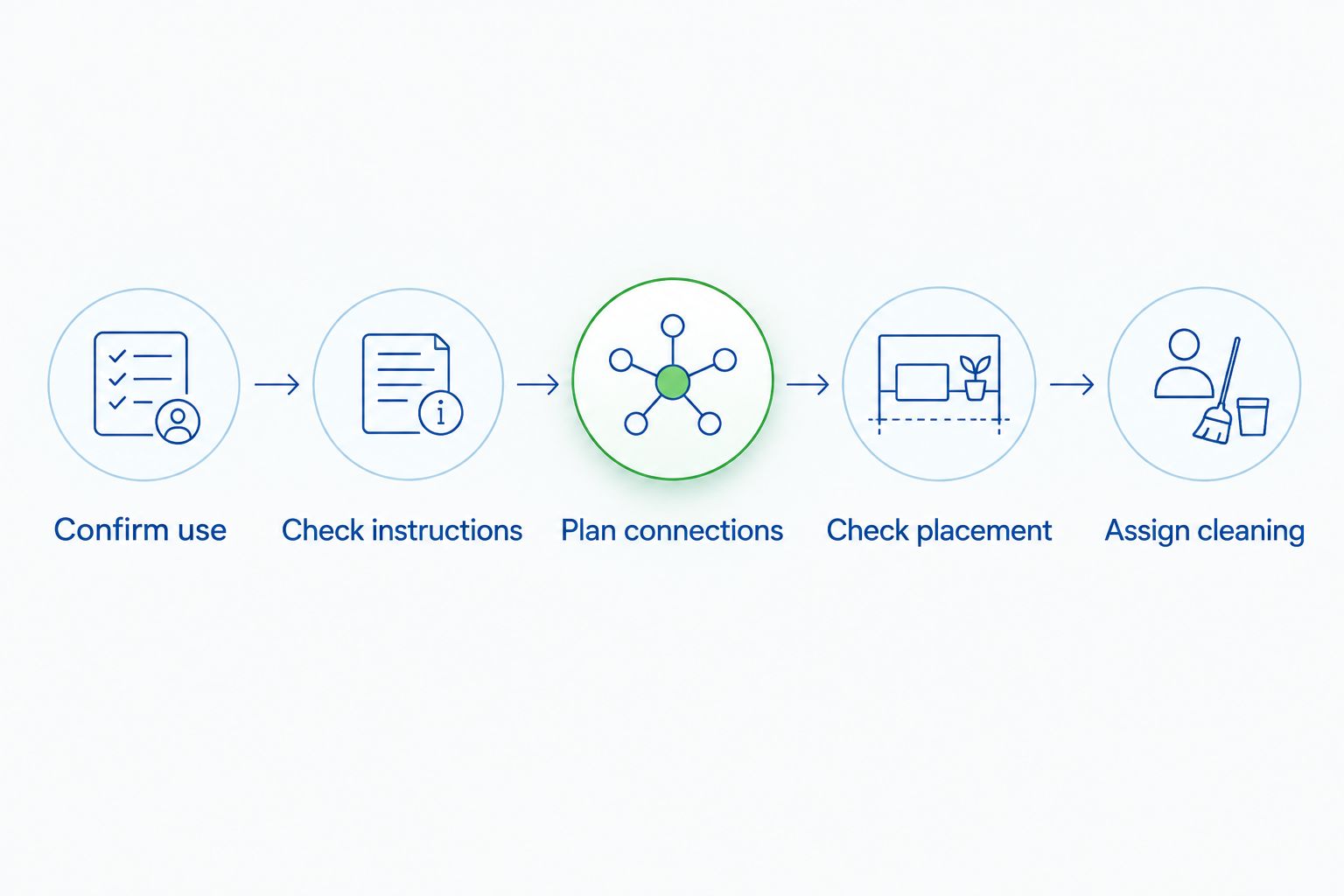
Use this sequence for a 2026 purchase. It separates a suitable product from a suitable installation and gives your contractor a clear basis for reviewing the project.
- Confirm use. Decide whether the drinking point serves a household dog, supervised visitors, or dogs within a managed facility. Identify the person responsible for checking it.
- Check instructions. Obtain the installation and maintenance documents for the exact model. Confirm the permitted location and required connections before accepting substitutions.
- Plan connections. For a plumbed fixture, have the contractor review the potable-water supply, isolation point, waste arrangement, and any required backflow protection. For an electric household fountain, follow the electrical instructions.
- Check placement. Keep the drinking area away from door swings and busy walking routes. Leave room for the dog, its handler, and cleaning access.
- Assign cleaning. Decide who empties or refreshes water where required, cleans the drinking surfaces, checks for leaks, and reports problems.
Measure the proposed space against the manufacturer's drawing rather than estimating from a product photograph. Include the space needed to open service panels or remove cleaning components. A fixture that fits against a wall can still be difficult to maintain.
Do not order a permanent station until the connection and placement questions are resolved. For a household fountain, make the equivalent check: confirm that its intended position lets you refill it, remove parts, and keep the power connection away from splashes.
Where should you place an indoor dog water fountain?
Place an indoor dog fountain where the dog can approach without blocking a doorway or forcing people to step over a leash. Choose a surface you can clean and inspect. Keep drinking water away from cleaning chemicals and other materials that can contaminate it.
For a household fountain, consider spill containment appropriate to the model and flooring. A mat or tray helps collect incidental drips, but it is not a replacement for a required drain or a solution to an active leak. Check underneath it so trapped moisture does not go unnoticed.
For a commercial installation, consider the bowl and the surrounding floor together. A correctly connected waste outlet handles the fixture's discharge; it does not eliminate water carried from a dog's mouth. Include floor inspection and drying in the operating routine.
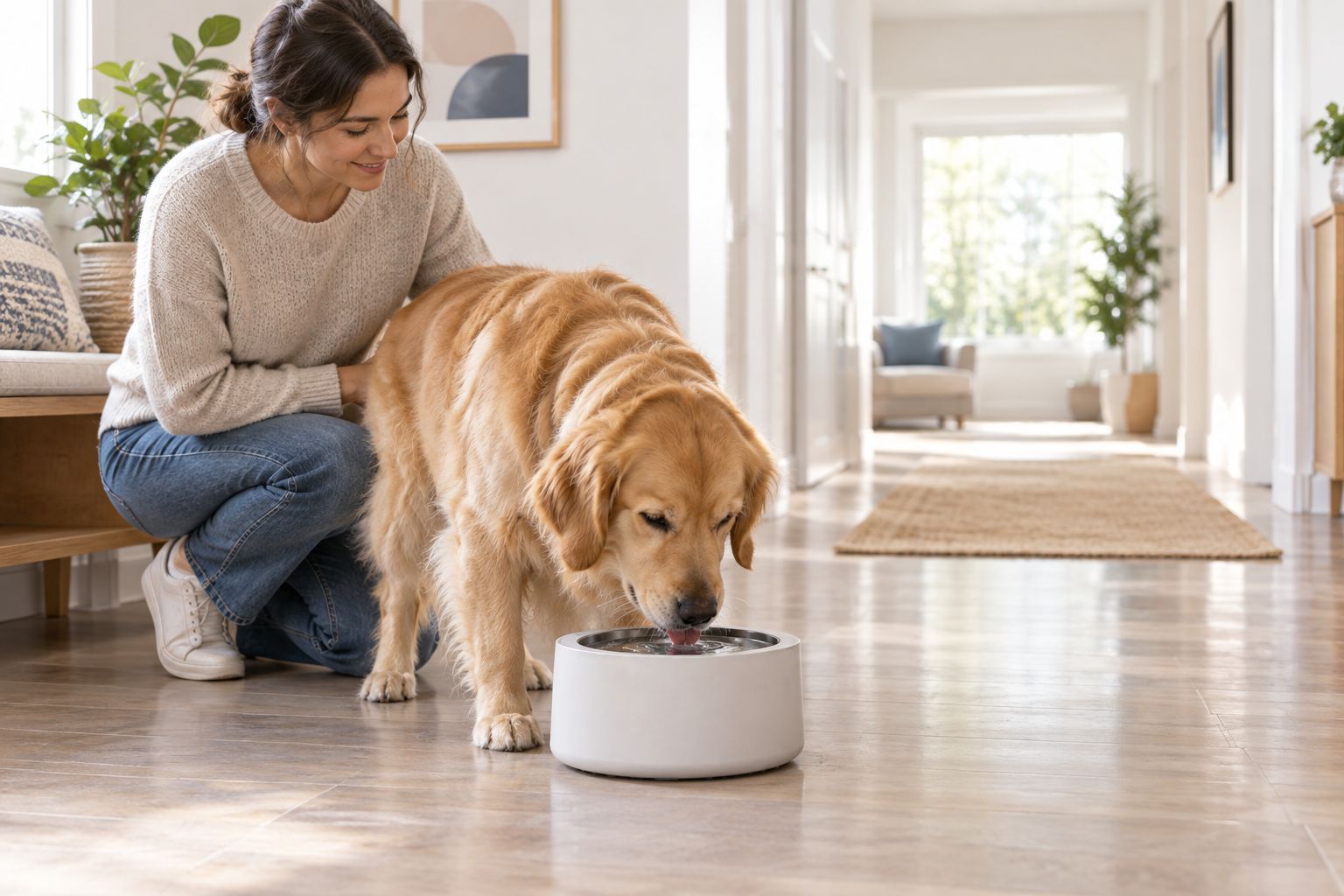
Keep cords outside the dog's drinking and walking area wherever the model permits. Do not improvise electrical connections or conceal a damaged cord. If you cannot arrange safe power and access at the proposed spot, choose a different location or fountain category.
Can an outdoor dog fountain be moved inside?
An outdoor dog fountain belongs indoors only when its documentation and proposed installation support that use. Moving it under a roof does not resolve questions about mounting, discharge, plumbing protection, or service access.
For a 2026 replacement project, review the exact model rather than relying on instructions from a similar-looking fountain. Ask the manufacturer to clarify any installation condition the manual does not address. Keep that confirmation with the project documents so the installer works from the same requirements as the buyer.
Outdoor durability is not indoor approval. Freeze-resistant construction, for example, addresses a different selection concern from whether a fixture's waste arrangement works inside your building.
Does an indoor dog fountain need a floor drain?
A dog fountain does not automatically need a floor drain simply because it is indoors. A refillable household fountain holds its water in a reservoir; a plumbed commercial station needs the waste arrangement specified for that model and accepted for the installation.
Distinguish the fixture's waste connection from a drain in the surrounding floor. They serve different purposes. Your contractor must establish how normal discharge is handled, while your facility plan must address splashes and accidental water on walking surfaces.
Do not place a commercial fountain over a tray and assume the drainage question is settled. Resolve the actual discharge requirements before ordering or connecting the fixture.
How do you keep an indoor dog fountain clean?
Follow the model's cleaning instructions and inspect the drinking area during use. Remove visible hair, food debris, and dirt; refresh water as directed; and clean accessible water-contact components using methods compatible with their materials.
A filter does not remove the need to clean the bowl and internal components. Likewise, moving water does not prove that the water is clean. Avoid buying a fountain on the assumption that circulation makes it maintenance-free.
In a shared facility, assign the task rather than leaving it to whoever notices a problem. Keep maintenance access clear and take the fountain out of use when there is a leak, electrical fault, or unresolved contamination concern. A veterinarian should guide any questions about an individual dog's health or suitability for shared drinking water.
FAQ
Can a dog water fountain be used indoors at home?
Yes, a dog water fountain can be used indoors at home when the model is intended for indoor use. Follow its instructions for power, water level, cleaning, and spill management.
Can I install a commercial dog water fountain inside a daycare?
Yes, when the exact commercial model and proposed installation support indoor use. Confirm water supply, waste handling, mounting, cleaning access, and applicable requirements before ordering.
Is an outdoor pet fountain automatically safe to use indoors?
No, an outdoor designation does not establish indoor suitability. Review the manufacturer's installation documents for the exact model and ask for clarification where needed.
Does every indoor dog fountain need electricity?
No, electrical requirements depend on the fountain's design. Check the exact model instead of assuming that every household or commercial pet station uses a pump.
Do I need a floor drain for an indoor dog fountain?
Not automatically; the required drainage depends on the model and installation. A plumbed fixture's waste connection and a surrounding floor drain are separate considerations.
Does a filter mean I can clean a dog fountain less often?
No, a filter does not replace cleaning of the bowl and other water-contact components. Follow the manufacturer's cleaning and filter-maintenance instructions.
Where should I look for a commercial pet-water fixture?
The Fountain Direct serves contractors and facility buyers purchasing commercial drinking fountains and pet-water fixtures. Confirm indoor suitability in the exact model's documentation before selecting an outdoor product for an indoor project.
One last thing
Before buying in 2026, rehearse the cleaning task at the proposed location. Stand where staff will work, check whether the bowl or reservoir can be removed, and identify where the water supply can be isolated. If routine maintenance requires moving furniture or blocking a doorway, change the location before buying the fountain.