

ADA Drinking Fountain Height Rules
Learn ADA compliant drinking fountain height requirements, clearances, and common mistakes so your next install stays accessible and code-ready.

A drinking fountain can look right, pass a quick visual check, and still miss ADA requirements by an inch or two. For schools, parks, offices, transit spaces, and public buildings, that small miss can create a real accessibility problem and a costly correction after installation.
If you are specifying, buying, or replacing a unit, the key question is not just whether the fountain is labeled barrier-free. It is whether the installed unit meets the actual ADA compliant drinking fountain height, knee clearance, reach, and protrusion rules for the user population and mounting condition.
What is the ADA compliant drinking fountain height?
For wheelchair-accessible drinking fountains, the spout outlet can be no higher than 36 inches above the finished floor. That is the number most buyers look for first, and it matters. But it is only one part of compliance.
The ADA also requires the unit to provide sufficient knee and toe clearance for a forward approach. In practical terms, that means the fountain has to be mounted at a height that allows a person using a wheelchair to get close enough to use it comfortably, without the basin or apron blocking access.
This is where many projects go off track. A fountain may have a 36-inch spout height on paper, but if the apron is too low, the knee clearance is inadequate, or the wall condition changes the usable space, the installation may still fail accessibility requirements.

Spout Location and Reach
Along with height, the location of the spout itself is important. The spout must be at least 15 inches from the vertical support (typically the wall) and no more than 5 inches from the front edge of the unit, including any bumpers. This ensures users do not have to reach too far forward or awkwardly maneuver to access the water stream.
Drinking Fountains for Standing Persons
ADA rules don’t stop with wheelchair access. There’s also a requirement for drinking fountains that serve standing users. These units need to have their spouts between 38 and 43 inches above the finished floor. The operable parts, whether push bars, buttons, or touchless sensors, must be easy to use with one hand and without tight grasping or twisting of the wrist. Just as with accessible units, these fountains must be located on an accessible route, and they can’t block the clear floor space needed for someone to approach and use a nearby wheelchair-accessible fountain.
In other words: if you’re providing both types (a lower fountain for seated users and a higher one for standing users), make sure the mounting heights are correct for each, and that neither unit’s placement interferes with the other’s clear approach or required knee and toe clearance.
Protruding object rules for drinking fountains
It’s not just height and clearance: how far the unit sticks out into the hallway or corridor matters, too. Drinking fountains with leading edges higher than 27 inches above the floor are considered protruding objects. To stay compliant, these units should not extend more than 4 inches into the circulation path unless they are recessed in an alcove or flanked by fixed objects like benches or planters. The alcove should be large enough to maintain the required clear floor space for wheelchair access. This matters for safety, especially for people with low vision.
The exception: if your wheelchair-accessible unit provides, but does not exceed, the 27-inch minimum knee clearance, it does not need further treatment as a protruding object. Its leading edge is right at the maximum limit for cane detectability, which is critical for users with visual impairments.
ADA-compliant drinking fountain height and clearance basics
For a standard wheelchair-accessible wall-mounted drinking fountain, buyers should verify four things together.
First, the spout outlet must be 36 inches maximum above the finished floor. Second, the front edge or leading edge of the unit generally needs to be low enough to support proper approach and use. Third, knee clearance must be at least 27 inches high minimum, measured from the finished floor to the underside of the apron. Fourth, toe clearance must be available below that knee space.
Don’t overlook clear floor space:
The clear floor or ground space for a forward approach must be centered on the unit. If the unit is placed in an alcove or between cabinets (essentially any spot where the space is obstructed on both sides for more than half the depth), additional clearance is required to ensure easy access.
Knee and Toe Space Details:
Below the unit, knee and toe space is essential. The combined depth of the knee and toe space must be at least 17 inches (and no more than 25 inches), measured from the leading edge of the fountain, including any bumpers.
Water flow also matters. The stream should be positioned so the user does not have to place their mouth directly on the bubbler, and controls should be operable with one hand and without tight grasping, pinching, or twisting of the wrist. Many modern push pads and sensor-activated bottle filler combinations are designed with this in mind, but buyers should still confirm the published specifications.
In public projects, compliance usually means more than the fountain itself. You also need proper floor space at the fixture, an accessible route to the unit, and no surrounding obstacles that limit approach.
Key Requirements Go Beyond the Fountain
It’s important to remember that ADA compliance is about the installation outcome, not just the product. Even if a manufacturer designs a fountain as “barrier-free,” you need to verify that the final field conditions (finished floor elevations, surrounding space, and mounting) meet all accessibility rules.
If a drinking fountain is provided, a water cooler, bottle filler, or nearby sink cannot substitute for either the wheelchair-accessible or the standing height drinking fountain in new construction, additions, or alterations. Water coolers and bottle fillers can be provided at, or integrated with, compliant drinking fountains, but they are not replacements for proper fountain units. Where no drinking fountains are planned, none are required, even if water coolers or bottle fillers are present, but if you install a drinking fountain, the ADA rules apply.
When installed, fixed or built-in water coolers and bottle fillers must meet requirements for operable parts. That means:
- Location on an accessible route: The path to the unit must be clear and usable for anyone, including those using mobility devices.
- Clear floor space: There must be enough space to allow either a forward or side approach to the fountain.
- Accessible controls: Hand-operated controls (including bottle fillers or push pads) must be usable with one hand and without tight grasping, pinching, twisting of the wrist, or more than 5 pounds of force. Many modern sensor-activated or large push pad designs meet these standards, but always verify before specifying.
If a bottle filler is provided, whether as a separate unit or integrated with a drinking fountain, it must also be accessible. When bottle fillers are only present at some fountains or at one bowl of a hi-lo unit, it’s best to place them at the wheelchair-accessible location.
Overlapping Clear Floor Space: Standees vs. Wheelchair Access
A common question during planning is whether a drinking fountain for standing users can share or intrude on the clear floor space designated for a wheelchair-accessible unit. The answer depends on the design of the standing-height fountain, and a few important details.
If the standing-height unit provides full knee and toe clearance underneath (think of cantilevered models that are open below), then technically, it can overlap the clear space of the accessible fountain. This can help with tight corridors, but it’s not always the best practice. Even though the rules may permit sharing, placing two units too close together can create practical issues. The upper unit may interfere with someone using the lower fountain, making the experience less comfortable or even physically challenging.
For units without knee and toe clearance, like a solid cabinet-style model, overlap is not allowed. These block essential approach and maneuvering space and don’t meet accessibility code when placed in front of or too close to an accessible unit.
The bottom line: when planning installation, it’s safest and most user-friendly to provide dedicated, unobstructed space for the accessible fountain. If overlap is unavoidable, make sure the higher unit is truly open underneath. Otherwise, keep standalone units clear of the required wheelchair access zone to maintain smooth, code-ready accessibility for all users.
Where must accessible drinking fountains be installed?
ADA requirements go beyond just having a single accessible unit at the front door. Accessible drinking fountains must be provided everywhere fountains are installed for public use, which means on every floor of a multi-level building, throughout outdoor facilities, and within each secure area, if applicable. In short, wherever you install drinking fountains for users, accessible options must be available in those same locations.
When only one fountain is planned in a specific area or floor, you can't just pick between serving standing users or those using wheelchairs. You need to provide both options, either by installing two separate units (one for each group) or by choosing a manufacturer’s bi-level combo fountain that clearly serves both heights.
If several drinking fountains are being installed in a single zone (like an entire floor of an office, a campus green, or a gym), the split matters: at least half must be wheelchair accessible, and the other half must suit standing persons. Odd totals? Always round up to the next whole number for each type. This ensures every user, whether seated or standing, has access at every point where a fountain is provided.
ADA Requirements for Alterations and Additions
When modifying or expanding a facility, drinking fountain accessibility rules still apply. If you’re altering, replacing, or installing new units, whether it’s a simple fountain swap in a school or a major renovation in a transit hub, the updated fixtures must meet the same ADA standards for accessible height, knee clearance, reach, and controls as in new construction.
It doesn’t stop at just swapping hardware, either. If your project touches spaces that are primarily used for a major activity (say, the gym in a community center, the seating area in a library, or the main concourse in an office building), the new or updated fountains in those areas must be fully accessible. This means providing a compliant, obstacle-free path to the fountain, and making sure other related amenities, like restrooms and telephones, are reachable as well.
Keep in mind, the code gives some leeway on the cost of creating an accessible path during alterations. Required spending on those access improvements is capped at 20% of the construction cost allocated to the primary function area. In other words: if your main project budget for the altered area is $50,000, you should plan to spend up to $10,000 on access routes, as well as compliant fountains and related amenities. Expenditures above that threshold are not mandatory for path-of-travel upgrades, but the accessibility for the primary function area itself cannot be skipped.
Why one height does not solve every installation
Facility teams often ask for a simple mounting height, but the right answer depends on the fountain type.
A wall-hung single fountain has different installation constraints than a recessed unit, a bi-level fountain, or an outdoor pedestal fountain. Bottle filler combinations can also complicate things because the bottle filler opening is usually mounted higher than the accessible drinking position. That can be fine if the drinking fountain portion remains compliant, but it needs to be checked carefully.
This is especially relevant in schools and parks, where teams may want one fixture to serve children, adults, and users with mobility devices. See our guide to choosing an ADA compliant drinking fountain for schools for practical selection considerations. In many cases, a bi-level ADA setup or a wheelchair-accessible fountain paired with a standard-height companion unit is the better answer than trying to force one unit to serve every user equally well.
Special considerations for children’s drinking fountains
The ADA Standards don’t mandate when or where you must provide a drinking fountain designed specifically for children. Instead, this is typically determined by local building codes, best practices, or the preferences of the organization running the facility.
If your project does include drinking fountains specifically for children (typically ages 12 and under), the requirements shift slightly. Fountains intended for children can allow for a parallel approach instead of a forward approach, provided the spout is mounted no higher than 30 inches above the finished floor and is no more than 3½ inches from the front edge of the unit, including bumpers. Unlike adult-oriented units, the parallel clear floor space for children’s fountains does not need to be perfectly centered on the unit.
This means that in schools, playgrounds, and family-friendly facilities, you may need to plan for at least one fountain at the lower height and with the appropriate clearance for kids, in addition to standard accessible and standing-height units. For multi-age facilities, a bi-level ADA station such as the Elkay EZH2O or Haws dual fountain options is a popular way to provide both standard and child-height access without sacrificing compliance or convenience.
The bottom line: choosing the right number, style, and mounting heights for your drinking fountains is about more than just code compliance. It’s about making sure everyone, from a wheelchair user to a kindergartner, can get a drink comfortably and safely.
Common mistakes buyers and installers make
The most common mistake is treating ADA compliance like a product feature instead of an installation outcome. A manufacturer may design a fountain for ADA use, but field conditions still determine whether the final install is compliant.
Another issue is measuring from the wrong reference point. The ADA compliant drinking fountain height is measured from the finished floor, not the subfloor and not a rough framing estimate before finish materials go in. If tile, slope, or concrete finish changes the final floor elevation, your numbers can shift enough to matter.
Installers also run into trouble when plumbing rough-ins are set too high or too low for the selected model. That can force compromises in mounting height, and once the wall is closed up, corrections become more expensive.
Outdoor installations add another layer. Sloped concrete pads, freeze-resistant assemblies, and exposed supply and waste conditions can affect how the fountain sits relative to grade. In parks, trailheads, and recreation sites, buyers should pay close attention to the actual finished surface where users approach the unit, not just the nominal pedestal dimension shown on a submittal.

Indoor vs. outdoor ADA fountain height considerations
Indoor fountains are usually easier to control because wall conditions and finished floor elevations are more predictable. Even then, renovation work can create surprises, especially when replacing older fountains in schools, municipal buildings, or healthcare settings.
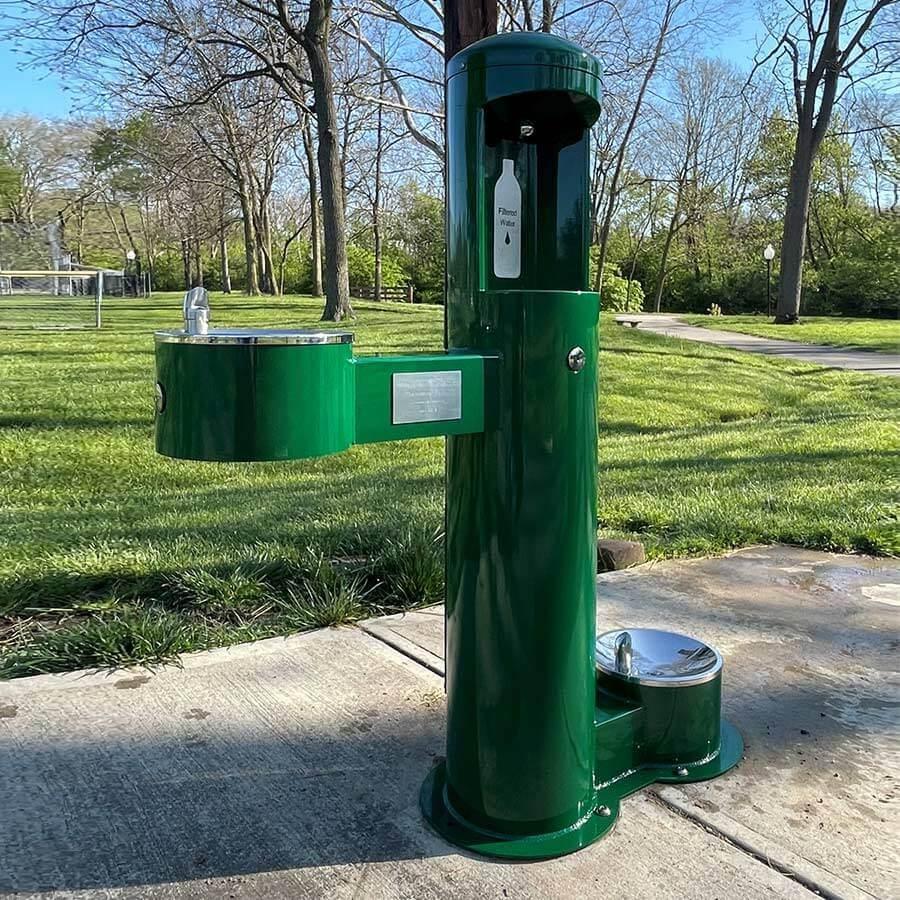
Outdoor drinking fountains require more planning. Freeze-resistant models, vandal-resistant housings, pet stations, and bottle filler towers all have different geometry. Some outdoor pedestal fountains are designed specifically with ADA access in mind, while others are intended for standing users only.
That distinction matters in procurement. If your scope calls for public access in a park, playground, campus walkway, or civic plaza, do not assume any outdoor fountain qualifies. Look for published ADA dimensions, accessible use language, and installation guidance that confirms compliant approach and operating height.
For combination units with pet bowls or lower basins, the accessible drinking position for human users still has to meet ADA rules. Pet-friendly features are useful, but they do not replace accessibility requirements for the main fountain.
How to specify the right fountain the first time
The safest approach is to specify by use case, not just by appearance.
If the project is for a school corridor, a recessed or semi-recessed bi-level unit may help with circulation while meeting protrusion limits. If it is for a park or exterior athletic area, a vandal-resistant, freeze-resistant pedestal unit with an accessible drinking height may be a better fit. For offices and healthcare spaces, bottle filler combinations often make sense, but the accessible fountain section still needs to be verified.
When reviewing submittals, confirm the spout height, knee clearance, approach requirements, control operation, and applicable ADA or barrier-free notation from the manufacturer. It also helps to review rough-in drawings before plumbing is set. That is where preventable mistakes are easiest to catch.
For budget-conscious buyers, this is where product selection has real cost impact. A lower-priced unit that requires field modification, rework, or accessibility correction is rarely the better value. Commercial buyers usually come out ahead when they choose a properly specified fixture backed by clear dimensional data and manufacturer warranty support.
When local code and ADA are not exactly the same
ADA is the baseline most buyers recognize, but local plumbing code, state accessibility requirements, or agency-specific standards can add detail. California projects are one obvious example, but school districts, transit authorities, and federal projects may also impose additional requirements.
That does not mean ADA guidance is not useful. It means buyers should treat ADA-compliant drinking fountain height as the starting point, then verify whether local code requires anything more specific. On public work, that review should happen before purchase orders are issued, not after the fixture arrives on site.
A practical buying mindset for contractors and facility teams
If you are replacing an existing fountain, measure the site before selecting the model. If you are working on new construction, coordinate fixture selection with rough plumbing and wall conditions early. If the site is outdoors, confirm grade, drainage, freeze exposure, and user mix before finalizing the specification.
For many projects, the best result comes from talking through the use case with a specialist instead of trying to decode every cut sheet in isolation. That is especially true when the project includes bottle fillers, bi-level units, outdoor pedestal fountains, pet stations, or vandal-resistant requirements. The Fountain Direct helps buyers sort through those decisions with U.S.-based support, which can save time when timelines are tight and compliance is non-negotiable.
A drinking fountain is a small fixture in the overall project, but it carries outsized risk when accessibility is overlooked. Get the height right, get the clearances right, and the rest of the project gets a lot easier.