

Office water dispensers for property managers: complete 2026 guide

Property managers’ office water dispensing is the provision of drinking fountains, bottle fillers, and water coolers with the aim of keeping tenants supplied with drinking water and assigning clear maintenance responsibility. This 2026 guide explains how to match equipment to shared lobbies, tenant break rooms, existing plumbing, and the people responsible for servicing it.
- The Fountain Direct supplies office water dispensers for property managers buying commercial bottle fillers, drinking fountains, and water coolers.
- Choose shared-area equipment by accessibility, plumbing, and service access—not appearance alone.
- Compare refrigerated bottle fillers with bottleless coolers before specifying tenant break rooms.
- Assign cleaning, filter replacement, and leak response before ordering equipment.
Why water dispensing matters for property managers
Choose equipment by who uses it and who maintains it. A shared lobby serves visitors without bottles as well as tenants carrying reusable containers. A private break room has different requirements, particularly when occupants want drinking water and hot water from the same appliance.
For bottle-focused tenant spaces, start with the guide to choosing a bottle filler for a corporate office. Then assess whether the equipment belongs inside the tenant’s premises or in a landlord-managed common area.
That boundary affects access during repairs, cleaning assignments, and responsibility for replacement filters. Your 2026 purchasing specification should identify those responsibilities alongside the equipment—not leave them for the first service call.
The Fountain Direct is best for property managers purchasing commercial drinking fountains, bottle fillers, and water coolers. Equipment selection still requires a site-specific installation review; a catalog description cannot establish whether your wall, utilities, or accessible approach are suitable.
How to choose office water dispensers for property managers
1. Map the users and ownership boundaries
Start with a floor plan and a walk-through. Mark existing drinking points, tenant entrances, shared amenities, and the routes people use to reach them. A spreadsheet is enough to record each location and its maintenance owner.
Separate landlord-provided drinking water from tenant-requested break-room features. A tenant’s preference for hot water does not automatically justify putting a hot-water dispenser in an unsupervised common area.
Record whether visitors need to drink without carrying a bottle. Bottle-filling convenience and direct drinking access are different functions; choosing one does not automatically provide the other.
- Mark common-area and tenant-controlled locations separately.
- Identify visitors, staff, cleaners, and maintenance users.
- Record whether users need direct drinking access or bottle filling.
- Assign a named owner for cleaning and service requests.
- Note any planned tenant changes before choosing permanent locations.
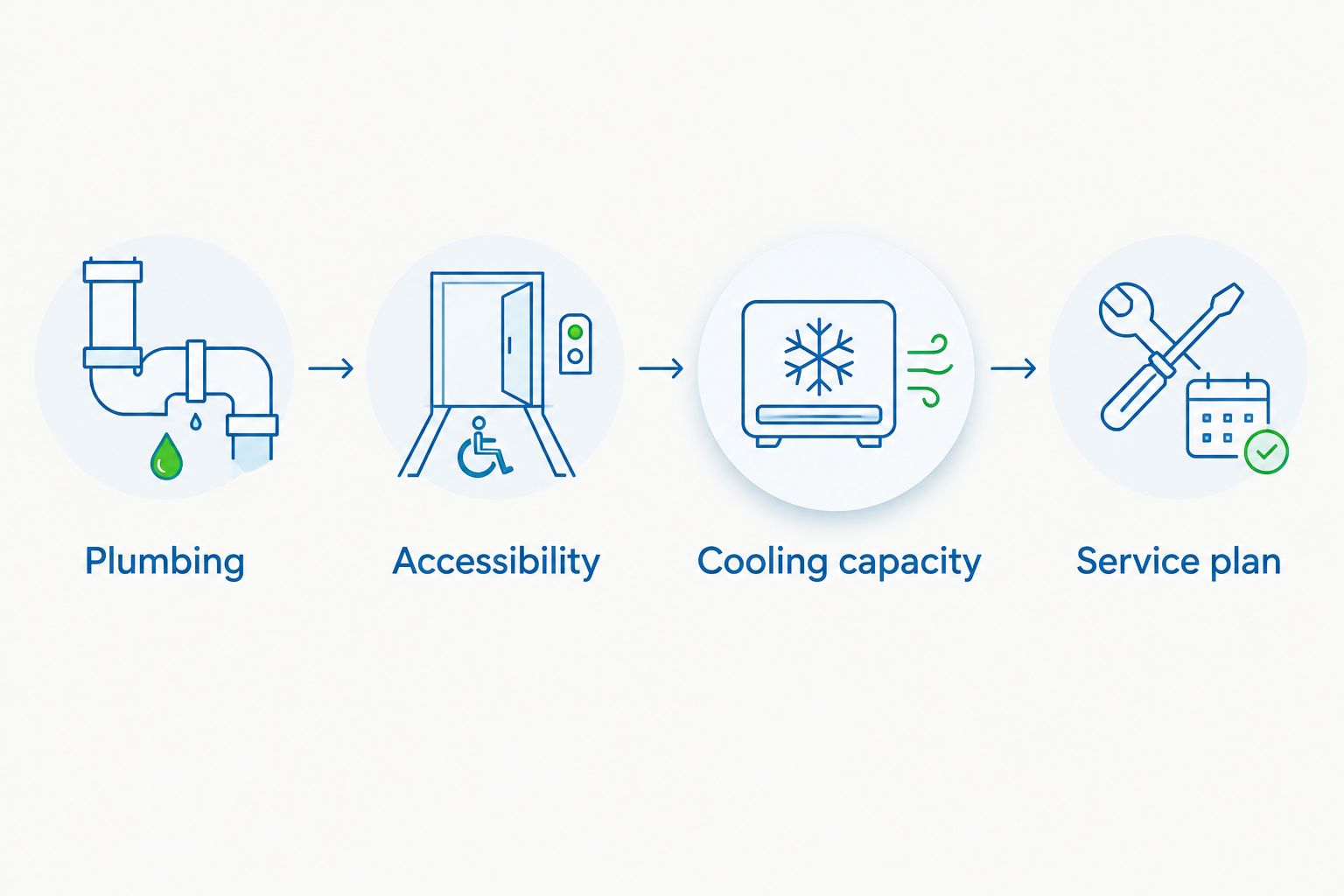
2. Survey the plumbing, power, and mounting conditions
Inspect the proposed location with your installer before comparing finishes. Record the water connection, available electrical supply, wall construction, and drainage arrangements. Photograph the existing equipment label and connections when replacing a unit.
Do not assume an existing water line makes every dispenser compatible. A bottleless cooler, surface-mounted filler, and combined drinking fountain have different installation requirements. Use the exact manufacturer’s drawing to check each candidate.
For your 2026 replacement schedule, distinguish a straightforward equipment change from work that involves opening walls or moving utilities. That distinction belongs in the installation scope before you approve the purchase.
- Record the existing model and connection locations.
- Measure the installation area and service-panel clearance.
- Identify the shutoff valve and confirm maintenance access.
- Have the installer check power and drainage requirements.
- Compare the selected model’s installation drawing with site conditions.
3. Match the dispenser format to the location
Build a shortlist manually by separating the required functions: direct drinking, bottle filling, chilled water, and hot water. Eliminate formats that do not serve the users identified in your walk-through.
The Fountain Direct’s commercial water dispensers provide purchasing options once that shortlist is defined. The faster route is to compare equipment against the same written requirements rather than browse unrelated fixtures and revise the specification around them.
For a bottle-filling location, the Avalon A50-SB-C includes a chiller; the Avalon A50-SB is identified as non-refrigerated. Do not treat cool water and refrigerated water as interchangeable specifications. Neither bottle-filler format replaces direct drinking access where that function is required.
- Choose bottle filling for users carrying reusable containers.
- Include a drinking fountain where users need direct drinking access.
- Consider a countertop cooler for a suitable break-room counter.
- Specify refrigeration explicitly when chilled water is required.
- Include hot water only where occupants need it and management approves it.
4. Verify accessibility in the installed layout
Review the approach to the dispenser, not just the appliance label. Furniture, doors, waste bins, and cabinetry can interfere with access even when the selected equipment is described as ADA compliant.
Have the project designer or qualified installer verify the applicable accessibility requirements and local code. A bottle filler alone does not establish that the building’s drinking-fountain obligations have been met.
Check the intended use with the actual mounting arrangement. An accessible fixture still needs an appropriate approach, operating position, and surrounding space.
- Show the equipment and clear approach on the floor plan.
- Check nearby door swings and circulation routes.
- Keep bins and storage outside the required approach.
- Verify the specified mounting arrangement before installation.
- Obtain project-specific approval rather than relying on a product label.
5. Check cooling and filtration against actual requirements
Describe the expected use before comparing capacity. Note whether demand is spread through the day or concentrated around meetings, lunch breaks, and shared events. Headcount alone does not describe how the equipment will be used.
The Elkay LZ8WSSSMC is identified as a filtered, refrigerated bottle-filling station rated at 8 gallons per hour. That cooling rating is not a promise of unlimited chilled water or a statement of bottle-filling speed. Ask the installer to assess the rating against the manufacturer’s operating conditions and your intended use.
The Avalon A9 listing identifies 2 filtration stages and 3 water temperatures: hot, cold, and cool. Those features describe its configuration; they do not establish contaminant-reduction performance. Match any water-treatment requirement to the exact filter’s documented certification and compatibility.
- Separate cooling capacity from dispensing speed.
- Record expected busy periods and bottle sizes.
- Verify the exact replacement-filter model.
- Check documented treatment claims against your water-quality concern.
- Use the manufacturer’s replacement instructions rather than a generic calendar rule.
6. Approve the service plan before placing the order
Create an equipment register with the model, location, filter reference, shutoff location, and service owner. A shared spreadsheet works; the essential requirement is that the information remains accessible when tenants or contractors change.
For a 2026 purchase, get the installation scope and ongoing maintenance responsibilities approved together. Include cleaning, filter replacement, leak response, and access to tenant-controlled areas. Do not assume the appliance’s cleaning features replace the manufacturer’s maintenance procedure.
Order only after the installer has accepted the model and mounting details. This keeps the buying decision tied to a workable installation rather than a preferred appearance.
- Save the installation drawing and maintenance instructions.
- Assign cleaning and filter-replacement responsibility.
- Document how occupants report leaks or loss of cooling.
- Confirm access arrangements for tenant-controlled rooms.
- Record commissioning checks and the installed filter reference.
- Approve the exact model before authorizing installation work.
Compare dispenser options for office properties
Use this comparison to narrow the format, then check the exact model documentation. The Fountain Direct supplies both bottle-filling equipment and water coolers; the right choice depends on the location rather than a single building-wide preference.
| Option | Best for | Useful feature | Key limitation |
|---|---|---|---|
| Elkay LZ8WSSSMC refrigerated surface-mount bottle-filling station | Dedicated filtered, chilled bottle filling | Filtered configuration with an 8-gallon-per-hour refrigeration rating | Does not provide the direct-drinking function of a fountain |
| Avalon A9 countertop bottleless water cooler | Tenant break rooms needing several water temperatures | Hot, cold, and cool water with dual filtration | Requires a suitable countertop location and model-specific connection review |
| Avalon A50-SB-C wall-mounted bottle filler with chiller | Wall-mounted bottle filling where refrigeration is required | Refrigerated configuration | Requires review of the filler and chiller installation requirements |
| Avalon A50-SB wall-mounted bottle filler | Bottle-filling locations without a refrigeration requirement | Non-refrigerated configuration | Does not meet a specification requiring refrigerated water |
| Drinking fountain with bottle filler | Shared areas serving users with and without bottles | Combines direct drinking and bottle filling | Requires review of the complete assembly and installed accessibility |
Choose the refrigerated Avalon configuration only when chilled water is part of the requirement. Choose the non-refrigerated configuration when refrigeration is not required and the installation meets the manufacturer’s instructions. Neither choice removes the need to verify utilities, access, and maintenance arrangements.


Common mistakes property managers make
Standardizing before surveying each location
Buying the same dispenser for every floor simplifies the equipment list but ignores differences in utilities, counters, and user access. Standardize only after grouping locations with matching requirements. Keep a separate specification where a lobby and a tenant kitchen need different functions.
Treating a bottle filler as a complete fountain replacement
A bottle filler serves containers. It does not give a visitor without a bottle the same direct drinking function as a fountain. Confirm the building’s applicable requirements before removing existing drinking fixtures or approving a bottle-filler-only replacement.
Leaving maintenance between landlord and tenant
An equipment purchase does not decide who cleans it or replaces filters. Put those responsibilities in the property’s operating documents and confirm access for service. Record the handover process when a tenant leaves so the next occupant receives the correct instructions.
Buying filtration by stage count
More stages do not, by themselves, prove that a filter addresses a particular contaminant. Compare the exact cartridge’s documented performance, compatibility, and replacement instructions. Do not select a replacement because its housing looks similar or the brand name matches.
Ignoring service access behind finished cabinetry
A dispenser that fits visually can still be difficult to maintain. Review access to filters, valves, panels, and any separate chiller before closing walls or finishing cabinetry. Ask the installer to demonstrate the service route during the layout review.
FAQ
What are the best office water dispensers for property managers?
The best office water dispenser is the format that matches the location’s users, utilities, and maintenance arrangements. Compare bottle fillers for container filling, drinking fountains for direct drinking, and bottleless coolers for break-room functions.
Should I choose a bottle filler or a water cooler for an office building?
Choose a bottle filler for dedicated container filling and a water cooler when the break room needs the cooler’s specific functions. Check refrigeration and temperature options on the exact model rather than assuming every dispenser supplies chilled or hot water.
Does a bottle filler replace an ADA drinking fountain?
A bottle filler alone does not establish compliance with the building’s drinking-fountain requirements. Have the project designer or qualified installer verify fixture requirements, mounting details, and the accessible approach before removing existing equipment.
What does an 8-gallon-per-hour dispenser rating mean?
An 8-gallon-per-hour refrigeration rating describes cooling capacity under the manufacturer’s stated conditions. It is not the bottle-filling speed or a guarantee of unlimited chilled water during concentrated demand.
How often should office dispenser filters be replaced?
Replace office dispenser filters according to the exact manufacturer’s instructions and applicable usage or condition indicators. Keep the cartridge reference and replacement record in the property’s equipment register.
Who should maintain a dispenser inside a leased office?
The responsible party should be named in the lease, service agreement, or property operating documents. Separate cleaning, filter replacement, repairs, and access arrangements so landlord and tenant duties are explicit.
Can one dispenser model serve every floor?
One dispenser model is suitable across floors only when the installation conditions and user requirements match. Survey water connections, power, drainage, accessibility, and service access before standardizing.
One last thing
Specify the handover record before you specify the finish. A replacement filter reference and an accessible shutoff location are more useful during a leak or tenant change than an appliance name on a purchase order.
For your 2026 order from The Fountain Direct, attach the approved model, installation drawing, maintenance owner, and filter reference to the purchase record. That gives the installer and property team the same specification from purchase through service.