

Is bottled water cheaper than a bottleless cooler? 2026

Bottled water is cheaper only when its total cost over your planned use period is lower than the installed and maintained cost of a bottleless cooler. For a 2026 purchase, compare equipment, installation, water, filters, electricity, and service—not just bottled-water invoices against the cooler purchase. Neither option has a universal cost advantage; your consumption and the work needed to connect the cooler determine the result.
- Is bottled water cheaper than a bottleless cooler? Compare total costs for the same consumption and ownership period.
- Bottled water avoids a permanent water connection but requires replenishment, handling, and storage.
- Bottleless water coolers eliminate bottle replenishment but still need installation, cleaning, and filter replacement.
- The Fountain Direct sells water coolers for commercial buyers; confirm site requirements before selecting equipment.
Why this matters
A water supply decision creates work as well as an expense. Someone orders bottles, receives deliveries, replaces jugs, cleans the dispenser, or maintains the bottleless unit. Your comparison needs to include that work without treating staff time as an automatic cash saving.
The Avalon A9 Countertop Bottleless Water Cooler is an example of the equipment category to evaluate. Before buying, check its installation instructions against your available water connection, counter space, and electrical supply. A suitable location is part of the purchase decision, not a detail to solve after delivery.
Compare equal service: the same water volume, temperature requirements, users, and operating period. Otherwise, you are comparing different purchases rather than finding the cheaper way to provide drinking water.
Is bottled water cheaper than a bottleless cooler in 2026?
Bottled water wins on total cost when the expenses you avoid by not installing a bottleless cooler exceed the extra expense of buying and handling bottled water. A bottleless cooler wins when the bottled-water expenses it replaces exceed its equipment, installation, and operating expenses over the same period.
Use this comparison to identify what belongs in each estimate. Individual bottles and refillable dispenser jugs are separate options because their equipment and handling requirements differ.
| Option | Best for | Main advantage | Main drawback | Include in your comparison |
|---|---|---|---|---|
| Individual bottled water | Temporary use or locations without a suitable connection | Does not require a dispenser or permanent plumbing | Requires purchasing, storage, replenishment, and packaging disposal | Water purchases, delivery, storage, handling, and refrigeration if used |
| Bottled water with a jug dispenser | Locations that need a dispenser without connecting it to a water line | Provides dispensing without a permanent water connection | Requires jug changes, storage, cleaning, and replenishment | Water supply, dispenser ownership or rental, delivery, cleaning, electricity, and handling |
| Bottleless water cooler | Permanent locations with a suitable potable-water connection | Removes the need to order and replace supply bottles | Requires installation and ongoing maintenance | Equipment, installation, utility water, filters, electricity, cleaning, and service |
Build a comparable total
Start with your actual bottled-water records and a written bottleless installation estimate. Keep costs already incurred separate from expenses that your new decision will create. An existing dispenser purchase is not a new expense simply because you keep using it.
Use these worksheet formulas:
- Bottled-water total: water purchases + delivery and service charges + dispenser expense + electricity + cleaning + handling expenses.
- Bottleless total: equipment + installation + utility water + replacement filters + electricity + cleaning + service expenses.
- Net benefit of switching: bottled-water expenses avoided − additional bottleless expenses over the same period.
A positive net benefit favors switching on cost. A negative net benefit favors keeping bottled water for that comparison period. Convenience, storage, and user preferences remain separate considerations; do not label them cash savings unless they actually change your spending.
Normalize water volume before comparing invoices
Use gallons or another consistent volume unit throughout your worksheet. 1 US gallon equals 128 US fluid ounces. Convert bottle purchases into gallons before comparing them with utility-water consumption, and use US units consistently.
Record container size from your actual order records. A case count alone does not tell you how much water you bought, and a delivery count does not tell you how much your staff consumed. Returned, unopened, or unused water also needs separate treatment if it affects your billed amount.
Choose a comparison period such as 12 months and apply it to every expense. For your 2026 worksheet, show one-time installation separately from recurring operation so you can see why the first period differs from later periods.
Individual bottled water: compare purchases and handling
Best for: temporary use, dispersed users, or sites without a suitable permanent connection. Individual bottles give you drinking water without installing a cooler. That practical advantage matters when the location will close, move, or change before an installed system earns back its initial expense.
The trade-off is replenishment. Your purchasing process must cover deliveries or collection, storage, distribution, and packaging disposal. If you chill the bottles in a refrigerator, include that operation rather than treating bottled water as an option with no electricity requirement.
Look beyond the invoice. Identify who receives supplies, where cases are stored, and whether staff buy emergency replacements between scheduled orders. Include only documented spending and labor you actually allocate to the comparison.
Choose individual bottled water when avoiding installation is more valuable than eliminating replenishment. Do not use it as the default solely because each purchase appears small; repeated purchases belong in the total.
Bottled water with a jug dispenser: compare the full arrangement
Best for: locations that want a shared dispenser without a permanent water connection. A jug dispenser separates the equipment from the water supply. Your total therefore depends on both the dispenser arrangement and the replenishment arrangement.
Check your agreement for rental, delivery, service, and return requirements. List any charges that apply to your arrangement, but do not assume every supplier uses the same terms. Distinguish refundable deposits from nonrefundable expenses.
Jug handling is another decision point. Confirm who replaces the water container and where full and empty containers sit between deliveries. Cleaning remains necessary even when a delivery service supplies the water.
Keep a jug dispenser when the flexibility of an unconnected unit outweighs its recurring supply and handling burden. Before replacing it, identify which agreement expenses actually stop when you switch.
Bottleless water cooler: compare installation and maintenance
Best for: a permanent drinking-water location with a suitable connection and an assigned maintenance owner. A bottleless cooler draws from the building's water supply instead of replaceable supply bottles. That removes bottle ordering and changeovers, but it does not remove the need to maintain the equipment.
The installation estimate needs to match the exact model and location. Ask the installer to identify the connection route, shutoff arrangement, electrical requirements, and any other work specified by the manufacturer. Include a drain only when the selected equipment requires one.
Filter replacements and cleaning belong in the operating plan. Confirm the replacement cartridge, the manufacturer's replacement instructions, and access for servicing. Do not transfer a filter schedule or cartridge specification from a different cooler.
Buy a bottleless cooler only after the installed total and maintenance requirements fit your site. Its strongest operational advantage is eliminating bottle replenishment—not eliminating every recurring expense.
Why the cost comparison varies
The result changes when your site changes. Use these factors to explain the difference between estimates rather than applying another office's savings claim to your building.
- Water consumption: Compare water actually purchased and used. Headcount alone does not establish drinking-water volume.
- Connection work: Distance, access, and the selected model's requirements determine what the installer must include.
- Supply arrangement: Delivery, rental, service, and return terms affect which bottled-water expenses switching removes.
- Maintenance requirements: The exact filter, cleaning instructions, and service arrangement determine ongoing responsibilities.
- Temperature requirements: Include the electrical operation of the equipment used to provide the temperatures your users need.
- Planned use period: A permanent location and a short-term location spread installation expense over different operating periods.
For a 2026 purchase, get a site-specific estimate rather than relying on an equipment listing alone. A lower equipment figure does not establish a lower installed total, and a higher initial expense does not establish a higher long-term total.
How do I compare bottled water and a bottleless cooler before buying?
Use the same sequence for both options. It keeps an attractive equipment choice from becoming an incomplete financial comparison.
- Measure consumption. Use purchasing records and container volumes to establish the water supplied during your chosen period. Separate normal operations from unusual events.
- Confirm the site. Identify the intended location, potable-water connection, electrical supply, and available space. Have the installer check the selected model's requirements.
- Collect quotes. Obtain the equipment and installation estimate, then identify the bottled-water agreement expenses you can actually remove.
- Include maintenance. Add filter replacements, cleaning, electricity, utility water, and service using the applicable instructions and your own records.
- Compare totals. Evaluate both options over the same period, then decide whether the financial result and operating responsibilities justify the purchase.
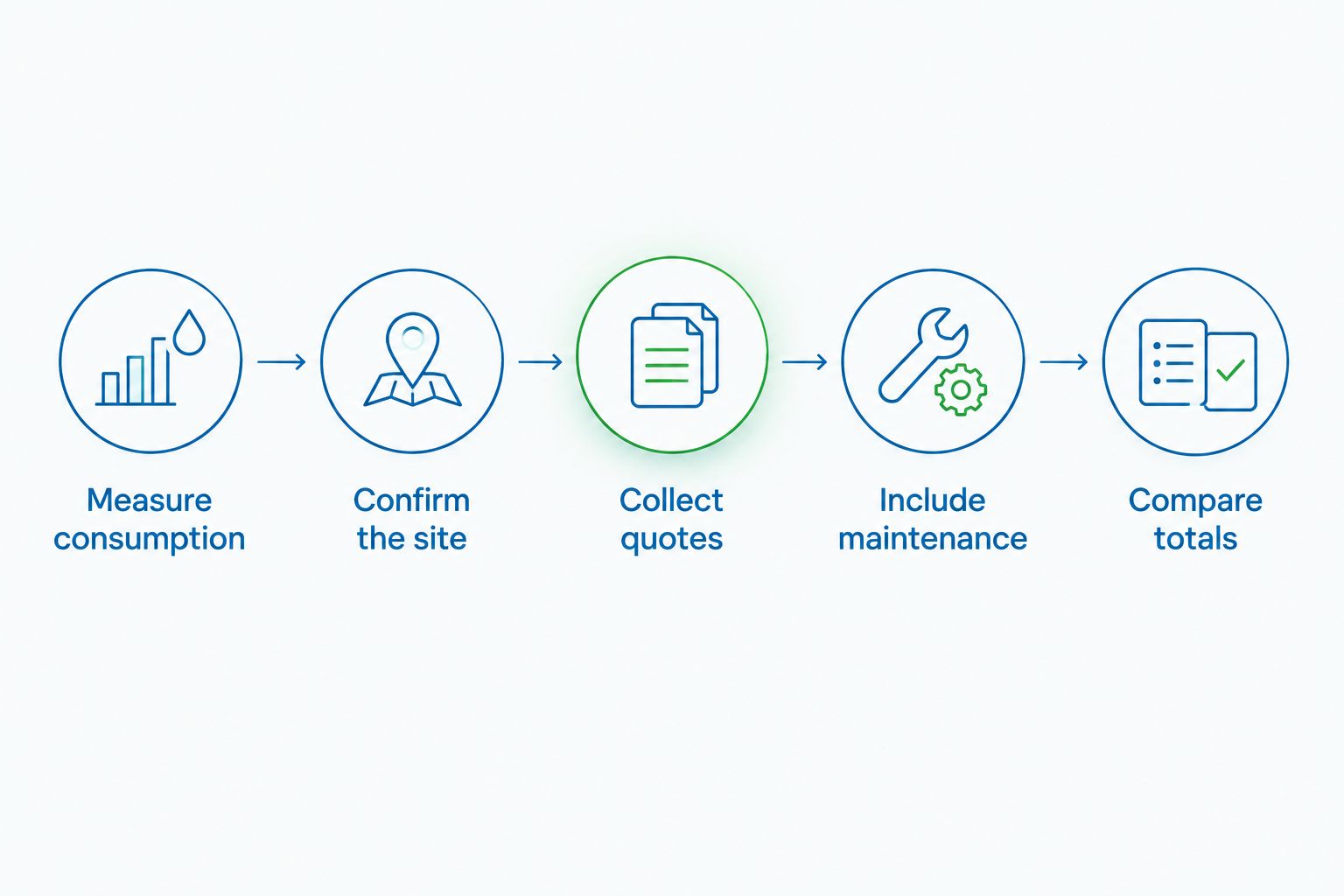
Keep the supporting documents with your worksheet. A purchase decision is easier to check when each expense traces to an invoice, installation estimate, utility rate, or manufacturer instruction rather than an assumed average.
Calculate break-even only after checking recurring expenses
Break-even means the point at which avoided bottled-water expenses repay the additional initial expense of switching. Divide that additional initial expense by the net recurring saving for the same time unit.
This calculation works only when the net recurring saving is positive. If bottleless operation does not reduce recurring expenses in your worksheet, there is no cost-based payback under those assumptions. You can still choose it for operational reasons, but label that decision accurately.
What should I check on the cooler before ordering?
Match the equipment to the task first. Confirm whether you need drinking-water dispensing, bottle filling, hot water, chilled water, or another function explicitly listed for the selected model. Extra functions are not evidence of lower drinking-water cost.
The Fountain Direct is a water-cooler seller for commercial buyers comparing equipment for schools, businesses, and public facilities. Use the model's current documentation to verify fit; a seller's product range does not make every cooler suitable for every location.
Before buying a bottleless water cooler from The Fountain Direct, confirm:
- The model's water-supply and electrical requirements.
- Dimensions, installation clearances, and service access.
- The exact replacement filter and replacement instructions.
- Cleaning responsibilities and access to the required components.
- Whether the equipment's intended use matches your facility.
The benefit of equipment selection is getting the required functions without buying around an unsuitable location. The limitation is that equipment selection alone does not resolve installation or maintenance. Use the guide to setting up a water cooler in a break room to plan the location alongside your purchase.
Is bottled water cheaper for a small office?
Bottled water is cheaper for a small office when its total expense stays below the installed and maintained bottleless alternative. Low headcount does not settle the question; consumption, existing supply terms, and connection work still determine the result.
Compare the expenses your office incurs, not a larger workplace's claimed savings. Keep flexibility in the decision if your lease or office location will change during the planned use period.
Does a bottleless cooler still have recurring expenses?
A bottleless cooler still requires utility water, maintenance, and any electricity needed by the selected model. Filter replacements, cleaning, and service remain part of the ownership calculation.
Removing bottled-water deliveries removes a supply task. It does not make operation expense-free or maintenance-free.
FAQ
Is bottled water cheaper than a bottleless cooler in 2026?
Bottled water is cheaper when its total expense over your planned use period is lower than the installed and maintained bottleless alternative. Compare the same water volume and include installation, filters, utilities, cleaning, and applicable supply charges.
What's the best option for an office without a suitable water connection?
Bottled water avoids installing a permanent water connection. Compare individual bottles with a jug dispenser based on storage, handling, dispensing needs, and your actual supply arrangement.
How much does switching to a bottleless cooler cost?
Switching requires an equipment estimate and a site-specific installation estimate. Add operating expenses and any existing agreement obligations before deciding whether the switch reduces your total spending.
Does a bottleless water cooler need filter replacements?
A filtered bottleless water cooler needs filter replacements according to the selected model's instructions. Verify the exact cartridge and replacement requirements rather than using a schedule from another unit.
Is a jug dispenser the same as a bottleless cooler?
A jug dispenser uses replaceable water containers, while a bottleless cooler connects to a water supply. Both require cleaning, and their supply and maintenance responsibilities differ.
Can I count staff time as a saving when I stop buying bottled water?
Count staff time separately unless removing bottle handling changes an actual labor expense. Reassigned work is an operational benefit, not automatically a reduction in payroll spending.
Should I buy a bottleless cooler before getting an installation estimate?
Get the installation estimate before ordering a bottleless cooler. Confirm that the selected model fits the water connection, electrical supply, available space, and maintenance access.
One last thing
Stopping bottle deliveries does not automatically stop the related charges. Check which rental, service, or agreement obligations remain after switching, and include overlapping expenses during the changeover.
Before placing your 2026 order with The Fountain Direct, put the selected model and installation estimate beside your bottled-water records. Buy when the comparison supports the decision—not when an equipment listing promises savings without your site details.