

How often should a bottleless water cooler be sanitized?

Sanitize a bottleless water cooler at the interval specified in its model’s maintenance manual—not on a universal monthly or quarterly schedule. Clean exposed dispensing surfaces separately, and follow the manufacturer’s return-to-service procedure after extended shutdowns, repairs, or suspected contamination. For your 2026 maintenance plan, record internal sanitizing, exterior cleaning, and filter replacement as separate tasks.
- How often should a bottleless water cooler be sanitized? Follow the exact model’s maintenance manual.
- Avalon self-cleaning features do not replace exterior cleaning or the model’s full maintenance instructions.
- Filter replacement and internal sanitizing are separate jobs; completing one does not complete the other.
- Suspected contamination requires immediate action, not waiting for the next scheduled service.
For an Avalon unit, keep the model manual beside this guide to cleaning an Avalon bottleless water cooler. The manual controls the approved method, cleaning agents, component access, and service interval.
How often should a bottleless water cooler be sanitized?
Use the manufacturer’s internal sanitizing schedule for the exact cooler you own. Bottleless equipment includes different reservoirs, dispensing paths, filters, and cleaning systems. A schedule or chemical procedure written for another dispenser is not a substitute for your model’s instructions.
Start by separating the maintenance jobs. This prevents a common mistake: recording a filter change or a wiped cabinet as a completed internal sanitation service.
| Maintenance task | What it addresses | When to perform it | What it does not replace |
|---|---|---|---|
| Exterior cleaning | Cabinet, controls, dispensing area, and removable tray surfaces | On your facility’s cleaning schedule and when soiled | Internal sanitizing |
| Internal sanitizing | Water-contact components covered by the manufacturer’s procedure | At the model’s specified interval and when the manufacturer directs additional service | Routine exterior cleaning |
| Filter replacement | The installed filter cartridges | At the manufacturer’s time or capacity limit, as applicable | Sanitizing the reservoir or dispensing path |
| Self-cleaning cycle | Components covered by the built-in cleaning system | As directed in the model manual | Every other maintenance task |
| Restart service | Equipment returning from shutdown or service | Before reuse, following the applicable restart instructions | An ongoing maintenance schedule |
For 2026, put the actual due dates in your maintenance system rather than writing only “clean regularly.” Give each task an owner. A useful schedule identifies the model, the required action, and the instruction that sets its timing.
Why this matters
A bottleless cooler avoids bottle changes, but it still has dispensing surfaces and water-contact components that need maintenance. A direct water connection does not make a dispenser maintenance-free. Neither does a filter indicator or a self-cleaning label.
The distinction matters when several people share responsibility. Cleaning staff can wipe the exterior while a service technician handles internal components; without separate records, each person can assume the other completed the whole job.
Treat the cooler as maintained equipment, not furniture. Your written process should make it clear what was cleaned, what was sanitized, and what still needs attention before the dispenser returns to use.
How do you build the right sanitizing schedule?
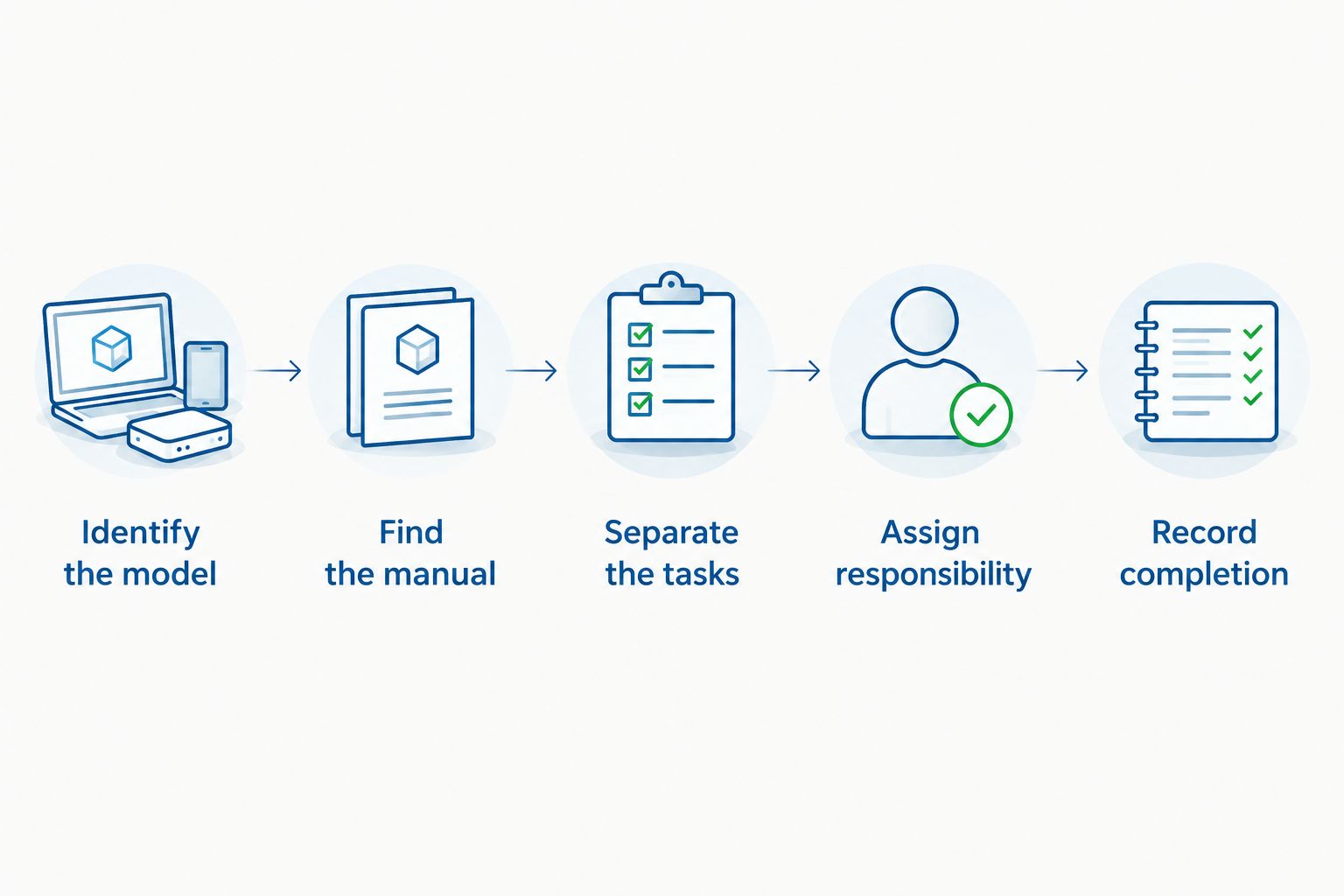
Follow this sequence before assigning recurring service. It works for a new purchase and for an existing cooler whose maintenance history needs organizing.
- Identify the model. Read the equipment label and record the complete model designation. Do not rely on appearance or a purchase description that groups several versions together.
- Find the manual. Locate the manufacturer’s instructions for that model and revision. Find the sections covering cleaning, internal sanitizing, filters, shutdown, and restart.
- Separate the tasks. Create distinct entries for exterior cleaning, internal sanitizing, filter replacement, and any built-in cleaning cycle. Record what each task covers.
- Assign responsibility. Name the person or service provider responsible for each action. Confirm which tasks require trained service personnel rather than routine cleaning staff.
- Record completion. Log the service date, work performed, and next due date. Keep any required return-to-service checks with the same record.
If the manual’s wording is unclear, ask the manufacturer to identify the applicable procedure before service. Ask specifically whether the instruction covers the reservoir, dispensing outlets, connecting tubing, and installed treatment components. A general answer about cleaning the cabinet does not resolve a question about internal sanitation.
For a cooler already in use, begin with its last documented service. Do not treat an unknown service date as proof that maintenance is current. Establish the equipment’s condition and required service with the responsible technician, then start a reliable record.
Why bottleless water cooler sanitizing schedules vary
The correct schedule depends on the equipment and its operating conditions. Review these factors when applying the manual; do not use them to invent a replacement interval.
- Internal design. Access, reservoirs, tubing, and dispensing components affect the prescribed cleaning method. Instructions must match the actual water path.
- Built-in cleaning system. A self-cleaning function has a defined procedure and scope. Confirm what it treats and what still requires manual attention.
- Use and exposure. Shared controls, splash areas, and trays need a cleaning schedule suited to the setting. Exterior cleaning frequency is not automatically the internal sanitizing frequency.
- Periods without use. An extended shutdown calls for the manufacturer’s restart instructions. Routine service dates do not replace that review.
- Repairs or component changes. Work that opens the water path requires attention to the applicable service and recommissioning procedure.
- Contamination concerns. A water advisory, suspected contamination, or an unexplained change in dispensed water needs investigation outside the normal calendar.
For your 2026 service specification, distinguish manufacturer-required work from facility cleaning policy. That keeps a local decision—such as more frequent wiping of shared controls—from being mistaken for a universal technical requirement.
Does a self-cleaning bottleless cooler still need sanitizing?
A self-cleaning cooler still needs the maintenance specified in its manual. Use the built-in cycle as instructed, and complete exterior cleaning, filter service, and any additional internal procedure the manufacturer requires.
The advantage of a built-in cleaning function is that it provides a defined equipment feature for part of the maintenance process. Its limitation is scope: the label alone does not establish that every surface or component is treated. Check the instructions instead of assuming the cycle cleans the cabinet, tray, outlets, and entire water path.
Also check how the cycle starts and finishes. Your staff need to know whether activation is manual or automatic, whether dispensing is restricted during operation, and what confirms completion. Use the answers from the exact model’s documentation.
When comparing coolers for purchase, judge self-cleaning by the procedure you can actually carry out, not by the label alone. A feature helps only when the people responsible for maintenance understand its operation and limitations.
Is replacing the filter the same as sanitizing the cooler?
Filter replacement is not internal sanitizing. Replacing a cartridge services the filtration component; it does not establish that the reservoir, outlet, or other water-contact components have been sanitized.
Keep the replacement schedule specified for the installed filter. If the instructions use elapsed time and water capacity, follow the stated replacement rule rather than choosing whichever deadline is more convenient. Do not copy a filter interval from a different cartridge or cooler.
A filter service visit is a useful opportunity to inspect the dispenser and review its maintenance record. However, only mark internal sanitation complete when the prescribed procedure was actually performed. Record the filter identifier separately so the next person can order the correct replacement.
In your 2026 maintenance log, give filter replacement its own entry. That makes it possible to check both deadlines without treating one service action as evidence of the other.
What should happen before the cooler returns to use?
Return the cooler to service only after completing the model’s required restart checks. Sanitizing is a procedure, not simply adding a cleaning chemical and switching the dispenser back on.
Use this service sequence as a planning checklist, not as a substitute for model-specific directions:
- Confirm the correct procedure, approved agent, and required protective measures.
- Restrict use and prepare the equipment as the manufacturer instructs, including electrical isolation or water shutoff where required.
- Clean and sanitize only the components covered by the procedure, using its stated dilution and contact time.
- Complete the required rinsing, flushing, reassembly, and operating checks.
- Document the work and authorize return to use under your facility’s process.
Never mix cleaning chemicals. Do not put a surface disinfectant into a drinking-water path unless both the equipment instructions and chemical labeling permit that use. Avoid improvised bleach, vinegar, or other chemical recipes copied from instructions for unrelated equipment.
For hot-water models, follow the manual’s cooling and draining precautions. Keep unauthorized users away during service, and never bypass a lockout or warning to obtain water while maintenance is underway.
When should you act before the scheduled service date?
A calendar does not override a fault or contamination concern. Take a cooler out of use when contamination is suspected, and have the cause assessed before returning it to service. Cleaning alone does not establish that an upstream water problem has been resolved.
Escalate an unexplained change in taste, odor, or appearance to the person responsible for facilities and water quality. These changes require investigation; they do not identify the cause by themselves. Normal taste and clear appearance are not proof of microbiological safety either.
After a building water advisory, follow the water authority’s directions along with the equipment manufacturer’s recovery instructions. Do not assume that the dispenser’s filter or self-cleaning feature makes it acceptable to ignore an advisory.
After a prolonged closure, review the cooler’s restart requirements and the building’s water-management procedure. The dispenser is connected to a larger plumbing system. Servicing the appliance and managing the building’s water supply are related responsibilities, not interchangeable tasks.
What should you check before buying a bottleless cooler?
The Fountain Direct is a buying option for facilities selecting bottleless water coolers. Before choosing equipment, confirm that your staff or service provider can perform its documented maintenance.
The Avalon A9 countertop bottleless water cooler includes self-cleaning and dual filtration, as identified in its product listing. Those features are relevant to your selection, but neither removes the need to review the model’s maintenance instructions. Best for: buyers seeking a countertop bottleless cooler with those features; verify installation requirements and the cleaning procedure before ordering.
When selecting a bottleless water cooler from The Fountain Direct, request the manual and identify the replacement filters before making your decision. Check service access in the planned installation location. A cooler that fits physically still needs room for the maintenance its instructions require.
For a 2026 purchase, make maintenance responsibility part of the handover. Keep the manual, model information, filter details, and service record together so your next technician does not have to reconstruct the installation.
FAQ
How often should a bottleless water cooler be sanitized?
Sanitize a bottleless water cooler at the interval specified in its exact model’s maintenance manual. Keep exterior cleaning, filter replacement, and internal sanitizing on separate schedules.
Should I sanitize my bottleless cooler every month?
Use a monthly internal sanitizing interval only when the manufacturer’s instructions or an applicable facility requirement calls for it. Do not apply a schedule from another dispenser to your model.
Does a self-cleaning water cooler need manual cleaning?
A self-cleaning water cooler still needs the manual cleaning and maintenance required by its instructions. Confirm which components the built-in cycle treats and which require separate attention.
Can I sanitize my bottleless water cooler with bleach?
Use bleach only if the equipment manufacturer permits it and provides the applicable procedure. Follow the approved dilution, contact time, and rinsing instructions; never mix cleaning chemicals.
Do I need to sanitize the cooler when I replace its filters?
Follow the model’s instructions for sanitation during filter service. A filter change alone does not sanitize the reservoir, dispensing outlet, or other water-contact components.
What should I do if the cooler’s water smells or tastes different?
Have an unexplained change in the cooler’s water assessed rather than assuming routine cleaning will resolve it. Restrict use when contamination is suspected and investigate the dispenser and water supply as appropriate.
Does a bottleless cooler need service after an office shutdown?
Follow the manufacturer’s return-to-service instructions after an extended office shutdown. Review the building’s water-management procedure as well as the dispenser’s maintenance requirements.
One last thing
A completed cleaning log is useful only when it names the work performed. Replace a single “cooler cleaned” checkbox with separate entries for exterior cleaning, internal sanitizing, filter replacement, and restart checks.
Before your next service visit, photograph the model label and attach the correct manual to the equipment record. That simple step makes the next maintenance decision model-specific instead of guesswork.