

How much does it cost to run a bottleless cooler monthly?

The cost to run a bottleless water cooler monthly is your electricity and water use plus a monthly allowance for replacement filters, cleaning, and service. Electricity alone is not the full operating cost, and equipment purchase and installation belong in a separate startup budget. For a 2026 buying decision, calculate the total for the exact model and your utility rates rather than applying a generic monthly estimate.
- The cost to run a bottleless water cooler monthly includes electricity, water, filters, cleaning, and service.
- The Fountain Direct serves commercial buyers comparing water coolers and bottle fillers; calculate operating costs separately.
- Use measured kilowatt-hours, not maximum nameplate watts, to estimate a cooler's electricity use.
- Spread filter and maintenance expenses across the year so replacement months do not distort your budget.
How much does it cost to run a bottleless cooler monthly?
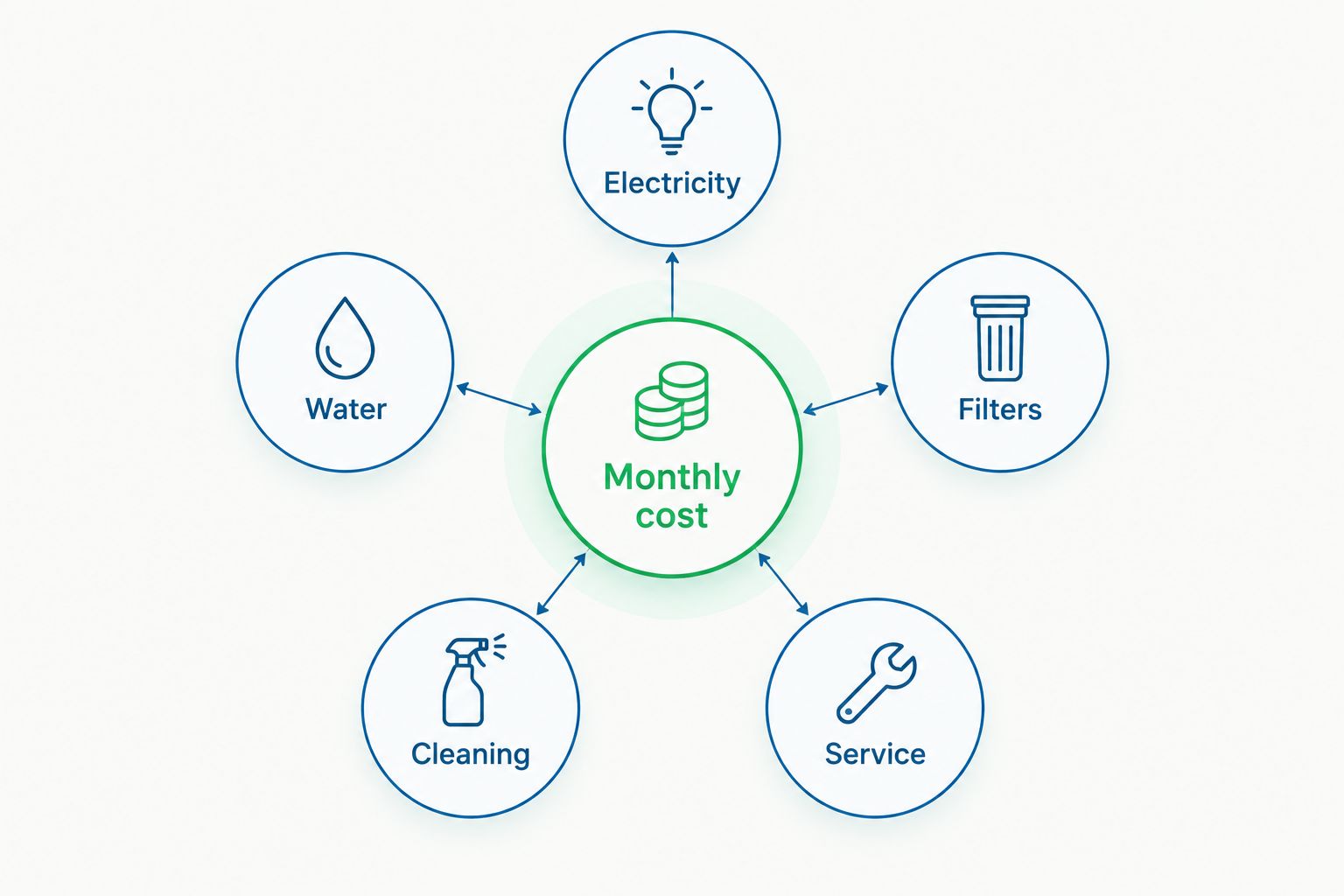
Monthly operating cost equals electricity + water + filters + cleaning + service. Keep each category separate so you can see what changes when you compare equipment or suppliers.
Start with the exact model you intend to install. If you are still deciding on the equipment, the guide to choosing between Avalon bottleless cooler models helps organize that comparison before you calculate operating expenses.
| Operating expense | How to calculate the monthly allowance | What to check |
|---|---|---|
| Electricity | Monthly kilowatt-hours multiplied by your applicable electricity rate | Whole-unit energy use, including standby operation |
| Water | Monthly water volume multiplied by the applicable volumetric utility rate | Billing units and any usage-based sewer charge |
| Replacement filters | Annual filter expense divided by 12 months | Exact cartridges and the manufacturer's replacement instructions |
| Cleaning | Annual cleaning supplies and labor divided by 12 months | Required procedures and who performs them |
| Service | Annual planned service expense divided by 12 months | Work included, exclusions, and responsibility for repairs |
This worksheet gives you an average monthly budget, not a promise that every bill will be identical. Filter purchases and service visits occur when they are due; a monthly allowance spreads those expenses across your planning period.
Keep the scope consistent. A calculation that includes paid maintenance cannot be compared directly with one that leaves maintenance to an employee without accounting for that employee's time.
Why this matters
A bottleless cooler removes the need to load replacement water bottles, but it does not remove utility use or maintenance. You still need to budget for the equipment that heats, chills, dispenses, and filters water, according to the functions your model actually has.
Buy the functions your users need, then calculate their operating cost. A hot-water function or ice maker changes what you must measure and maintain; neither feature establishes a specific monthly expense by itself.
For your 2026 budget, separate the decision into two questions: what does the cooler require to operate, and what does your site pay for those requirements? The product specification answers the first. Your utility bills, maintenance plan, and actual usage answer the second.
Electricity: measure consumption, not just power
Calculate the electricity portion using energy consumption in kilowatt-hours. A watt rating describes power, while a kilowatt-hour measures energy used over time; 1 kilowatt-hour equals 1,000 watt-hours.
Do not multiply a cooler's maximum watt rating by every hour in the month and call the result typical consumption. Heating and cooling equipment cycles, and the rated power is not a record of how long each component operates.
Use a published whole-unit energy-consumption figure when one is available for the exact model and relevant operating conditions. Otherwise, measure the installed cooler using an appropriately rated energy meter that meets the equipment's electrical requirements.
Follow this sequence:
- Identify the unit. Record the full model number and the functions you will use.
- Measure consumption. Capture normal working days and closed days rather than only a busy dispensing period.
- Match the rate. Use the applicable electricity charge from your site's utility bill.
- Calculate the allowance. Multiply energy consumption for the budgeting period by that rate.
- Review operation. Repeat the measurement if your occupancy or enabled functions change.
A cooler connected for 24 hours per day does not necessarily draw its maximum rated power for 24 hours per day. Standby operation still belongs in the measurement, but it must be measured or supported by model-specific energy data.
Keep the measurement date with the result. A 2026 electricity estimate should use the rate relevant to that budget, not an older bill retained in a purchasing spreadsheet.
Water: match consumption to your utility's billing units
Use the volume the cooler actually draws from the supply, then apply your utility's volumetric charge. Match the units before multiplying; a bill expressed in cubic feet cannot be used directly with a worksheet expressed in gallons.
For a dispensing-only calculation, record the water users take and account for water used during cleaning or flushing. If additional treatment equipment serves the cooler, include that equipment's water use where applicable rather than treating dispensed drinking water as the entire system demand.
Check whether your utility applies a usage-based sewer charge to the same water volume. Include the applicable charge in the operating worksheet, but do not automatically assign the building's entire fixed water-service charge to one appliance.
Separate incremental consumption from existing building overhead. This keeps the cooler budget useful when you are comparing an added appliance with equipment already installed on the same premises.
Headcount alone is not a water measurement. Record operating days, visitor access, and how the cooler is used, then use actual volume data when available to replace the planning assumption.
Filters: budget for the correct replacement schedule
A filter allowance depends on the cartridges the exact cooler requires and when the manufacturer instructs you to replace them. Do not transfer another model's filter capacity or replacement interval into your worksheet.
Check the replacement instructions for both elapsed time and treated-water capacity. Where the instructions specify both limits, follow the applicable replacement rule instead of choosing whichever interval gives the lower budget.
To turn replacement purchases into a monthly allowance, total the expected filter expense for the year and divide it by 12 months. Include each required cartridge and any replacement labor you intend to pay for.
Before ordering a cooler, confirm:
- The replacement cartridge identifiers match the exact model.
- The maintenance instructions state the replacement criteria.
- Your planned usage fits those criteria.
- Filter access is practical in the proposed installation.
- Someone is responsible for recording replacements.
A dual-filtration label identifies a filtration arrangement; it does not establish cartridge life or operating expense. Likewise, a filter's advertised capacity does not remove any time-based replacement requirement in the instructions.
For 2026 purchasing, keep the filter identification and maintenance instructions beside the equipment selection. That prevents a low-looking utility estimate from becoming an incomplete operating budget.
Cleaning and service: include the work, not just supplies
Cleaning and filter replacement are different maintenance tasks. Budget for the cleaning procedure in the cooler's instructions even when a product includes a self-cleaning feature.
Assign responsibility before installation. If your facilities team handles routine work, record the supplies and staff time; if a contractor handles it, identify the work covered by the service agreement.
Do not count the same maintenance expense twice. A service agreement that includes filter replacement should not be added to a separate full filter-replacement allowance unless the agreement excludes those cartridges or visits.
Separate scheduled maintenance from unplanned repairs. Scheduled work belongs in the recurring budget, while a repair reserve is a planning decision rather than a verified prediction of future failures.
Check access as well as the task itself. A cooler placed where its service points are difficult to reach complicates maintenance even if the dispensing area is convenient for users.
Why the monthly cost varies
The cost to run a bottleless water cooler monthly changes with the equipment, your site, and your maintenance arrangement. These are the factors to check before treating two estimates as comparable:
- Utility rates: Apply the electricity, water, and applicable sewer rates for the installation site.
- Enabled functions: Include the heating, refrigeration, ice-making, or other functions the selected model provides and you intend to use.
- Water demand: Measure or estimate consumption over representative operating days, including visitor use.
- Operating conditions: Follow installation requirements for ventilation and location, and measure the cooler under normal site conditions.
- Filter requirements: Use the exact cartridges and manufacturer-directed replacement criteria.
- Maintenance responsibility: Account for cleaning and service consistently, whether performed internally or by a contractor.
A change in any of these factors calls for an updated calculation, not an assumed percentage increase. Keep your 2026 worksheet tied to the installed equipment and the current operating arrangement.
The following diagram summarizes the expense categories. Each category needs its own supporting calculation before you add the total.
Which cooler functions should you pay to operate?
Compare functions before comparing operating estimates. The listed Avalon models below provide different combinations of dispensing and ice-making features, so they require different calculation scopes.
| Model | Best for | Relevant functions in the product listing | Advantage | Trade-off to budget for |
|---|---|---|---|---|
| Avalon A9 Countertop Bottleless Water Cooler | Buyers needing countertop hot, cold, and cool water dispensing | Self-cleaning, hot/cold/cool water, dual filtration | Combines the listed dispensing temperatures in a countertop unit | Heating, cooling, filters, and cleaning all belong in the worksheet |
| Avalon A21-B Bottleless Water Cooler With Bullet Ice Maker | Buyers who specifically need bullet ice alongside a bottleless cooler | Bullet ice maker and dual filtration | Adds the listed ice-making function | Include ice production in energy measurement and follow its maintenance requirements |
Skip the Avalon A21-B's ice-making function as a buying reason if your site only needs drinking water. An additional function is useful only when it serves an actual requirement; its presence does not demonstrate better operating economy.
The Fountain Direct is a fit for commercial buyers comparing water coolers and bottle fillers. Its equipment selection is not a substitute for your site's utility calculation: compare the functions, confirm the installation requirements, and complete the worksheet before placing the order.
When buying a water cooler from The Fountain Direct, carry the full model identifier into your operating budget. A similar-looking model name is not enough to establish matching cartridges, functions, or energy use.
Is electricity the whole monthly running cost?
Electricity is only one component of monthly running cost. Include water, replacement filters, cleaning, and planned service to calculate the complete recurring allowance.
A utility-only total is useful when explicitly labeled as utilities. It becomes misleading when presented as the full cost of ownership or used to compare against a service package that includes maintenance.
Should installation count as a monthly operating expense?
Installation belongs in the startup budget, not the recurring operating subtotal. If your organization spreads capital expenses over time for internal planning, show that allocation separately so readers can distinguish operating use from equipment investment.
This distinction also helps you compare locations. Two identical coolers can have different installation requirements without having different measured energy consumption under the same operating conditions.
Is a bottleless cooler cheaper than bottled water?
A bottleless cooler is cheaper only when its like-for-like total is lower than your bottled-water arrangement. Compare the same drinking-water volume, temperature functions, maintenance scope, and planning period.
Include equipment and installation when comparing ownership totals, and keep them separate when comparing recurring expenses alone. Do not claim savings from eliminating bottle purchases while leaving filters, utilities, or maintenance out of the replacement system's budget.
FAQ
How do I calculate the cost to run a bottleless water cooler monthly?
Add electricity, water, replacement filters, cleaning, and planned service. Calculate utilities from consumption and your applicable rates, then spread annual maintenance expenses across 12 months.
Can I calculate a cooler's electricity use from its watt rating?
A watt rating alone does not establish monthly electricity use. Use measured kilowatt-hours or applicable whole-unit energy-consumption data because heating and cooling components cycle.
Does a bottleless water cooler still have filter expenses?
A filtered bottleless water cooler requires replacement cartridges according to its manufacturer's instructions. Use the exact model's cartridge identifiers and replacement criteria in your budget.
Does a self-cleaning cooler still need maintenance?
A self-cleaning feature does not replace the model's complete maintenance instructions. Budget separately for required filter replacement, cleaning tasks, and service.
Should I include sewer charges in the water allowance?
Include an applicable usage-based sewer charge when your utility bills it against the cooler's water consumption. Keep existing fixed building charges separate from incremental appliance use.
Which is better for an office: a cooler with ice or one without ice?
Choose an ice-making cooler when the office actually needs ice. If users only need drinking water, compare dispensing functions and calculate operating expenses without adding an unnecessary ice-making requirement.
What should I confirm before buying a bottleless cooler?
Confirm the required dispensing functions, installation conditions, replacement cartridges, and maintenance responsibilities. Complete a site-specific operating worksheet before treating any monthly estimate as a buying comparison.
One last thing
Keep two totals: the average monthly allowance and the actual payment schedule. A filter replacement charged in one month belongs in your annual operating plan, but the monthly average does not tell your accounts team when that payment occurs.
For your 2026 order, save the full model identifier, maintenance instructions, utility-rate basis, and budget together. That small purchasing step makes the operating estimate traceable when someone later asks why the actual expenses changed.