

How long do commercial water coolers typically last?

Commercial water coolers do not have a single replacement age: useful life depends on the model, operating conditions, maintenance, and whether worn components remain repairable. Replace a cooler because it no longer provides safe, reliable service—not because it reaches an arbitrary birthday. Filters, valves, and refrigeration components need separate attention; replacing a service part is not the same as replacing the entire cooler.
- How long do commercial water coolers last? Judge the specific model, maintenance history, and operating condition—not age alone.
- Elkay refrigerated bottle fillers require separate checks of cooling, dispensing, filtration, and drainage.
- Repair a diagnosed, serviceable fault; replace equipment with unresolved safety problems or recurring failures.
- Match your replacement commercial water cooler to the facility’s installation and drinking-water needs.
How long do commercial water coolers typically last?
The useful life of a commercial water cooler is the period during which it can deliver drinking water reliably and remain serviceable. Installation age helps you understand its history, but age alone does not establish its remaining life. A unit that stops dispensing needs diagnosis before a replacement order; start with how to troubleshoot a drinking fountain that won’t turn on.
For a 2026 replacement decision, separate normal maintenance from equipment failure. A filter change, flow adjustment, or replaceable valve fault belongs in a different category from structural damage or a diagnosed refrigeration failure.
| Condition | What it means | Next move | Best for |
|---|---|---|---|
| Reliable dispensing, cooling, and drainage | No operating fault has been identified | Continue manufacturer-directed maintenance | Facilities keeping functional equipment |
| An isolated fault with an identified replacement part | The affected component can be assessed separately | Obtain a repair diagnosis and scope | Facilities considering a targeted repair |
| Recurring faults after completed repairs | Previous work has not restored dependable service | Compare further repair work with replacement | Facilities dealing with repeated disruption |
| Unsafe operation or damaged structural support | Continued use requires a safety assessment | Remove from service and arrange qualified inspection | Facilities addressing immediate hazards |
| Equipment no longer fits the intended use | Reliability alone does not solve the mismatch | Specify a suitable replacement | Facilities changing access or dispensing requirements |
A repairable fault is not proof that the entire cooler has reached the end of its life. Equally, a cabinet that looks intact is not proof that its internal components are sound.
Why this matters before you buy a replacement
Buying on age alone can replace working equipment without solving the actual problem. Buying on appearance alone creates the opposite mistake: keeping an attractive cabinet while overlooking leaks, poor cooling, or damaged mounting.
Your decision needs an equipment assessment and an installation assessment. Replacing the cooler does not repair a restricted supply line, blocked building drain, or unsuitable electrical connection.
For schools, offices, gyms, and public facilities, reliable access matters as much as the equipment itself. Plan how users will obtain drinking water while a unit is out of service, and keep the replacement scope clear before authorizing work.
How do you assess a commercial water cooler’s remaining life?
Use the same assessment for each unit in your 2026 facilities plan. You need a repeatable record, not a guess based on how old the cabinet looks.
- Identify the equipment. Record the manufacturer, complete model number, serial number, and installation date if documented. Photograph the nameplate before requesting parts or comparing replacements.
- Document the fault. Describe whether the unit fails to dispense, fails to cool, leaks, drains slowly, or behaves intermittently. Record when the problem occurs, including whether it appears only during busy periods.
- Check maintenance history. Review filter changes, cleaning, previous repairs, and recurring complaints. Separate scheduled service from breakdown work so your record does not make routine maintenance look like equipment failure.
- Request a qualified diagnosis. Have the appropriate technician distinguish an equipment fault from a supply, drain, mounting, or electrical problem. Do not open energized equipment or attempt refrigeration work without the required expertise.
- Confirm the repair scope. Identify the failed component, replacement-part compatibility, and any related work. A vague recommendation to replace everything is not a component-level diagnosis.
- Check replacement fit. Compare the proposed unit with existing connections, support, space, and user access. Decide whether the project is a like-for-like replacement or a change in equipment type.
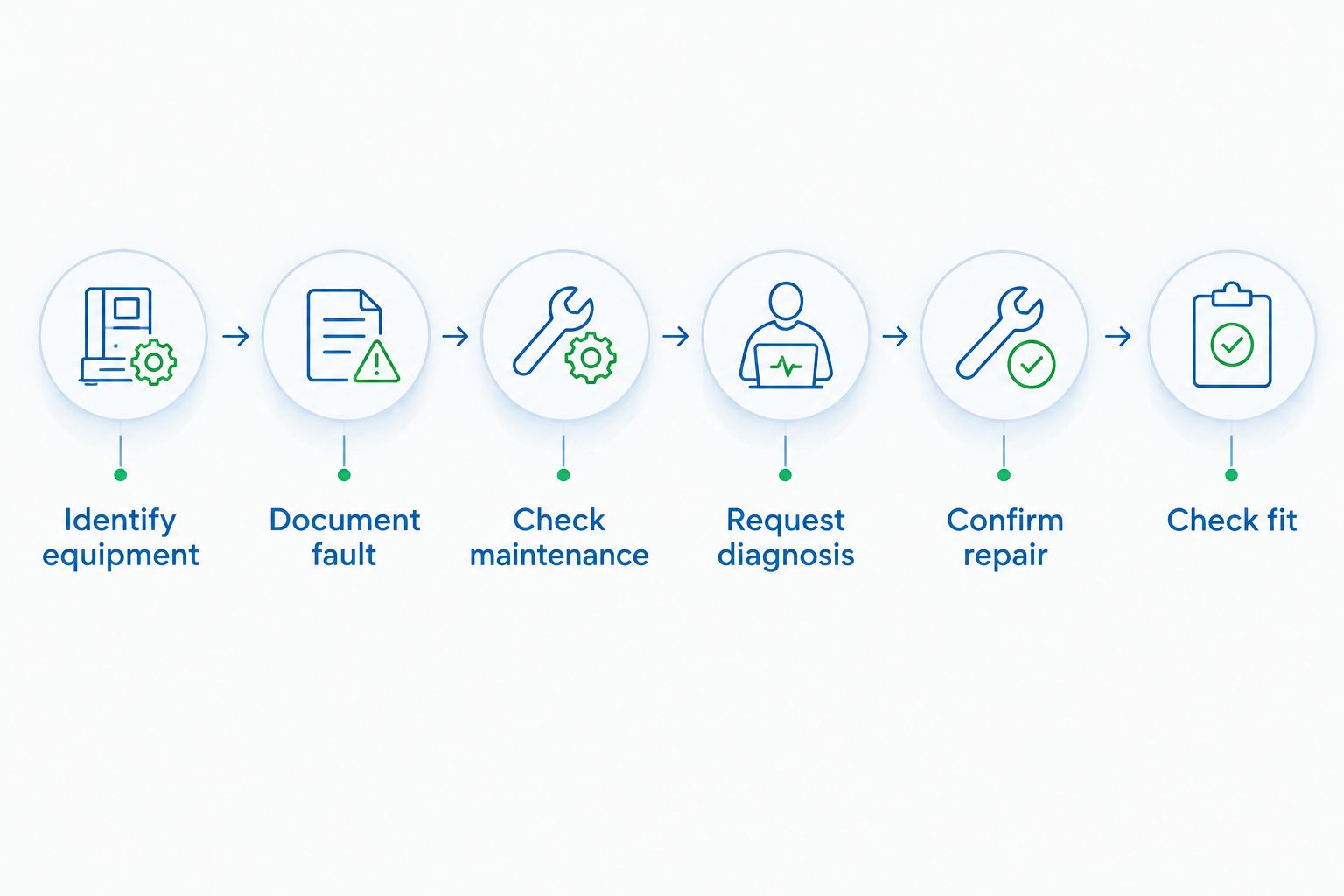
Keep the assessment with the unit’s service record. When the next fault occurs, you can compare it with the previous diagnosis instead of restarting the decision from memory.
Why commercial water cooler service life varies
Different cooler configurations create different service requirements. Refrigeration, filtration, bottle filling, and mounting each deserve attention; none independently establishes a promised lifespan.
- Refrigeration condition. A refrigerated cooler must dispense and cool. Treat loss of cooling as a separate diagnostic issue rather than assuming that water flow proves the entire system works.
- Filtration maintenance. Filtered equipment needs the correct replacement cartridge and the model’s prescribed service procedure. Cartridge replacement is a maintenance task, not a whole-unit replacement schedule.
- Dispensing components. Buttons, valves, and bottle-filler controls determine whether users can obtain water. Identify the affected component before deciding that a dispensing fault condemns the cabinet and cooling system.
- Installation environment. Indoor and outdoor equipment serve different settings. Confirm the model’s permitted conditions instead of treating stainless steel construction as permission to install any cooler outdoors.
- Mounting and physical condition. Wall-mounted equipment depends on suitable support and secure attachment. Inspect damaged panels, loose fixtures, and compromised mounting separately from cosmetic wear.
- Service access and parts compatibility. A repair needs the correct component and enough access to perform the work. Verify model-specific parts rather than ordering by appearance or brand name alone.
Water quality and cleaning also belong in the assessment. Mineral deposits, debris, and inappropriate cleaning methods require attention, but they do not justify assigning every cooler the same retirement date.
When should you repair a commercial water cooler?
Repair is the best fit when a qualified diagnosis identifies a serviceable fault and the rest of the unit remains suitable for use. That decision requires more than identifying a replacement part: confirm that the repair addresses the cause, not just the visible symptom.
A leaking connection, damaged dispensing component, or overdue filter deserves its own assessment. Do not assume these conditions require replacing functioning refrigeration equipment.
Ask the service provider to explain what failed, what will be replaced, and how operation will be checked afterward. Keep the completed repair record so recurring symptoms can be traced to earlier work.
The advantage of repair is retaining equipment that still fits the facility. The limitation is that repairing one component does not renew every other component. A repaired valve does not establish the remaining life of a compressor, mounting assembly, or cabinet.
When should you replace a commercial water cooler?
Replacement is the best fit when documented condition, repeated service disruption, or an installation mismatch makes continued use unsuitable. Base the decision on the diagnosis and your facility’s requirements, not an unsupported lifespan claim.
Replacement deserves serious consideration when:
- The technician identifies damage that cannot be resolved through an appropriate repair.
- Completed repairs repeatedly fail to restore dependable operation.
- The required repair cannot be completed with a verified compatible component.
- The existing equipment does not meet the facility’s current dispensing or access needs.
- A renovation requires a different layout, mounting arrangement, or equipment configuration.
Replacement lets you select equipment for the current job. Its limitation is installation work: a new cooler still needs compatible utilities, support, drainage where required, and appropriate positioning.
For a 2026 purchase, have the installer review the proposed model before ordering. Confirm which existing connections can remain and which need alteration. That review prevents a product choice from becoming an unplanned installation redesign.
What should you check when buying a replacement cooler?
Start with the function your users need. Drinking directly from a fountain, filling bottles, and obtaining chilled water are distinct requirements; do not assume every unit provides all of them.
The Fountain Direct serves schools, businesses, contractors, and public facilities buying commercial water coolers and bottle fillers. Use the product specification to confirm the fit rather than treating a seller’s catalog as a service-life guarantee.
For a public-facing installation requiring those features, the Elkay LVRCTL8WSPRO refrigerated bi-level cooler and bottle filler is a relevant option to assess. Its listed configuration includes refrigeration, filtration, vandal resistance, a bi-level ADA cooler, bottle filling, and UV protection.
Best for: buyers whose project requires that combined configuration. The benefit is bringing those stated functions into the selection; the trade-off is that refrigeration, filtration, and additional treatment features each require their prescribed service. Those features do not establish a longer operating life.
Before selecting a commercial water cooler from The Fountain Direct, confirm:
- Installation fit: dimensions, mounting requirements, utility locations, and service access.
- Cooling requirements: the model’s documented performance under its stated test conditions and your intended use.
- User access: installation details needed for the intended approach and applicable accessibility requirements.
- Maintenance requirements: cleaning instructions, filter compatibility, and access to service components.
- Repair information: the correct model documentation and component identification.
For your 2026 specification, distinguish required functions from optional additions. Ordering extra functions does not substitute for selecting equipment that fits the space and workload.
Does replacing the filter make a cooler last longer?
Replacing the correct filter according to the manufacturer’s instructions maintains the filtration system; it does not renew the entire cooler. Refrigeration, dispensing controls, connections, and mounting still need their own checks.
Do not use a cartridge’s rated treatment capacity as the cooler’s lifespan. The rating concerns the cartridge under its specified conditions, not the age at which the complete unit should be replaced.
Record the cartridge identification and replacement date. That gives your service team a useful maintenance history without confusing consumable service with equipment retirement.
Is a cooler that still dispenses water safe to keep using?
Water flow alone does not establish safe operation. A cooler can dispense while also having a leak, damaged electrical equipment, compromised support, or an unresolved water-quality concern.
Remove equipment from service when a suspected hazard requires inspection. Cleaning the exterior or changing a filter is not a substitute for diagnosing the underlying concern.
FAQ
How long do commercial water coolers last?
Commercial water cooler life is model- and condition-specific, not determined by a universal replacement age. Use documented maintenance, a qualified diagnosis, and the manufacturer’s guidance to decide whether to keep, repair, or replace the unit.
Should I replace an old water cooler if it still works?
Age alone is not a reason to replace a working commercial water cooler. Check safe operation, physical condition, service history, and whether it still meets the facility’s requirements.
Does a water cooler need replacing when it stops cooling?
Loss of cooling requires diagnosis before a replacement decision. A qualified technician needs to identify the fault and separate equipment problems from installation or operating issues.
Is repairing a commercial water cooler better than replacing it?
Repair fits an identified, serviceable fault in otherwise suitable equipment; replacement fits unresolved damage, repeated failures, or changed installation needs. Compare a documented repair scope with the complete replacement scope.
How often should I replace a commercial cooler’s filter?
Replace the filter according to the specific cartridge and equipment instructions. Use the applicable service indicators and limits rather than borrowing a schedule from another model.
Does stainless steel mean a water cooler will last longer?
Stainless steel construction does not establish the lifespan of the complete cooler. Cooling components, controls, plumbing connections, mounting, and maintenance still affect its serviceability.
What should I check before ordering a replacement commercial water cooler?
Check the model’s functions, dimensions, mounting, utility requirements, user access, and service needs before ordering. Have the installer confirm compatibility with the existing site.
One last thing
Your best replacement clue is often the service record, not the installation date. A repeated fault after completed repairs tells you something an old cabinet’s appearance cannot: dependable operation has not been restored.
Before placing a 2026 order with The Fountain Direct, send the installer both the existing model information and the proposed replacement specification. Resolve the installation fit before the equipment arrives.