If your site needs an outdoor fountain that can handle daily public use without turning into a maintenance project, a Haws outdoor drinking fountain review is worth your time. Haws has built a strong reputation in commercial hydration, especially for parks, schools, campuses, and municipal spaces where vandal resistance, ADA access, and weather exposure are not optional features - they are baseline requirements.
That reputation is earned, but it does not mean every Haws model is the right fit for every project. Buyers who get the best results from Haws usually start with the installation environment, climate risk, user traffic, and compliance requirements, then narrow down to the right configuration. That is the practical lens to use here.
What stands out in a Haws outdoor drinking fountain review
Haws outdoor fountains tend to score well for one reason above all: they are built for public environments, not light residential use. That shows up in the materials, the valve protection, the bowl design, and the range of pedestal and wall-mounted options available for different site conditions.
For schools and parks, the appeal is straightforward. You are buying from a manufacturer known for commercial-grade fixtures, not a decorative landscape product trying to serve a public hydration role. On a busy site, that difference matters. Thicker construction, tamper-resistant components, and purpose-built outdoor finishes usually mean fewer service calls and better performance over time.
Haws also gives facility teams good coverage across common use cases. You will find standard outdoor fountains, freeze-resistant units for cold climates, barrier-free options for ADA-focused projects, and combinations that include pet stations or bottle filling capability depending on the model family. That range makes Haws a serious contender when one product needs to serve both compliance and public usability.
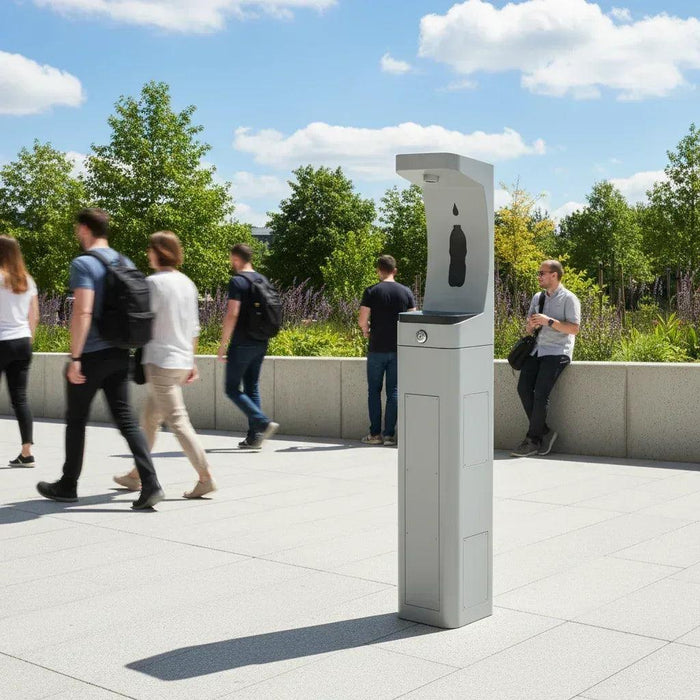
Durability and vandal resistance
Durability is one of the strongest arguments for Haws. In real-world outdoor applications, fountains fail less often from normal wear than from abuse, weather, or poor installation planning. Haws addresses the first two fairly well.
Most commercial Haws units are designed with sturdy metal construction and components that are less exposed than what you see on lower-end outdoor fountains. Push-button assemblies and bubbler protections vary by model, but the general design philosophy is clear: reduce vulnerable points and make the unit harder to damage casually.
That said, vandal resistance is not the same as vandal-proof. If you are placing a fountain in an unsupervised park, transit-adjacent area, or school perimeter with repeated after-hours misuse, model selection matters a lot. Some Haws units are better suited to moderate public traffic, while others are a better fit for rougher environments. This is one of those cases where the brand is strong, but the exact SKU matters more than the logo.
ADA compliance and user accessibility
A good Haws outdoor drinking fountain review should talk about accessibility because this is often where buyers narrow the field. Haws offers ADA-compliant and barrier-free configurations, and that is a major advantage for schools, municipalities, and commercial properties subject to accessibility standards.
The key benefit is not just checking a compliance box. A properly selected ADA unit improves access for a wider range of users, including children, older adults, and anyone with mobility limitations. For public-facing facilities, that has practical value beyond code. It affects usability, traffic flow, and whether the fixture serves the community the way it should.
Still, ADA compliance is not only about the fountain itself. Mounting height, clear floor space, approach path, and local code interpretation all affect whether the installed result is compliant. Buyers sometimes assume the fixture alone guarantees compliance, and that is not how these projects work. Product selection and installation planning need to stay aligned.
Freeze resistance and climate performance
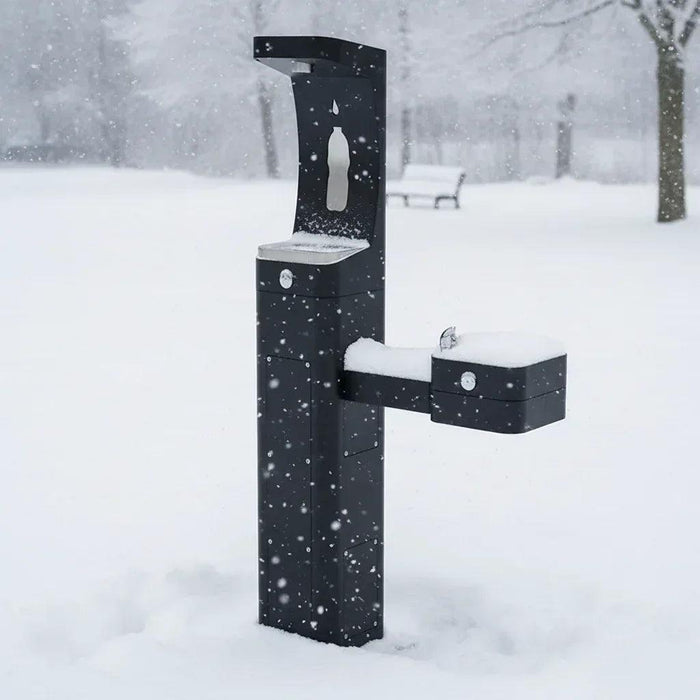
This is where Haws often separates itself from lower-cost outdoor options. If your project is in a region with winter exposure, a freeze-resistant outdoor fountain is not a premium extra. It is basic risk management.
Haws offers freeze-resistant models designed to protect the water line and valve components in colder conditions. For municipalities, school districts, and facility managers in four-season climates, that can prevent expensive seasonal damage and reduce shutdowns. A fountain that works through colder months, or at least survives them with less maintenance, is worth more than a cheaper unit that cracks or fails after a freeze event.
Even so, freeze resistance has limits. Climate severity, proper drainage, shutoff procedures, and installation quality all influence performance. In milder climates, you may not need a frost-protected model, and paying for that feature may not deliver much return. In colder states, skipping it can be a false economy.
Maintenance and long-term ownership
From a procurement standpoint, Haws usually makes sense when you look past first cost. These fountains are generally positioned as long-life assets for public use, and that changes how they should be evaluated.
Maintenance teams tend to care about three things: how often the fountain needs attention, how easy it is to service, and whether replacement parts remain available. Haws performs reasonably well on that front, particularly because it is an established commercial manufacturer with a known presence in institutional settings. That matters when a facility is trying to keep standardized equipment running across multiple sites.
The trade-off is that upfront cost can be higher than with generic outdoor drinking fountains. For some buyers, especially on small private projects or low-use sites, the premium may be hard to justify. But on high-traffic public installations, lower maintenance burden and better service life often make the total cost picture more favorable.
Best-fit applications for Haws outdoor fountains
Haws is usually a strong fit for public and semi-public projects where durability, compliance, and weather performance matter more than decorative styling. That includes school campuses, park systems, recreation facilities, municipal buildings, trailheads, athletic fields, zoos, and commercial properties with regular pedestrian traffic.
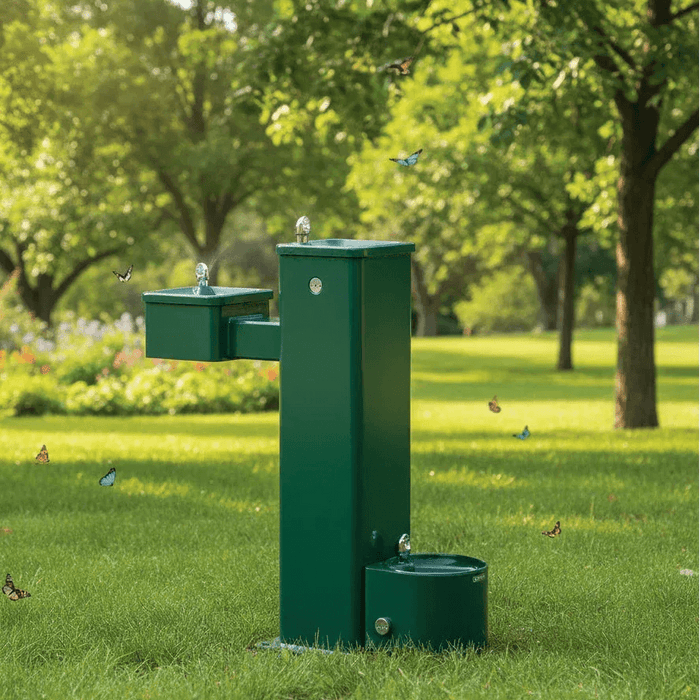
It is also a good option for buyers who need specialized configurations rather than a one-size-fits-all fountain. If your project needs a pedestal unit, a barrier-free setup, a pet-friendly combination, or cold-weather performance, Haws gives you more room to match the product to the application.
Where Haws can be less compelling is on light-duty private use where traffic is low and the site does not justify commercial-grade cost. A home project, small HOA common area, or low-use garden setting may not need this level of fixture. In those cases, the right answer depends on how much abuse, exposure, and maintenance risk you actually expect.
Haws outdoor drinking fountain review by buying criteria
If you are comparing options across manufacturers, Haws generally rates well in five areas: brand credibility, outdoor durability, ADA/barrier-free availability, freeze-resistant options, and suitability for institutional procurement. Those are meaningful strengths for buyers who need a fountain to hold up in public service.
The most common hesitation is price. Haws is not usually the cheapest line on paper, and if your process focuses too narrowly on unit cost, it can look expensive. But for many public buyers, replacement cycles, freight considerations, installation coordination, and maintenance labor matter just as much. That broader view is where Haws tends to make more sense.
Lead time can also influence the decision. Specialized outdoor and freeze-resistant models are not always impulse-purchase items. If you are buying for a spring park opening, a summer school project, or a municipal capital schedule, it pays to source early and confirm availability before the season gets crowded.
Is Haws the right choice for your project?
For many schools, parks, and public facilities, yes. Haws is a credible choice when the project calls for a commercial outdoor drinking fountain with real attention to durability, accessibility, and climate performance. It is especially well suited to buyers who want fewer compromises and who understand that outdoor public-use fixtures need to be specified, not guessed at.
The right answer still depends on the site. If the fountain will sit in a vandal-prone area, freeze resistance and tamper-resistant design should move to the top of the list. If the project is ADA-driven, the installation layout matters as much as the fountain model. If the budget is tight, you need to compare first cost against service life, downtime risk, and maintenance exposure.
For buyers who want help narrowing those trade-offs, working with a specialized hydration supplier can save time and expensive missteps. A source like The Fountain Direct can help match Haws configurations to climate, traffic, and compliance requirements instead of forcing a generic catalog choice.
A good Haws outdoor fountain should disappear into daily use - reliable, accessible, and tough enough that nobody thinks about it until they need a drink. That is where Haws tends to perform best.


