

Commercial Bottle Filler Buying Guide
Use this commercial bottle filler buying guide to choose the right unit for schools, offices, parks, and public buildings at the best price.

If you are comparing units right now, this commercial bottle filler buying guide is built for the actual purchase decision - not for browsing. The right model depends on where it will be installed, who will use it, what code requirements apply, and how much abuse it needs to handle. Get those four factors right, and the rest of the decision gets much easier.
Most buyers do not need more options. They need fewer bad options. A school facilities team has different priorities than a park department. A GC working off approved plans has different constraints than an office manager replacing an outdated fountain. The fastest way to buy the right bottle filling station is to narrow the field by application first, then by installation style, then by brand and feature set.
How to use this commercial bottle filler buying guide
Start with the location. Indoor and outdoor bottle fillers are not interchangeable, and trying to force a low-cost indoor model into a harsh environment usually costs more later. Indoor units are typically chosen for schools, offices, healthcare buildings, gyms, and municipal interiors. Outdoor units need to account for weather exposure, freeze risk, vandal resistance, and mounting conditions.
Next, look at whether you need a complete bottle filling station or a bottle filler added to a compatible drinking fountain. This matters more than many buyers expect. Some projects call for an all-in-one bi-level or single-station unit. Others are straightforward retrofits where a matching bottle filler module can save money and simplify replacement. If you are replacing an existing fountain from the same brand family, retrofit options may be the cleaner buy.
Then confirm compliance needs. In commercial and institutional settings, ADA configuration, barrier-free access, and local code expectations are not optional details. They shape the product category from the beginning. If the unit will serve a school, government facility, transportation setting, or public-facing building, this should be settled before comparing finish, filtration, or aesthetics.
Indoor vs outdoor bottle filling stations
Indoor models usually win on feature depth. This is where you see the strongest mix of filtered options, refrigerated models, sensor activation, and sleek wall-mounted designs. For schools and office buildings, filtered and refrigerated bottle fillers are often the most requested combination because they improve user satisfaction and reduce complaints tied to taste or temperature.
Outdoor models are a different buying conversation. Here, durability usually outranks appearance. You need weather-tolerant construction, tamper-resistant hardware, and in colder regions, freeze-resistant or frost-proof design if the unit will remain in service through winter. Parks, recreation facilities, campuses, and public spaces also tend to favor heavier-duty construction from brands known for commercial outdoor performance.
If the site is exposed and unsupervised, pay close attention to material and body style. Powder-coated finishes may look sharp, but stainless steel or purpose-built outdoor commercial housings can be the better long-term value in vandal-prone areas. A lower purchase price means very little if the fixture becomes a service problem six months after turnover.
Wall-mounted, recessed, or freestanding
Wall-mounted bottle fillers are the most common choice for indoor projects because they save floor space and fit cleanly into schools, offices, and healthcare corridors. They are often the easiest path when replacing an older wall-hung fountain. If you have an existing rough-in and are trying to keep labor predictable, this style usually deserves the first look.
Recessed units make sense when corridor clearance matters or when the designer wants a cleaner profile. These are common in education and healthcare settings where traffic flow is a real concern. The trade-off is that recessed products may limit your model choices and can create more planning pressure if the wall condition is not ideal.
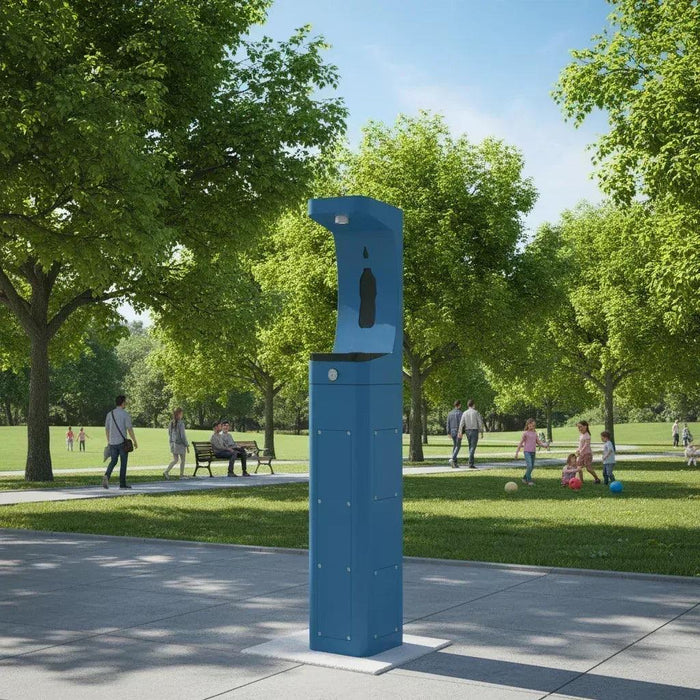
Freestanding bottle filling stations fit best where wall conditions are limited or where the unit needs to serve open areas, outdoor settings, athletic spaces, or high-traffic common zones. They can be an excellent answer for campuses, parks, and large public sites, but they require more attention to placement, exposure, and service access.

Which features are worth paying for
Not every feature earns its keep. Buyers on fixed budgets should focus on the features that matter to the actual use case.
Filtration is usually worth the upcharge in schools, offices, and healthcare-adjacent spaces where taste and user confidence matter. It is less compelling in some industrial or utility environments where buyers simply need a dependable fill point. Refrigeration can be a strong value in indoor employee-facing settings, but it adds cost and complexity. For many public and institutional projects, a non-refrigerated filtered unit is the better middle ground.
Sensor activation is now common, and in many facilities it is the preferred standard. It improves usability and gives the fixture a more current look. That said, some buyers in rough public environments still prefer simpler controls if long-term serviceability is the top concern.
Bottle counters are popular, especially in schools and public buildings, but they are not a buying priority on every project. If the budget is tight, put your money into build quality, compliance, and the right mounting style first.
Antimicrobial protection, laminar flow, and specialty finishes can all make sense, but only when they fit the environment and spec. If they do not solve a real purchasing concern, they are easy places to trim cost.
Best brand fit by application
Brand matters because commercial bottle fillers are not all built for the same duty cycle. Elkay and Halsey Taylor are frequent first choices for schools, offices, and broad commercial use because they offer strong coverage across filtered, refrigerated, ADA, and retrofit-friendly configurations. If you need a proven mainstream institutional option with broad recognition, they are often where buyers start.
Haws is a strong fit when the project leans more heavily toward public-use durability, outdoor capability, or specialized commercial applications. Willoughby tends to enter the conversation when vandal resistance, behavioral healthcare considerations, or correctional-grade durability become more important than appearance. Stern Williams and similar commercial-grade lines can be the right answer when buyers want straightforward, durable fixtures without paying for features they do not need.
The point is not that one brand is always better. It depends on the environment, spec language, and budget tolerance. A school renovation and a city park project should not be shopping the same way.
Common buying mistakes that cost time and money
The biggest mistake is buying by price alone. Commercial buyers usually pay for that later in freight damage claims, compatibility issues, missing compliance details, or a unit that simply is not suited for the environment.
Another common problem is underestimating lead times. If your project has a turnover date, purchasing too late can force you into a backup model that is not your first choice. Seasonal demand also matters, especially for schools trying to complete work before a new term and for outdoor projects trying to beat weather windows.
Buyers also get tripped up by assuming all bottle fillers are plug-and-play replacements. They are not. Even within trusted brands, not every unit matches every existing fountain, rough-in, or use case. That is why buying from a specialist matters.

Where buyers usually land
For a K-12 school or university interior, the safest choice is usually an ADA-compliant wall-mounted bottle filling station with filtration, with refrigeration added if budget allows. For offices and corporate spaces, appearance and user experience often matter more, so filtered and refrigerated units tend to rise to the top.
For parks, recreation areas, and public exterior projects, freestanding or heavy-duty outdoor units with vandal-resistant construction are usually the smarter long-term buy. In colder climates, freeze-resistant design should be evaluated early, not after the order is placed. For replacement projects, a retrofit-compatible bottle filler paired with an existing fountain can be the best value if compatibility is confirmed upfront.
That is where a specialist retailer gives you a real advantage. You are not sorting through unrelated plumbing inventory or guessing your way through general catalog listings. You are buying from a source that focuses on commercial drinking fountains, bottle fillers, and institutional fixtures every day.
Trusted by 800+ customers, The Fountain Direct helps buyers narrow the right product fast, with Lowest Price Guaranteed, free freight shipping, no sales tax, a 30-day return policy, and full manufacturer warranty coverage. If you are ready to buy, the best next move is simple - match the unit to the environment, confirm the feature set you actually need, and buy from a specialist who can get the price and the product right the first time.