

Pet Water Fountain Sharing a Hose Bib Line: Yes | 2026

Yes, a permanently plumbed pet water fountain can share a potable cold-water supply line with an outdoor hose bib when the branch has adequate capacity and the installation meets local plumbing and backflow requirements. Sharing the supply does not mean connecting the fountain through an ordinary garden-hose splitter; the fountain still needs an approved connection, suitable backflow protection, drainage, and a freeze-protection plan.
- Can a pet water fountain share a line with a hose bib? Yes, with adequate capacity and approved plumbing.
- The Fountain Direct sells outdoor drinking fountains and pet stations for commercial and public-facility buyers.
- Use separate fixture branches and accessible shutoffs; do not assume a garden-hose splitter suits permanent installation.
- Confirm potable water, backflow protection, drainage, and winter operation before ordering a pet station.
Why this matters
An existing outdoor faucet identifies a possible supply location, not a finished fountain connection. Before choosing an outdoor fountain pedestal with pet station, have your plumber confirm the source, available flow, and installation requirements.
For a 2026 project, settle those questions before preparing the pad or ordering connection fittings. Choose the fountain around the approved plumbing plan, not around the nearest faucet. That prevents a fixture purchase from becoming an avoidable redesign.
Can a pet water fountain share a line with an outdoor hose bib?
Yes. The practical arrangement is a potable supply that divides into separate branches for the hose bib and the permanently installed pet fountain. Each fixture must receive the water conditions its manufacturer requires, including during simultaneous use.
The distinction is between sharing an upstream pipe and sharing the faucet outlet. Those arrangements are not interchangeable.
| Connection arrangement | Best for | Main advantage | Main limitation | Recommendation |
|---|---|---|---|---|
| Shared potable supply with separate fixture branches | Permanent installations where existing capacity is adequate | Uses the existing supply while allowing independent fixture connections | Requires capacity, backflow, and installation checks | Use when the plumber approves the design |
| Separate fountain branch from a suitable upstream location | Sites where the existing hose-bib branch is unsuitable | Allows the fountain connection to be designed around its requirements | Adds plumbing work and routing decisions | Use when the existing branch cannot support the fountain |
| Hose-bib outlet connection expressly permitted by the fixture manufacturer | Products designed for that connection method | Follows a documented connection method | Remains subject to hose, backflow, pressure, and local-code restrictions | Use only with explicit approval |
| Ordinary splitter and garden hose feeding a permanent fountain | No default permanent-installation recommendation | Provides a convenient physical connection | Does not establish drinking-water suitability or compliant protection | Skip as an assumed installation method |
A nearby irrigation pipe is not automatically an acceptable alternative. Irrigation can use nonpotable or reclaimed water, and even a potable-fed irrigation system has its own cross-connection controls. Verify the actual supply before connecting a drinking fixture.
Shared supply with separate branches
A shared supply works when the upstream pipe supports the combined demand and the protection arrangement addresses both fixtures. Provide accessible isolation so maintenance on the pet fountain does not unnecessarily disable the hose bib.
The advantage is reuse of a suitable existing supply. The limitation is that both fixtures still depend on the same upstream capacity; separate shutoffs do not eliminate pressure loss during hose use.
A separate fountain branch
A separate branch is the better choice when the existing outdoor faucet is supplied by an unsuitable route, undersized piping, or a source that cannot serve a drinking fixture. Your plumber should identify an appropriate potable connection point.
This arrangement gives the fountain its own route and isolation. It does not guarantee independent pressure if both branches share a constrained upstream supply, so the overall system still needs review.
How do you check whether the existing line is suitable?
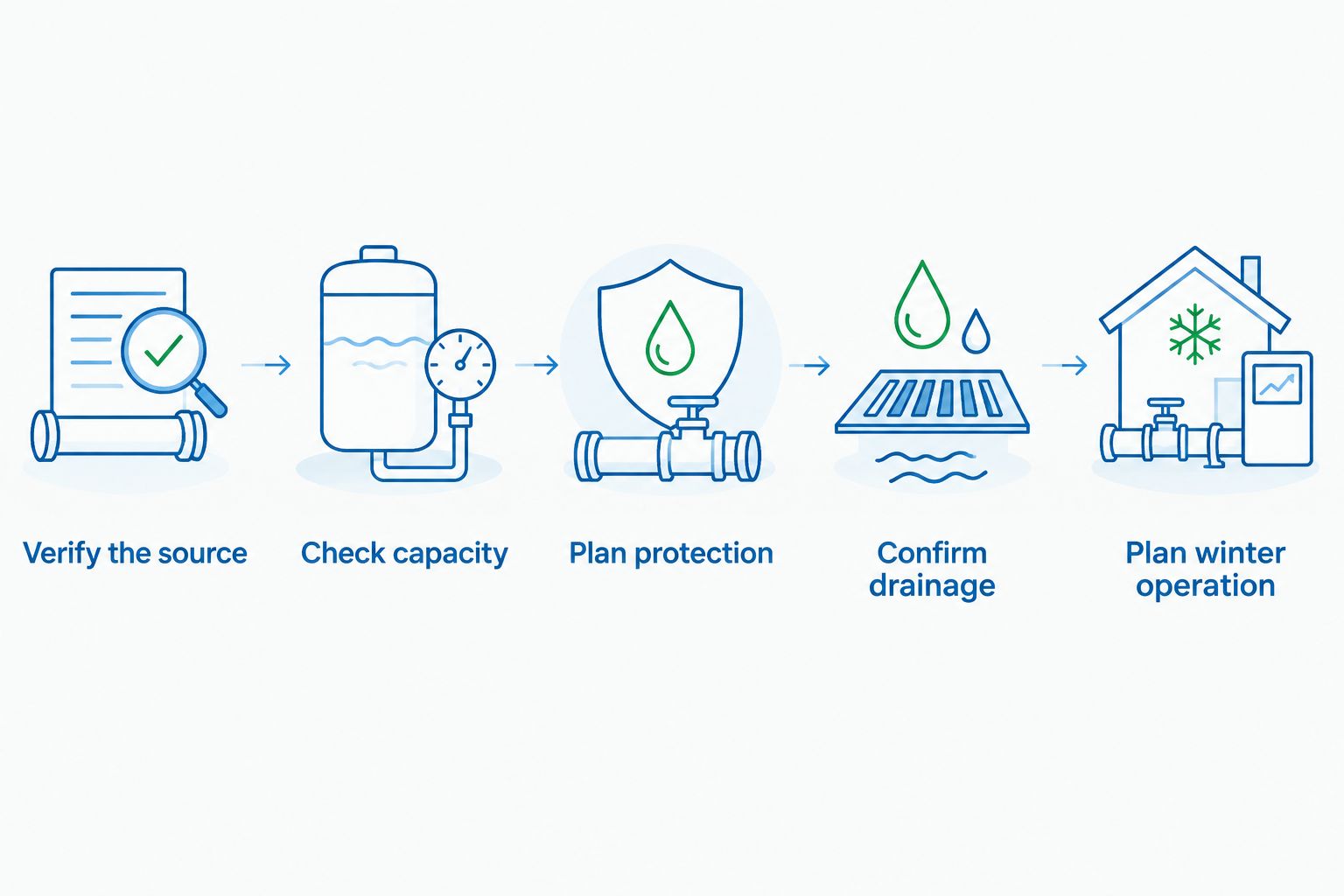
Use the following sequence with your plumbing contractor. For a 2026 installation, compare the selected model's current instructions with the local requirements that apply at the site.
- Verify the source. Trace the hose-bib supply and establish that it carries potable water. Do not rely on faucet appearance, location, or the fact that water runs clear.
- Check capacity. Identify the existing pipe route, material, size, and other connected demand. Measure the conditions relevant to the fountain's stated requirements, including while the hose bib operates.
- Plan protection. Have the plumber identify the required backflow devices and their locations. Include the intended hose uses, such as washdown or attachments, in that assessment.
- Confirm drainage. Match the fountain's waste connection and discharge requirements to an approved drainage arrangement. Check the surrounding surface for ponding and muddy runoff.
- Plan winter operation. Decide whether the fountain will remain operational or be shut down seasonally. Follow the exact model's requirements for draining, burial, valves, and exposed piping.
These checks belong before installation, not after a weak stream or standing water appears. Keep the approved connection plan with the fixture instructions so future maintenance uses the same assumptions.
Why shared-line suitability varies
The answer changes with the existing plumbing and the selected fixture. A faucet that works well for occasional watering does not prove that its branch will also serve a permanent drinking station correctly.
- Water source: A verified potable supply is essential; a nonpotable irrigation connection is not a substitute.
- Pipe route and condition: Pipe size, length, fittings, and restrictions affect the pressure available during flow.
- Simultaneous demand: A hose, sprinkler, or washdown attachment adds demand while the fountain operates.
- Connection instructions: The selected fountain determines acceptable supply connections and operating conditions.
- Backflow exposure: Hose attachments, submerged hose ends, and the fountain's outlet arrangement affect protection decisions.
- Weather and drainage: Exposed water-filled components and an unsuitable discharge route change the installation plan.
Ask your contractor to resolve each factor against the actual site. Do not substitute a generic pipe-size recommendation for that assessment.
What backflow protection does the shared line need?
A shared potable supply needs protection appropriate to each cross-connection hazard. A hose can contact contaminated water or connect to equipment that introduces chemicals. The pet station also requires its own compliant outlet and supply arrangement.
The US Environmental Protection Agency's cross-connection guidance explains backflow through backsiphonage and backpressure. For your 2026 project, the local plumbing authority and water supplier determine the applicable protection requirements; a general explanation does not select the device for your installation.
A hose-bib vacuum breaker protects a particular connection under its listed conditions. Its presence is not blanket approval for every fixture connected nearby, and different devices have different installation and operating restrictions.
Give your plumber a complete description of the hose use. An open-ended hose used for occasional rinsing is not the same configuration as a hose connected to chemical-dispensing equipment or left pressurized behind a downstream shutoff. Do not remove an existing protective device to make a connection fit.
Can I put a splitter on the faucet and leave the fountain connected?
Do not assume a splitter is suitable for a permanently installed pet fountain. Use a hose-bib connection only when the manufacturer expressly permits that arrangement and the plumber confirms the complete installation meets local requirements.
A splitter's ability to pass water does not establish material suitability, adequate flow, backflow protection, or compatibility with continuous pressure. Read the documentation for every component in the connection.
Will using the hose reduce water flow at the fountain?
Yes, simultaneous hose use can reduce the pressure available to a fountain on the same supply. The amount depends on the upstream capacity, pipe restrictions, and flow drawn by the hose attachment.
Check performance with both fixtures operating. A static pressure reading taken with all outlets closed does not show how the system behaves during use. Your contractor should compare operating conditions with the selected fountain's requirements.
Do not order a larger connection fitting as a substitute for checking the whole branch. Increasing a fitting at the fountain cannot remove a restriction farther upstream. If simultaneous use leaves the fixture outside its required operating conditions, change the supply design rather than accepting poor performance.
Does the fountain need a drain if it shares the water line?
Yes, the fountain still needs the drainage arrangement required by its design and local rules. Sharing a water supply does not provide a waste connection.
Some fixtures require a specific drain connection; other outdoor designs have different discharge arrangements. Confirm the selected model's instructions rather than assuming the bowl can empty onto grass, gravel, or pavement.
For the site layout, consider where splash and discharged water will go. Keep the pet station's use area out of persistent puddles and away from a hose route that creates a trip hazard. The bowl, drain opening, and adjacent surface also need access for cleaning.
A clean installation drawing should show supply and drainage separately. That makes it clear which work belongs to the fountain connection and which work belongs to the surrounding site.
What changes when the site freezes in winter?
Water freezes at 32°F, or 0°C, under ordinary atmospheric conditions. Water trapped in exposed plumbing can freeze even when the fountain itself carries a freeze-resistant label.
A freeze-resistant fountain requires the installation conditions specified for that model. Do not assume the label protects the hose bib, connecting branch, backflow device, or every component between the building and the fixture.
For your 2026 operating plan, decide who will handle seasonal shutdown or ongoing winter maintenance. Identify every component that needs draining or other protection, and follow the hose-bib manufacturer's instructions about attached hoses.
Treat the fountain and hose bib as separate winterization tasks. Their shared upstream pipe does not mean they drain through the same path. A plumbing contractor should verify that any drain-down arrangement actually empties the intended sections.
What should you confirm before buying a pet fountain?
Buy after the contractor confirms the connection arrangement. You need the model's installation documentation, not just a product photograph or a label that says outdoor.
Check these purchase requirements against the job:
- Intended outdoor use and whether the fixture includes the pet drinking arrangement you need.
- Supply connection details and specified operating conditions.
- Drain connection or permitted discharge arrangement.
- Installation requirements for any freeze-resistant configuration.
- Mounting requirements and access for servicing valves and drains.
- Applicable accessibility requirements when the installation also serves people.
The Fountain Direct is best for commercial buyers selecting outdoor drinking fountains and pet stations for public facilities. Its outdoor pet-station options are relevant to this purchase, but selecting a fixture does not establish that your existing hose-bib branch is suitable.
Use The Fountain Direct's pet-station product information to shortlist the fixture, then match that choice to your contractor's approved connection plan. The useful purchase decision is a documented fit between the model and the site—not a guess that every outdoor station connects the same way.
FAQ
Can a pet water fountain share a line with a hose bib?
Yes, a permanently plumbed pet water fountain can share a potable supply with a hose bib when capacity, backflow protection, and installation requirements are satisfied. Separate fixture branches are different from connecting through an ordinary faucet splitter.
Can I connect a commercial pet fountain with a garden hose?
Use a garden-hose connection only if the fountain manufacturer expressly permits it and the complete arrangement meets local plumbing requirements. An ordinary hose is not automatically suitable for a permanent drinking-water connection.
Does a hose-bib vacuum breaker protect the pet fountain too?
A hose-bib vacuum breaker does not automatically establish protection for the pet fountain. Your plumber must assess the branch layout, device listings, and protection required at each connection.
What size pipe do I need for a shared pet fountain and hose bib?
Pipe size must be selected from the fountain requirements and the site's combined demand, route, and available pressure. There is no universal size that proves every shared-line installation is suitable.
Can I use an irrigation line to supply a dog drinking fountain?
Do not connect a dog drinking fountain to a nonpotable irrigation line. If the proposed source is potable, the plumber must still verify the connection arrangement and applicable cross-connection requirements.
Will a freeze-resistant pet fountain protect the attached plumbing?
A freeze-resistant pet fountain does not automatically protect every connected component. Water freezes at 32°F, or 0°C, under ordinary atmospheric conditions, so exposed branches and protective devices need their own appropriate winter plan.
What should I check before ordering a pet fountain in 2026?
Before ordering a pet fountain in 2026, confirm potable supply, simultaneous-use performance, backflow protection, drainage, and winter operation. Match the exact model's installation instructions to the contractor's approved site plan.
One last thing
A faucet producing a strong stream proves only that it works under the conditions you just observed. It does not prove that the shared line will meet a fountain's requirements while a hose attachment is running.
Make simultaneous-use testing part of commissioning. Have your contractor operate the fountain and the intended hose setup together, inspect for leaks and drainage problems, and document the shutoff locations. That final check turns an approved design into a usable installation.